Machine learning prediction of energy band gaps in curcumin derivatives
DOI:
https://doi.org/10.55713/jmmm.v37i1.2581Keywords:
Machine learning, curcumin derivatives, Molecular fingerprints, Organic photovoltaicsAbstract
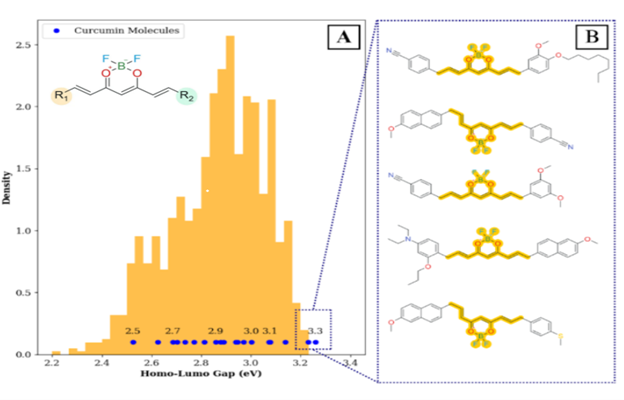
Machine learning (ML) regression models using SMILES-encoded molecular fingerprints were developed to predict the band gaps of 19 synthesized curcumin derivatives. The goal was to develop a ML-based framework capable of estimating the band-gap values prior to synthesis, thereby guiding chemists in their experimental effort. Training data for the model were obtained from the Harvard Clean Energy Project (HOPV-15), restricted to 52,000 non-fullerene acceptor (NFA) organic molecules with density functional theory (DFT)-calculated band gaps. Multiple fingerprinting schemes, including Morgan fingerprints, MACCS keys, atom-pairs, and FCFP, were used to train a pool of regression models. These models were then applied to the 19 curcumin derivatives for band-gap prediction and compared to DFT simulation calculations. The accuracy of the predictions was enhanced by using the Most Common Substructure (MCS) approach, narrowing it to molecules sharing key curcumin motifs. This refinement reduced the average predictive error by 30% compared with using the full HOPV-15 dataset, highlighting the benefit of targeted feature selection. Finally, the model was applied to virtually generate and evaluate 1,225 unsynthesized curcumin derivatives by permuting side groups on the BF2-curcuminoid backbone, identifying ten candidates with predicted band gaps above 3.2 eV, which were selected as a proof-of-concept case study to demonstrate the capability of the proposed machine learning framework for targeted virtual screening. This workflow demonstrates how ML-guided screening can uncover promising curcumin-based chromophores prior to synthesis, reducing experimental costs while providing chemical insights into structure–property relationships.
Downloads
References
B. Zhang, M. Jiang, P. Mao, S. Wang, R. Gui, Y. Wang, H. Y. Woo, H. Yin, J.-L. Wang, and Q. An, “Manipulating alkyl inner side chain of acceptor for efficient as-cast organic solar cells,” Advanced Materials, vol. 36, no. 36, p. 2405718, 2024. DOI: https://doi.org/10.1002/adma.202405718
G. Sharma, S. K. Saini, K. Mulchandani, A. Bheemaraju, and C. Lal, “Investigation of ultrafast carrier dynamics in curcumin dye for environment friendly dye-sensitized solar cell,” Environmental Science and Pollution Research, vol. 30, pp. 121175–121181, 2023. DOI: https://doi.org/10.1007/s11356-023-30668-5
Y. Liu, H. Yang, Y. Wu, H. Fan, X. Li, K. Hu, C. Cui, and Y. Li, “Simultaneous improvement in efficiency and photostability of organic solar cells by modifying the ZnO electron-transport layer with curcumin,” Journal of Materials Chemistry C, vol. 11, no. 38, pp. 13010–13017, 2023. DOI: https://doi.org/10.1039/D3TC02060F
X. Zarate, I. González P, S. Caramori, E. Benazzi, T. Barra, L. Arrue, Y.-n. Wu, C. Diaz-Uribe, W. Vallejo, and E. Schott, “Experimental and DFT study of natural curcumin derived dyes as n-type sensitizers,” Solar Energy, vol. 225, pp. 305–315. 2021. DOI: https://doi.org/10.1016/j.solener.2021.06.051
C. Tonnelé, M. Catherin, M. Giorgi, G. Canard, D. Casanova, F. Castet, E. Zaborova, and F. Fages, “Optoelectronic properties of a self-assembling rigidly-linked BF2-curcuminoid bi-chromophore,” Dyes and Pigments, vol. 207, p. 110677, 2022. DOI: https://doi.org/10.1016/j.dyepig.2022.110677
S. Zhong, W. Hsu, H. Chen, T. Yang, J. Yi, C. Zhu, S. Yin, Z. Li, L. Gao, J. Lin, L. Ying, and N. Li, “A simple and promising prediction model to analyze the optical properties of organic photovoltaic materials,” Solar RRL, vol. 8, no. 12, p. 2400288, 2024. DOI: https://doi.org/10.1002/solr.202400288
N. Meftahi, M. Klymenko, A. J. Christofferson, U. Bach, D. A. Winkler, and S. P. Russo, “Machine learning property prediction for organic photovoltaic devices,” NPJ Computation Materials, vol. 6, no. 166, 2020. DOI: https://doi.org/10.1038/s41524-020-00429-w
G. H. Kim, K. Yoon, C. Lee, M. Nam, and D.-H. Ko, “Molecular structural descriptor-assisted machine learning for organic photo-voltaics with perylenediimide acceptors,” Bulletin of the Korean Chemical Society, vol. 45, no. 2, pp. 125–130, 2023. DOI: https://doi.org/10.1002/bkcs.12810
P. Gao, D. Kochan, Y.-H. Tang, X. Yang, and E. G. Saldanha “Machine learning for the redox potential prediction of molecules in organic redox flow battery,” Journal of Power Sources, vol. 629, p. 236035, 2025. DOI: https://doi.org/10.1016/j.jpowsour.2024.236035
W. Chen, Y. Fu, and P. Stinis, “Physics-informed machine learning of redox flow battery based on a two-dimensional unit cell model, Journal of Power Sources, vol. 584, p. 233548, 2023. DOI: https://doi.org/10.1016/j.jpowsour.2023.233548
L. Zhu, M. Huang, G. Han, Z. Wei, and Y. Yi, “The key descriptors for predicting the exciton binding energy of organic photovoltaic materials,” Angewandte Chemie International Edition, vol. 64, no. 1, p. e202413913, 2024.
K. Khoussa, P. Leveque, and L. Boubchir, “On the use of machine learning to discover novel donor-acceptor pairs for organic photovoltaic devices,” in 2024 IEEE International Conference on Big Data, Institute of Electrical and Electronics Engineers Inc, 2024, p. 4659–4662. DOI: https://doi.org/10.1109/BigData62323.2024.10825948
W. Sun, Y. Zheng, K. Yang, Q. Zhang, A. A. Shah, Z. Wu, Y. Sun, L. Feng, D. Chen, Z. Xiao, S. Lu, Y. Li, and K. Sun, “Machine learning-assisted molecular design and efficiency prediction for high-performance organic photovoltaic materials,” Science Advances, vol. 5, no. 11, p. eaay4275, 2019. DOI: https://doi.org/10.1126/sciadv.aay4275
L. Zhu, M. Huang, G. Han, Z. Wei, and Y. Yi, “The Key descriptors for predicting the exciton binding energy of organic photovoltaic materials,” Angewandte Chemie International Edition, vol. 64, no. 1, p. e202413913, 2024. DOI: https://doi.org/10.1002/anie.202413913
W. J. M. Kort-Kamp, C. L. Vecchio, D. Sebastián, X. Lyu, P. Atanassov, P. Zelenay, V. Baglio, and A. Serov, “Machine learning-guided design of direct methanol fuel cells with a platinum group metal-free cathode,” Journal of Power Sources, vol. 626, p. 235758, 2025. DOI: https://doi.org/10.1016/j.jpowsour.2024.235758
B. Das, and A. Mondal, “Predictive modeling and design of organic solar cells: A data-driven approach for material innovation,” ACS Applied Energy Materials, vol. 7, no. 20, pp. 9349–9363, 2024. DOI: https://doi.org/10.1021/acsaem.4c01847
R. Khatua, B. Das, and A. Mondal, “Physics-informed machine learning with data-driven equations for predicting organic solar cell performance, ACS Applied Materials & Interfaces, vol. 16, no. 42, pp. 57467‒57480, 2024. DOI: https://doi.org/10.1021/acsami.4c10868
S. A. Lopez, B. Sanchez-Lengeling, J. de G. Soares, and A. Aspuru-Guzik, “Design principles and top non-fullerene acceptor candidates for organic photovoltaics,” Joule, vol. 1, no. 4, pp. 857–870, 2017. DOI: https://doi.org/10.1016/j.joule.2017.10.006
S. Zhong, and Guan X. “Count-based morgan fingerprint: A more efficient and interpretable molecular representation in developing machine learning-based predictive regression models for water contaminants’ activities and properties,” Environmental Science & Technology, vol. 57, no. 46, pp. 18193–18202, 2023. DOI: https://doi.org/10.1021/acs.est.3c02198
M. C. Hutter, “Differential multimolecule fingerprint for similarity search─making use of active and inactive compound sets in virtual screening,” Journal of Chemical Information and Modeling, vol. 62, no. 11, pp. 2726–2736, 2022. DOI: https://doi.org/10.1021/acs.jcim.2c00242
U. V. Ucak, I. Ashyrmamatov, and J. Lee, “Reconstruction of lossless molecular representations from fingerprints,” Journal of Cheminformatics, vol. 15, p. 26, 2023. DOI: https://doi.org/10.1186/s13321-023-00693-0
D. Bajusz, A. Rácz, and K. Héberger, “Why is Tanimoto index an appropriate choice for fingerprint-based similarity calculations?,” Journal of Cheminformatics, vol. 7, p. 20, 2015. DOI: https://doi.org/10.1186/s13321-015-0069-3
F. Neese, “The ORCA program system,” WIREs Computational Molecular Science, vol. 2, no. 1, pp. 73–78, 2012. DOI: https://doi.org/10.1002/wcms.81
F. Weigend, and R. Ahlrichs, “Balanced basis sets of split valence, triple zeta valence and quadruple zeta valence quality for H to Rn: Design and assessment of accuracy,” Physical Chemistry Chemical Physics, vol. 7, no. 18, pp. 3297‒3305, 2005. DOI: https://doi.org/10.1039/b508541a
C. Lee, W. Yang, R. G. Parr, "Development of the Colle-Salvetti correlation-energy formula into a functional of the electron density," Physical Review B, vol. 37, pp. 785‒789, 1988. DOI: https://doi.org/10.1103/PhysRevB.37.785
A. D. Becke, "Density-functional thermochemistry. III. The role of exact exchange." The Journal of Chemical Physics, vol. 98, pp. 5648‒5652, 1993. DOI: https://doi.org/10.1063/1.464913
Downloads
Published
How to Cite
Issue
Section
License
Copyright (c) 2026 Journal of Metals, Materials and Minerals

This work is licensed under a Creative Commons Attribution-NonCommercial-NoDerivatives 4.0 International License.
Authors who publish in this journal agree to the following terms:
- Authors retain copyright and grant the journal right of first publication with the work simultaneously licensed under a Creative Commons Attribution License that allows others to share the work with an acknowledgment of the work's authorship and initial publication in this journal.
- Authors are able to enter into separate, additional contractual arrangements for the non-exclusive distribution of the journal's published version of the work (e.g., post it to an institutional repository or publish it in a book), with an acknowledgment of its initial publication in this journal.