Strategic optimization of plasticizers, fillers, and blend ratios for enhanced performance of dynamically cured epoxidized natural rubber (ENR)/polypropylene (PP) thermoplastic vulcanizates
DOI:
https://doi.org/10.55713/jmmm.v36i2.2362Keywords:
Epoxidized natural rubber (ENR), Thermoplastic vulcanizates (TPVs), plasticizer, carbon black, silica, polypropyleneAbstract
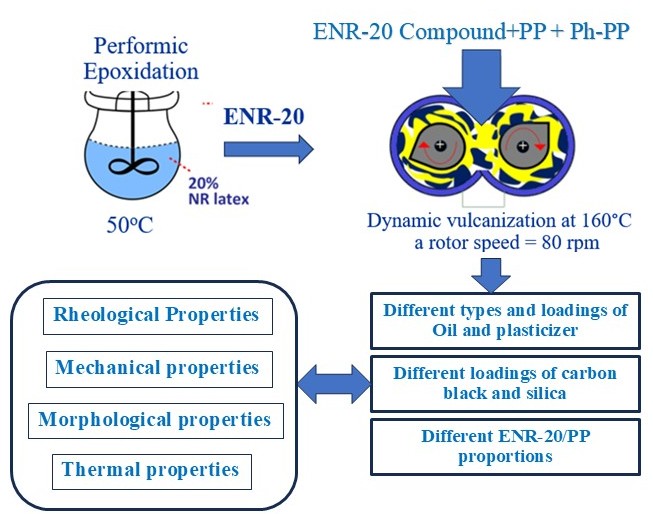
This study introduces an innovative methodology for optimizing oil, plasticizer, filler, and blend proportions in epoxidized natural rubber with 20 mol% epoxide (ENR-20) and polypropylene (PP) thermoplastic vulcanizates (TPVs), aiming to achieve superior rheological, mechanical, morphological, and thermal performance. By leveraging paraffinic oil, epoxidized soybean oil, and phthalate-based plasticizers, the research investigates their influence on tensile strength, elasticity, and processability. Among the oils and plasticizers evaluated, paraffinic oil demonstrated the most effective plasticizing performance, offering superior flexibility and elasticity. Various paraffinic oil loadings (15 phr, 25 phr, 30 phr, 35 phr, 40 phr, 45 phr, 50 phr, and 75 phr) were investigated in the 60/40 ENR-20/PP blend, with 30 phr identified as the optimum level. This formulation yielded the highest elongation at break (~410%) and a reduced tension set of less than 50%. The study also evaluates the role of carbon black and silica fillers, investigated at loadings of 10 phr, 20 phr, 30 phr, 40 phr, and 50 phr in the 60/40 ENR-20/PP blend, focusing on their reinforcement effects and contributions to thermal stability. Carbon black at 30 phr exhibited effective reinforcement, yielding tensile strength values above 7.0 MPa and elongation at break of up to 380%. Variations in ENR-20/PP blend ratios (40/60, 50/50, 60/40) demonstrate a clear pathway for optimizing phase morphology and mechanical performance. Advanced techniques such as differential scanning calorimetry (DSC) and scanning electron microscopy (SEM) reveal critical correlations between crystallinity, glass transition behavior, and morphological features with processing parameters. These results underscore the strategic importance of tailored additive selection and precise blending methodologies, offering a roadmap to advance TPV materials for industrial applications that demand durability, flexibility, and cost-effectiveness.
Downloads
References
G. Urtekin, M. S. Ullah, R. Yildirim, G. Ozkoc, and M. Kodal,
“A comprehensive review of the recent developments in thermo-plastics and rubber blends-based composites and nanocomposites,”
Polymer Composites, vol. 44, no. 12, pp. 8303‒8329, 2023. DOI: https://doi.org/10.1002/pc.27712
S. Patermann, and V. Altstädt, “Influence of different crosslinking systems on the mechanical and morphological properties of thermoplastic vulcanizates,” AIP Conference Proceedings, vol. 1664, no. 1, p. 120002, 2015. DOI: https://doi.org/10.1063/1.4918492
C. L. Hel, V. Bounor-Legaré, M. Catherin, A. Lucas, A. Thèvenon, and P. Cassagnau “TPV: A new insight on the rubber morphology and mechanic/elastic properties,” Polymers, vol. 12, no. 10, p. 2315, 2020. DOI: https://doi.org/10.3390/polym12102315
A. S. Mohite, Y. D. Rajpurkar, and A. P. More, “Bridging the gap between rubbers and plastics: a review on thermoplastic polyolefin elastomers,” Polymer Bulletin, vol. 79, pp. 1309–1343, 2022. DOI: https://doi.org/10.1007/s00289-020-03522-8
A. Jha, B. Dutta, and A. K. Bhowmick, “Effect of fillers and plasticizers on the performance of novel heat and oil-resistant thermoplastic elastomers from nylon-6 and acrylate rubber blends,” Journal of Applied Polymer Science, vol. 74, no. 6, pp. 1490-1501, 1999. DOI: https://doi.org/10.1002/(SICI)1097-4628(19991107)74:6<1490::AID-APP22>3.0.CO;2-U
C. Nakason, M. Narathichat, C. Kummerlöwe, and N. Vennemann, “Thermoplastic natural rubber based on polyamide-12 blended with various types of natural rubber: Effect of processing oils and plasticizer,” Journal of Elastomers & Plastics, vol. 45, no. 1, pp. 47‒75, 2013. DOI: https://doi.org/10.1177/0095244312445522
H. Wu, N. Ning, L. Zhang, H. Tian, Y. Wu, and M. Tian, “Effect of additives on the morphology evolution of EPDM/PP TPVs during dynamic vulcanization in a twin-screw extruder,”
Journal of Polymer Research, vol. 20, p. 266, 2013. DOI: https://doi.org/10.1075/idj.20.3.061lou
C. Lei, X. Huang, and F. Ma, “The distribution coefficient of oil and curing agent in PP/EPDM TPV,” Polymers for Advanced Technologies, vol. 18, no. 12 pp. 999‒1003 2007.
Y. Tsai, J-H Wu, Y.-T Wu, C.-H Li, and M.-T. Leu, “Reinforcement of dynamically vulcanized epdm/pp elastomers using organoclay fillers,” Science and Technology of Advanced Materials, vol. 9, no. 4, p. 045005, 2008 DOI: https://doi.org/10.1088/1468-6996/9/4/045005
S. Li, H. Tian, G.-H Hu, N. Ning, M. Tian, and L. Zhang, “Effects of shear during injection molding on the anisotropic microstructure and properties of EPDM/PP TPV containing rubber nanoparticle agglomerates,” Polymer, vol. 229, p. 124008, 2021. DOI: https://doi.org/10.1016/j.polymer.2021.124008
N. Y. Çakır, Ö. İnan, M. Ergün, M. Kodal, and G. Özkoç, “Unlocking the potential use of reactive POSS as a coagent for EPDM/PP-based TPV,” Polymers, vol. 15 no. 10, p. 2267, 2023. DOI: https://doi.org/10.3390/polym15102267
S. Abdou-Sabet, R. C. Puydak, and C. P. Rader, “Dynamically vulcanized thermoplastic elastomers,” Rubber Chemistry and Technology, vol. 69, no. 3, pp. 476–494, 1996 DOI: https://doi.org/10.5254/1.3538382
Y. An, Y. Ding, J. Tan, and W. Yang, “Influences of polyester plasticizers on the properties of oil resistance flexible poly(vinyl chloride) and powder nitrile butadiene rubber blends,” Advanced Science Letters, vol. 4, no. 3, pp. 875‒879, 2011. DOI: https://doi.org/10.1166/asl.2011.1590
Y. Guo, H. Tian, H. Zhang, G. Xiang, J. Han, N. Ning, and M. Tian, “High heat- and oil-resistant and gas barrier thermo-plastic elastomers based on hydrogenated nitrile rubber and fluoro-copolymer,” Industrial and Engineering Chemistry Research, vol. 62, no. 38, pp. 15490–15498, 2023. DOI: https://doi.org/10.1021/acs.iecr.3c02026
A. Mousa, U. S. Ishiaku, and Z. A. Mohd Ishak, “Rheological properties of dynamically vulcanized poly(vinyl chloride)/ epoxidized natural rubber thermoplastic elastomers: effect of processing variables,” Polymer Testing, vol. 19, no. 2, pp. 193–204, 2000. DOI: https://doi.org/10.1016/S0142-9418(98)00093-2
Bahruddin, A. Ahmad, A. Prayitno, and R. Satoto, “Morphology and mechanical properties of palm based fly ash reinforced dynamically vulcanized natural rubber/polypropylene blends,” Procedia Chemistry, vol 4., pp. 146‒153, 2012. DOI: https://doi.org/10.1016/j.proche.2012.06.021
C. Nakason, and W. Kaewsakul, “Influence of oil contents in dynamically cured natural rubber and polypropylene blends,” Journal of Applied Polymer Science, vol. 115, pp. 540‒548, 2010. DOI: https://doi.org/10.1002/app.30909
W. Pechurai, C. Nakason, and K. Sahakaro, “Thermoplastic natural rubber based on oil extended nr and hdpe blends: blend compatibilizer, phase inversion composition and mechanical properties,” Polymer Testing, vol. 27, no. 5, pp 621‒631, 2008. DOI: https://doi.org/10.1016/j.polymertesting.2008.04.001
C. Nakason, S. Pichaiyut, N. Vennemann, and A. Kaesaman, “Influence of processing oil on properties of dynamically cured epoxidized natural rubber and thermoplastic polyurethane blends,” Polymer Bulletin, vol. 80, pp. 8627–8650, 2023. DOI: https://doi.org/10.1007/s00289-022-04430-9
J. Vršková, I. Labaj, and P. Skalková, “Effect of different types of plasticizers on the properties of elastomeric blends filled with biopolymer,” NanoWorld Journal, vol. 8, no. 4, pp. 91‒95, 2022.
A. Kaesaman, S. Chiponbarn, and C. Nakason, “Curing, rheological, mechanical, and flame retardant properties of high thermal-resistant dibutyl phosphate-bound natural rubber,” Express Polymer Letters, vol. 18, no. 6, pp. 623‒637, 2024. DOI: https://doi.org/10.3144/expresspolymlett.2024.46
C. Nakason, P. Wannavilai, and A. Kaesaman, “Thermoplastic vulcanizates based on epoxidized natural rubber/polypropylene blends: Effect of compatibilizers and reactive blending,” Journal of Applied Polymer Science, vol. 100, pp. 4729‒4740, 2006. DOI: https://doi.org/10.1002/app.23260
S. Saiwari, B. Sripornsawat, and C. Nakason, “Transformation of truck tire rubber waste into thermoplastic vulcanizates: influence of vulcanization systems and compatibilizers in copolyester blends,” Polymer Bulletin, vol. 82, pp. 971–997, 2025. DOI: https://doi.org/10.1007/s00289-024-05572-8
I. N. Indrajati, and I. Setyorini, “Relaxation behavior of natural rubber composites through recovery measurement after tension and compression set,” IOP Conference Series: Materials Science and Engineering, vol. 553, p. 012049, 2019. DOI: https://doi.org/10.1088/1757-899X/553/1/012049
F. J. Lanyi, N. Wenzke, J. Kaschta, and D.W. Schubert, “On the determination of the enthalpy of fusion of α-crystalline isotactic polypropylene using differential scanning calorimetry, X-ray diffraction, and Fourier-transform infrared spectroscopy: An old story revisited,” Advanced Engineering Materials, vol. 22, p. 1900796, 2020. DOI: https://doi.org/10.1002/adem.201900796
Q. Wang, Y. Chen, J. Tang, and Z. Zhang, “Determination of the solubility parameter of epoxidized soybean oil by inverse gas chromatography,” Journal of Macromolecular Science, Part B, vol. 52, no. 10, pp. 1405–1413, 2013. DOI: https://doi.org/10.1080/00222348.2013.768870
L. Mascia, Y. Kouparitsas, D. Nocita, and X. Bao, “Anti-plasticization of polymer materials: Structural aspects and effects on mechanical and diffusion-controlled properties,” Polymers, vol. 12, p. 769, 2020. DOI: https://doi.org/10.3390/polym12040769
A. Wypych, “Phthalates dimethyl phthalate (generic) in plasticizers databook,” ChemTec Publishing Book, 2013. DOI: https://doi.org/10.1016/B978-1-895198-58-4.50026-2
A. C. da Silva Ramos, M. P. Rolemberg, L. G. M. de Moura, and E. L. Zilio, F. P. Maria dos Santos, and G. González, “Determination of solubility parameters of oils and prediction of oil compatibility,” Journal of Petroleum Science and Engineering, vol. 102, pp. 36‒40, 2013. DOI: https://doi.org/10.1016/j.petrol.2013.01.008
A. S. Michaels, W. R. Vieth, and H. H. Alcalay, “The solubility parameter of polypropylene,” Journal of Applied Polymer Science, vol. 12, pp. 1621‒1624, 1968. DOI: https://doi.org/10.1002/app.1968.070120711
W. G. F. Sengers, M. Wübbenhorst, S. J. Picken, and A. D. Gotsis, “Distribution of oil in olefinic thermoplastic elastomer blends,” Polymer, vol.46, no. 17, pp 6391‒6401, 2005. DOI: https://doi.org/10.1016/j.polymer.2005.04.094
A. B. Bhattacharya, T. Chatterjee, and K. Naskar, “Automotive applications of thermoplastic vulcanizates,” Journal of Applied Polymer Science, vol. 137, p. e49181, 2020. DOI: https://doi.org/10.1002/app.49181
S. H. Kamarudin, E. R. Jusoh, L. C. Abdullah, M. H. S. Ismail, M. M. Aung, and C. T. Ratnam, “Thermal and dynamics mechanical analysis of polypropylene blown films with crude palm oil as plasticizer,” Indonesian Journal of Chemistry, vol. 19, no. 3, pp. 545‒555, 2019. DOI: https://doi.org/10.22146/ijc.30460
C. Lei, X. Huang, and F. Ma, “The Distribution coefficient of oil and curing agent in PP/EPDM TPV,” Polymers for Advanced Technologies, vol. 18, pp. 999‒1003, 2007. DOI: https://doi.org/10.1002/pat.955
H. H. Le, Q. Zia, S. Ilisch, and H. J. Radusch, “Effect of extender oils on the stress relaxation behavior of thermoplastic vulcanizates,” Express Polymer Letters, vol. 2, no. 11, pp. 791–799, 2008. DOI: https://doi.org/10.3144/expresspolymlett.2008.92
H. M. da Costa, R. C. R. Nunes, L. L. Y. Visconte, and C. R. G. Furtado, “Physical properties and swelling of natural rubber compounds containing rice husk ash,” KGK-Kautschuk Gummi Kunststoffe, vol. 54, no. 5, pp. 242‒249, 2001.
M. Jarnthong, Z. Peng, N. Lopattananon, and C. Nakason, “The influence of pre-compounding techniques and surface modification of nano-silica on the properties of thermoplastic natural rubber,” eXPRESS Polymer Letters, vol. 15, no. 12, pp. 1135–1147, 2021. DOI: https://doi.org/10.3144/expresspolymlett.2021.92
M. Mucha, J. Marszałek, and A. Fidrych, “Crystallization of isotactic polypropylene containing carbon black as a filler,” Polymer, vol. 41, no. 11, pp. 4137‒4142, 2000. DOI: https://doi.org/10.1016/S0032-3861(99)00706-5
J. Li, W. He, L. Long, K. Zhang, Y. Xiang, M. Zhang, X. Yin, and J. Yu, “A novel silica-based nucleating agent for poly-propylene: preparation, characterization, and application,” Journal of Vinyl and Additive Technology, vol. 24, pp. 58‒67, 2018. DOI: https://doi.org/10.1002/vnl.21525
B. Wu, X. Zheng, Y. Ren, H. Yu, Y. Wang, H. Jiang, “The crystallization morphology and conformational changes of polypropylene random copolymer induced by a novel β-nucleating agent,” Polymers, vol. 16, no. 6, p. 827, 2024. DOI: https://doi.org/10.3390/polym16060827
P. Faibunchan, S. Pichaiyut, C. Kummerlöwe, N. Venneman, and C. Nakason, “Green biodegradable thermoplastic natural rubber based on epoxidized natural rubber and poly(butylene succinate) blends: Influence of blend proportions,” Journal of Polymers and the Environment, vol. 28, pp. 1050–1067, 2020. DOI: https://doi.org/10.1007/s10924-020-01655-5
S. Steinmann, W. Gronski, and C. Friedrich, “Co-continuous polymer blends: Influence of viscosity and elasticity ratios of the constituent polymers on phase inversion,” Polymer, vol. 42, no. 15, pp. 6619‒6629, 2001. DOI: https://doi.org/10.1016/S0032-3861(01)00100-8
A. Joseph, S. George, K. Joseph, and S. Thomas, “Melting and crystallization behaviors of isotactic polypropylene/ acrylonitrile– butadiene rubber blends in the presence and absence of compatibilizers and fillers,” Journal of Applied Polymer Science, vol. 102, pp. 2067‒2080, 2006. DOI: https://doi.org/10.1002/app.23986
Downloads
Published
How to Cite
License
Copyright (c) 2026 Journal of Metals, Materials and Minerals

This work is licensed under a Creative Commons Attribution-NonCommercial-NoDerivatives 4.0 International License.
Authors who publish in this journal agree to the following terms:
- Authors retain copyright and grant the journal right of first publication with the work simultaneously licensed under a Creative Commons Attribution License that allows others to share the work with an acknowledgment of the work's authorship and initial publication in this journal.
- Authors are able to enter into separate, additional contractual arrangements for the non-exclusive distribution of the journal's published version of the work (e.g., post it to an institutional repository or publish it in a book), with an acknowledgment of its initial publication in this journal.