Influence of andesite as a supplementary cementitious material on the properties of Portland limestone cement-based products
DOI:
https://doi.org/10.55713/jmmm.v36i4.2457Keywords:
Andesite, Cement, Mortar, Supplementary cementitious material, Portland limestone cementAbstract
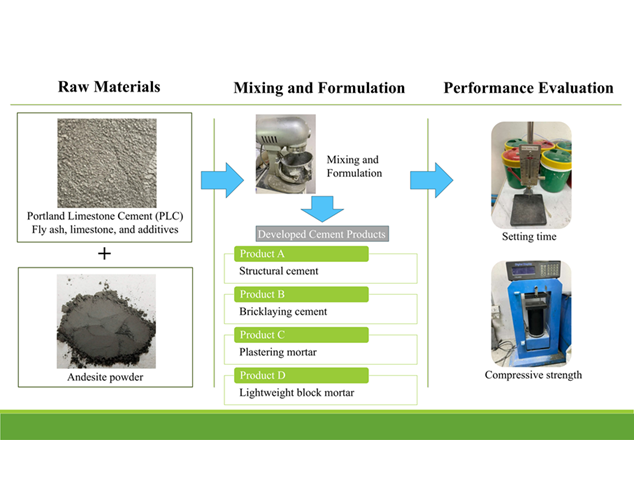
Andesite, a dark volcanic rock, was investigated as a supplementary cementitious material (SCM) in four Portland limestone cement (PLC)-based products—(1) cement for structural applications, (2) blended cement for bricklaying and plastering, (3) general-purpose plastering mortar, and (4) plastering mortar for lightweight block applications—with the aim of improving visual appearance, reducing carbon footprint, and lowering raw material cost. Laboratory tests identified 10% PLC replacement with andesite as the optimal level, which was then applied across all mixes. In paste and mortar testing, the incorporation of andesite increased initial and final setting times by 14.06% to 50.78% and 5.13% to 11.43%, respectively, compared to mixes without andesite, while still meeting industrial standards. Compressive strength results showed an 8.42% to 20.06% reduction at 28 days; however, all products continued to comply with the required performance criteria. At the industrial scale, products were produced and field-tested, and their color was evaluated using digital image analysis. Results showed that grayscale values were 13.12% to 32.03% lower than those of control products, indicating a consistently darker shade and enhanced visual appearance. Economically, substituting PLC with andesite reduced raw material costs by 2.64% to 7.44%, depending on the product, demonstrating that andesite can improve aesthetics and sustainability while maintaining compliance with industry standards.
Downloads
References
D. Cheng, D. M. Reiner, F. Yang, C. Cui, J. Meng, Y. Shan, Y. Liu, S. Tao, and D. Guan, "Projecting future carbon emissions from cement production in developing countries," Nature Communications, vol. 14, no. 1, p. 8213, 2023. DOI: https://doi.org/10.1038/s41467-023-43660-x
S. Barbhuiya, F. Kanavaris, B. B. Das, and M. Idrees, "De-carbonising cement and concrete production: Strategies, challenges and pathways for sustainable development," Journal of Building Engineering, vol. 86, p. 108861, 2024. DOI: https://doi.org/10.1016/j.jobe.2024.108861
ASTM C595: Standard Specification for Blended Hydraulic Cements, ASTM International, USA, 2023.
S. Gupta, B. N. Mohapatra, and M. Bansal, "A review on development of Portland limestone cement: A step towards low carbon economy for Indian cement industry," Current Research in Green and Sustainable Chemistry, vol. 3, p. 100019, 2020. DOI: https://doi.org/10.1016/j.crgsc.2020.100019
S. Sim, H. Suh, S. Cho, S. Im, J. Park, J. Liu, and S. Bae, "Synergistic effects of nano-alumina and triisopropanolamine in Portland limestone cements with various sulfate levels," Cement and Concrete Composites, vol. 159, p. 105994, 2025,. DOI: https://doi.org/10.1016/j.cemconcomp.2025.105994
S. B. Nia, A. Nyland, J. Wivast, M. Kioumarsi, and B. Shafei, "Investigations of portland limestone cement and waste glass powder for sustainable ultra-high performance concrete," Case Studies in Construction Materials, vol. 22, p. e04425, 2025. DOI: https://doi.org/10.1016/j.cscm.2025.e04425
Thai Cement Manufacturers Association (TCMA). "Hydraulic cement: A low carbon cement product to reduces greenhouse gas." 2025. [Online]. Available: https://www.thaicma.or.th/en/ environmentally/environment/environmentally_friendly_cement_products.
A. Mrema, Comparison of the properties of Portland cement and Portland limestone cement. 2010. DOI: https://doi.org/10.52339/tjet.v33i1.448
C. Sharma, and R. Kumar, Use of low-grade limestone slurry to develop Sustainable low carbon Portland Limestone cementitious (PLC) material. 2024.
Á. De La Rosa, G. Ruiz, and R. Moreno, "Mineral additions as pigments and mechanical property enhancers in self-compacting natural hydraulic lime concrete," Journal of Building Engineering, vol. 111, p. 113393, 2025. DOI: https://doi.org/10.1016/j.jobe.2025.113393
P. Khamput, "Using waste rock of mining andesite for development of interlocking block product," Thai Environmental Engineering Journal, vol. 31, no. 3, pp. 13‒19, 2017.
A. Sariisik, G. Sariisik, and A. Şentürk, "Applications of glaze and decor on dimensioned andesites used in construction sector," Construction and Building Materials, vol. 25, no. 9, pp. 3694-3702, 2011. DOI: https://doi.org/10.1016/j.conbuildmat.2011.03.062
B. Czinder, and Á. Török, "Strength and abrasive properties of andesite: Relationships between strength parameters measured on cylindrical test specimens and micro-Deval values—a tool for durability assessment," Bulletin of Engineering Geology and the Environment, vol. 80, no. 12, pp. 8871‒8889, 2021. DOI: https://doi.org/10.1007/s10064-020-01983-9
Ş. Özkan, and H. Ceylan, "The effects on mechanical properties of sustainable use of waste andesite dust as a partial substitution of cement in cementitious composites," Journal of Building Engineering, vol. 58, p. 104959, 2022. DOI: https://doi.org/10.1016/j.jobe.2022.104959
P. Khamput, and K. Suweero, "Development of construction materials from waste rock of mining andesite for technology transfer to local communities," Thai Environmental Engineering Journal, vol. 32, no. 3, pp. 45-51, 2018.
M. Davraz, H. Ceylan, İ. B. Topçu, and T. Uygunoğlu, "Pozzolanic effect of andesite waste powder on mechanical properties of high strength concrete," Construction and Building Materials, vol. 165, pp. 494‒503, 2018. DOI: https://doi.org/10.1016/j.conbuildmat.2018.01.043
S. M. Lahmar, B. K. Ben Ammar, and O. Kessal, "Enhancing high-performance concrete with local andesite and calcined marl: Insights from heat treatment and untreated conditions," Construction and Building Materials, vol. 457, p. 139370, 2024. DOI: https://doi.org/10.1016/j.conbuildmat.2024.139370
M. Hamidi, L. Kacimi, M. Cyr, and P. Clastres, "Evaluation and improvement of pozzolanic activity of andesite for its use in eco-efficient cement," Construction and Building Materials, vol. 47, pp. 1268‒1277, 2013.. DOI: https://doi.org/10.1016/j.conbuildmat.2013.06.013
P. Chakartnarodom, S. Polsilapa, W. Prakaypan, P. Ineure, N. Chuankrerkkul, E. A. Laitila, and N. Kongkajun, "Reinforcing fiber-cement composites for flooring with fibers from low-grade coal fly ash," Suan Sunandha Science and Technology Journal, vol. 12, no. 2, pp. 1‒8, 2025.
P. Chakartnarodom, S. Polsilapa, W. Prakapan, P. Ineure, N. Chuankrerkkul, E. A. Laitila, and N. Kongkajun, "Upcycling low-grade coal fly ash for the production of fly ash fibers and their applications in fiber-reinforced cement composites," Construction and Building Materials, vol. 414, p. 134880, 2024.. DOI: https://doi.org/10.1016/j.conbuildmat.2024.134880
M. Kuźnia, "A Review of coal fly ash utilization: environmental, energy, and material assessment," Energies, vol. 18, no. 1, p. 52, 2025. DOI: https://doi.org/10.3390/en18010052
L. K. Turner, and F. G. Collins, "Carbon dioxide equivalent (CO2-e) emissions: A comparison between geopolymer and OPC cement concrete," Construction and Building Materials, vol. 43, pp. 125-130, 2013.. DOI: https://doi.org/10.1016/j.conbuildmat.2013.01.023
D. J. M. Flower, and J. G. Sanjayan, "Green house gas emissions due to concrete manufacture," The International Journal of Life Cycle Assessment, vol. 12, no. 5, pp. 282‒288, 2007. DOI: https://doi.org/10.1065/lca2007.05.327
G. L. Golewski, "Concrete composites based on quaternary blended cements with a reduced width of initial microcracks," Applied Sciences, vol. 13, no. 12. p. 7338, 2023. DOI: https://doi.org/10.3390/app13127338
G. L. Golewski, "Study of strength and microstructure of a new sustainable concrete incorporating pozzolanic materials," Structural Engineering and Mechanics, vol. 86, no. 4, pp. 431‒441, 2023.
G. L. Golewski, "Mechanical properties and brittleness of concrete made by combined fly ash, silica fume and nanosilica with ordinary Portland cement," AIMS Materials Science, vol. 10, no. 3, pp. 390-404, 2023. DOI: https://doi.org/10.3934/matersci.2023021
G. L. Golewski, "Combined effect of coal fly ash (CFA) and nanosilica (nS) on the strength parameters and microstructural properties of eco-friendly concrete," Energies, Article vol. 16, no. 1, Art no. 452, 2023. DOI: https://doi.org/10.3390/en16010452
G. L. Golewski, "Assessing of water absorption on concrete composites containing fly ash up to 30% in regards to structures completely immersed in water," Case Studies in Construction Materials, vol. 19, p. e02337, 2023. DOI: https://doi.org/10.1016/j.cscm.2023.e02337
G. L. Golewski, "The effect of the addition of coal fly ash (CFA) on the control of water movement within the structure of the concrete," Materials, vol. 16, no. 15, p. 5218, 2023. DOI: https://doi.org/10.3390/ma16155218
Y. Yin, J. Huang, T. Wang, R. Yang, H. Hu, M. Manuka, F. Zhou, J. Min, H. Wan, D. Yuan, and B. Ma, "Effect of hydroxy-propyl methyl cellulose (HPMC) on rheology and printability of the first printed layer of cement activated slag-based 3D printing concrete," Construction and Building Materials, vol. 405, p. 133347, 2023.. DOI: https://doi.org/10.1016/j.conbuildmat.2023.133347
G. Gelardi, S. Mantellato, D. Marchon, M. Palacios, A. B. Eberhardt, and R. J. Flatt, "9 - Chemistry of chemical admixtures," in Science and Technology of Concrete Admixtures, P.-C. Aïtcin and R. J. Flatt Eds.: Woodhead Publishing, 2016, pp. 149‒218. DOI: https://doi.org/10.1016/B978-0-08-100693-1.00009-6
B. Feneuil, O. Pitois, and N. Roussel, "Effect of surfactants on the yield stress of cement paste," Cement and Concrete Research, vol. 100, pp. 32‒39, 2017. DOI: https://doi.org/10.1016/j.cemconres.2017.04.015
ASTM C186-98: Standard Test Method for Heat of Hydration of Hydraulic Cement, ASTM International, USA, 2017.
ASTM C191-13: Standard Test Methods for Time of Setting of Hydraulic Cement by Vicat Needle, ASTM International, USA, 2018.
TIS 2594-2567: Hydraulic Cement, Thai Industrial Standards Institute, Thailand, 2024.
TIS 80-2550: Mixed Cements, Thai Industrial Standards Institute, Thailand, 2007.
TIS 1776-2566: Mortar for plastering, Thai Industrial Standards Institute, Thailand, 2023.
TIS 2735-2559: Plastering Mortar for Lightweight Concrete, Thai Industrial Standards Institute, Thailand, 2016.
P. Pahusuwanno, P. Chakartnarodom, P. Ineure, and W. Prakaypan, "The influences of chemical treatment on recycled rejected fiber cement used as fillers in the fiber cement products," Journal of Metals, Materials and Minerals, vol. 29, no. 3, 2019. DOI: https://doi.org/10.55713/jmmm.v29i4.496
P. Sonprasarn, P. Chakartnarodom, P. Ineure, and W. Prakaypan, "Effects of the chemical treatment on coal-fired bottom ash for the utilization in fiber-reinforced cement composites," Journal of Metals, Materials and Minerals, vol. 29, no. 4, 2019. DOI: https://doi.org/10.55713/jmmm.v29i4.488
P. Chakartnarodom, S. Wanpen, W. Prakaypan, E. A. Laitila, and N. Kongkajun, "Development of high-performance fiber cement: a case study in the integration of circular economy in product design," Sustainability, vol. 14, no. 19, p. 12263, 2022. DOI: https://doi.org/10.3390/su141912263
J. J. Brooks, M. A. Megat Johari, and M. Mazloom, "Effect of admixtures on the setting times of high-strength concrete," Cement and Concrete Composites, vol. 22, no. 4, pp. 293‒301, 2000. DOI: https://doi.org/10.1016/S0958-9465(00)00025-1
L. Prasittisopin, "Power plant waste (fly ash, bottom ash, biomass ash) management for promoting circular economy in sustainable construction: Emerging economy context," Smart and Sustainable Built Environment, vol. 15, no. 3, pp. 1341‒1365, 2024. DOI: https://doi.org/10.1108/SASBE-09-2024-0395
W. Wongkeo, P. Thongsanitgarn, C.-S. Poon, and A. Chaipanich, "Heat of hydration of cement pastes containing high-volume fly ash and silica fume," Journal of Thermal Analysis and Calorimetry, vol. 138, no. 3, pp. 2065‒2075, 2019. DOI: https://doi.org/10.1007/s10973-019-08641-7
I. Sereewatthanawut, C. Panwisawas, C. Ngamkhanong, and L. Prasittisopin, "Effects of extended mixing processes on fresh, hardened and durable properties of cement systems incorporating fly ash," Scientific Reports, vol. 13, no. 1, p. 6091, 2023. DOI: https://doi.org/10.1038/s41598-023-33312-x
H. Beushausen, M. Alexander, and Y. Ballim, "Early-age properties, strength development and heat of hydration of concrete containing various South African slags at different replacement ratios," Construction and Building Materials, vol. 29, pp. 533‒540, 2012. DOI: https://doi.org/10.1016/j.conbuildmat.2011.06.018
M. Karataş, E. Bozcan, and M. Dener, "Evaluating the high-temperature resistance of self-compacting mortar incorporating waste andesite powder as a mineral admixture," Structural Concrete, vol. 26, no. 3, pp. 2366‒2380, 2025. DOI: https://doi.org/10.1002/suco.202401133
M. Amin, Y. Supriyatna, K. Isnugroho, S. Sudibyo, R. Septiana, and Syafriadi, "Process of andesite stone as material of cement substitution in making paving block," IOP Conference Series: Materials Science and Engineering, vol. 478, p. 012040, 2019. DOI: https://doi.org/10.1088/1757-899X/478/1/012040
T. T. Win, R. Wattanapornprom, L. Prasittisopin, W. Pansuk, and P. Pheinsusom, "Investigation of fineness and calcium-oxide content in fly ash from ASEAN region on properties and durability of cement–fly ash system," Engineering Journal, vol. 26, no. 5, pp. 77‒90, 2022. DOI: https://doi.org/10.4186/ej.2022.26.5.77
F. Moghaddam, V. Sirivivatnanon, and K. Vessalas, "The effect of fly ash fineness on heat of hydration, microstructure, flow and compressive strength of blended cement pastes," Case Studies in Construction Materials, vol. 10, p. e00218, 2019. DOI: https://doi.org/10.1016/j.cscm.2019.e00218
M. Xaba, S. Mapukata, and T. Mokhena, "ChatGPT based method for obtaining repeatable and quantitative colorimetric measurements," MethodsX, vol. 15, p. 103525, 2025. DOI: https://doi.org/10.1016/j.mex.2025.103525
Y.-H. Chang, P.-H. Huang, B.-Y. Wu, and S.-W. Chang, "A study on the color change benefits of sustainable green building materials," Construction and Building Materials, vol. 83, pp. 1‒6, 2015.. DOI: https://doi.org/10.1016/j.conbuildmat.2015.02.065
L. Tan, and J. Jiang, "Chapter 13 - Image Processing Basics," in Digital Signal Processing (Third Edition), L. Tan and J. Jiang Eds.: Academic Press, 2019, pp. 649‒726. DOI: https://doi.org/10.1016/B978-0-12-815071-9.00013-0
M. Ullah, J. Mir, and A. Ahmad, "Assessing the influence of cement replacement materials on concrete performance through image processing," Measurement, vol. 256, p. 118014, 2025. DOI: https://doi.org/10.1016/j.measurement.2025.118014
Downloads
Published
How to Cite
Issue
Section
Categories
License
Copyright (c) 2026 Journal of Metals, Materials and Minerals

This work is licensed under a Creative Commons Attribution-NonCommercial-NoDerivatives 4.0 International License.
Authors who publish in this journal agree to the following terms:
- Authors retain copyright and grant the journal right of first publication with the work simultaneously licensed under a Creative Commons Attribution License that allows others to share the work with an acknowledgment of the work's authorship and initial publication in this journal.
- Authors are able to enter into separate, additional contractual arrangements for the non-exclusive distribution of the journal's published version of the work (e.g., post it to an institutional repository or publish it in a book), with an acknowledgment of its initial publication in this journal.