Dual-functional activated carbon from coffee grounds for crystal violet dye removal and subsequent application as an electrode material in energy storage devices
DOI:
https://doi.org/10.55713/jmmm.v36i1.2488Keywords:
Spent coffee grounds, Activated carbon, Crystal violet, Supercapacitor electrode, Biomass valorizationAbstract
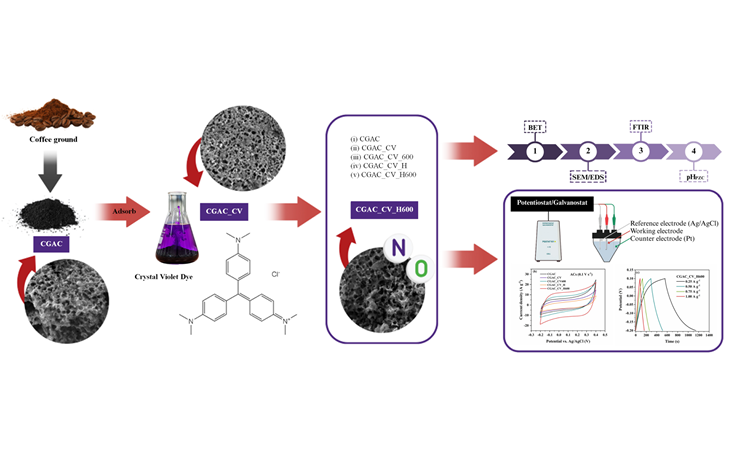
The conversion of agricultural waste into high-value functional materials offers a sustainable strategy to address environmental concerns. In this study, activated carbon was synthesized from spent coffee grounds (CGAC) via KOH activation and used for crystal violet (CV) dye adsorption. Under optimal conditions (0.5 g dosage, 300 mg∙L‒1 CV, 30°C, 120 min), CGAC achieved 91.41% removal efficiency, with adsorption behavior fitting pseudo-second-order kinetics and the Freundlich isotherm. Thermo-dynamic parameters confirmed a spontaneous and endothermic process. Moreover, the reusability study revealed that CGAC maintained a high removal efficiency above 88% after seven adsorption–desorption cycles, demonstrating its structural stability and potential for practical wastewater treatment. Notably, the dye-saturated carbon was further processed into electrode materials through five different preparation routes: unmodified CGAC, dye-loaded CGAC (CGAC_CV), hydro-thermally treated (CGAC_CV_H), thermally treated (CGAC_CV_600), and combined hydrothermal-thermal treated (CGAC_CV_H600). Among them, CGAC_CV_H600 exhibited the best electrochemical performance with a specific capacitance of 326.4 F∙g‒1 at 0.25 A∙g‒1 in 6 M KOH due to its optimized porosity and nitrogen/oxygen doping. This study is among the few that explore the reuse of dye-laden adsorbents through systematic post-treatment strategies, offering a circular and sustainable pathway for biomass-derived carbon in both environmental remediation and energy storage.
Downloads
References
J. Meena, S. shankari Sivasubramaniam, E. David, and S. K, “Green supercapacitors: review and perspectives on sustainable template-free synthesis of metal and metal oxide nanoparticles,” RSC Sustainability, vol. 2, no. 5, pp. 1224-1245, 2024. DOI: https://doi.org/10.1039/D4SU00009A
C. Karaman, O. Karaman, N. Atar, and M. L. Yola, “Sustainable electrode material for high-energy supercapacitor: biomass-derived graphene-like porous carbon with three-dimensional hierarchically ordered ion highways,” Physical Chemistry Chemical Physics, vol. 23, no. 22, pp. 12807-12821, 2021. DOI: https://doi.org/10.1039/D1CP01726H
D. V. Chernysheva, N. V. Smirnova, and V. P. Ananikov, “Recent trends in supercapacitor research: Sustainability in energy and materials,” ChemSusChem, vol. 17, no. 5, p. e202301367, 2024. DOI: https://doi.org/10.1002/cssc.202301367
G. Hristea, M. Iordoc, E.-M. Lungulescu, I. Bejenari, and I. Volf, “A sustainable bio-based char as emerging electrode material for energy storage applications,” Scientific Reports, vol. 14, no. 1, p. 1095, 2024. DOI: https://doi.org/10.1038/s41598-024-51350-x
T. Temesgen, E.T. Bekele, B. A. Gonfa, L. T. Tufa, F. K. Sabir, S. Tadesse, and Y.Dessie, “Advancements in biomass derived porous carbon materials and their surface influence effect on electrode electrochemical performance for sustainable super-capacitors: A review,” Journal of Energy Storage, vol. 73, p. 109293, 2023. DOI: https://doi.org/10.1016/j.est.2023.109293
S. Wang, Z. Ren, J. Li, Y. Ren, L. Zhao, and J. Yu, “Cotton-based hollow carbon fibers with high specific surface area prepared by ammonia etching for supercapacitor application,” RSC Advances, vol. 4, no. 59, pp. 31300-31307, 2014. DOI: https://doi.org/10.1039/C4RA04383A
N. Kumar, S.-B. Kim, S.-Y. Lee, and S.-J. Park, “Recent advanced supercapacitor: A review of storage mechanisms, electrode materials, modification, and perspectives,” Nanomaterials (Basel), vol. 12, no. 20, p. 3708, 2022. DOI: https://doi.org/10.3390/nano12203708
H. Ji, X. Zhao, Z. Qiao, J. Jung, Y. Zhu, Y. Lu, L. L. Zhang, A. H. MacDonald, and R. S. Ruoff, “Capacitance of carbon-based electrical double-layer capacitors,” Nature Communications, vol. 5, no. 1, p. 3317, 2014. DOI: https://doi.org/10.1038/ncomms4317
R. Li, Y. Zhou, W. Li, J. Zhu, and W. Huang, “Structure engineering in biomass-derived carbon materials for electro-chemical energy storage,” Research (Wash D C), vol. 2020, p. 8685436, 2020. DOI: https://doi.org/10.34133/2020/8685436
E. Huarote-Garcia, A. A. C. Riojas, I. E. Monje, E. O. López, O. M. A. Pinedo, G. A. Planes, and A. M. Baena-Moncada, “Activated carbon electrodes for supercapacitors from purple corncob (Zea maysL.),” ACS Environmental Au, vol. 4, no. 2, pp. 80-88, 2024. DOI: https://doi.org/10.1021/acsenvironau.3c00048
Z. Liu, S. Zhang, L. Wang, T. Wei, Z. Qiu, and Z. Fan, “High-efficiency utilization of carbon materials for supercapacitors,” Nano Select, vol. 1, no. 2, pp. 244-262, 2020. DOI: https://doi.org/10.1002/nano.202000011
M. Pathak, D. Bhatt, R. C. Bhatt, B. S. Bohra, G. Tatrari, S. Rana, M. C. Arya, and N. G. Sahoo, “High energy density supercapacitors: An overview of efficient electrode materials, electrolytes, design, and fabrication,” The Chemical Record, vol. 24, no. 1, p. e202300236, 2023. DOI: https://doi.org/10.1002/tcr.202300236
A. A. Ahmad, M. A. Gondal, M. Hassan, R. Iqbal, S. Ullah, S. Alzahrani, W. A. Memon, F. Mabood, and S. Melhi, “Preparation and characterization of physically activated carbon and its energetic application for all-solid-state supercapacitors: A case study,” ACS Omega, vol. 8, no. 24, pp. 21653-21663, 2023. DOI: https://doi.org/10.1021/acsomega.3c01065
S. M. Omokafe, A. A. Adeniyi, E. O. Igbafen, S. R. Oke, and P. A. Olubambi, “Fabrication of activated carbon from coconut shells and its electrochemical properties for supercapacitors,” International Journal of Electrochemical Science, vol. 15, no. 11, pp. 10854-10865, 2020. DOI: https://doi.org/10.20964/2020.11.10
Q. Xu, P. Cai, X. Ni, Y. Zhao, D. Li, Y. Chen, and H. Yuan, “Pyrolysis of loofah sponge into N/O self-doped three-dimensional porous carbon for supercapacitor,” Journal of Energy Storage, vol. 109, p. 115180, 2025. DOI: https://doi.org/10.1016/j.est.2024.115180
K. Li, J. Luo, M. Wei, X. Yao, Q. Feng, X. Ma, and Z, Liu, “Functional porous carbon derived from waste eucalyptus bark for toluene adsorption and aqueous symmetric supercapacitors,” Diamond and Related Materials, vol. 127, p. 109196, 2022. DOI: https://doi.org/10.1016/j.diamond.2022.109196
K. Kanjana, P. Harding, T. Kwamman, W. Kingkam, and T. Chutimasakul, “Biomass-derived activated carbons with extremely narrow pore size distribution via eco-friendly synthesis for supercapacitor application,” Biomass and Bioenergy, vol. 153, p. 106206, 2021. DOI: https://doi.org/10.1016/j.biombioe.2021.106206
S. R. Manippady, M. Michalska, M. Krajewski, K. Bochenek, M. Basista, A. Zaszczynska, T. Czeppe, L. Rogal, and A. Jain, “One-step synthesis of a sustainable carbon material for high performance supercapacitor and dye adsorption applications,” Materials Science and Engineering: B, vol. 297, p. 116766, 2023. DOI: https://doi.org/10.1016/j.mseb.2023.116766
E. Taer, A. Apriwandi, and R. Taslim, “Heteroatom-doped biomass-derived porous carbon for supercapacitor applications: A review,” Trends in Sciences, vol. 22, no. 8, Art. no. 8, 2025. DOI: https://doi.org/10.48048/tis.2025.10115
S. Ghosh, S. Barg, S. M. Jeong, and K. (Ken) Ostrikov, “Heteroatom-doped and oxygen-functionalized nanocarbons for high-performance supercapacitors,” Advanced Energy Materials, vol. 10, no. 32, p. 2001239, 2020. DOI: https://doi.org/10.1002/aenm.202001239
J. Wang, T. Huo, Y. Zhao, R. Lu, and X. Wu, “Recent advances in heteroatoms-doped porous carbon electrode materials for supercapacitors: A review,” Journal of Energy Storage, vol. 110, p. 115216, 2025. DOI: https://doi.org/10.1016/j.est.2024.115216
M. Jalalah, H. Han, A. K. Nayak, and F. A. Harraz, “High-performance supercapacitor based on self-heteroatom-doped porous carbon electrodes fabricated from Mikania micrantha,” Advanced Composites and Hybrid Materials, vol. 7, no. 1, p. 20, 2024. DOI: https://doi.org/10.1007/s42114-024-00833-6
D. Mohan, A. Sarswat, Y. S. Ok, and C. U. Pittman, “Organic and inorganic contaminants removal from water with biochar, a renewable, low cost and sustainable adsorbent – A critical review,” Bioresource Technology, vol. 160, pp. 191-202, 2014. DOI: https://doi.org/10.1016/j.biortech.2014.01.120
A. Ahmadpour, and D. D. Do, “The preparation of activated carbon from macadamia nutshell by chemical activation,” Carbon, vol. 35, no. 12, pp. 1723-1732, 1997. DOI: https://doi.org/10.1016/S0008-6223(97)00127-9
J. Guo, and A. C. Lua, “Textural and chemical characterisations of activated carbon prepared from oil-palm stone with H2SO4 and KOH impregnation,” Microporous and Mesoporous Materials, vol. 32, no. 1, pp. 111-117, 1999. DOI: https://doi.org/10.1016/S1387-1811(99)00096-7
B. M. Thamer, F. A. Al-aizari, and H. S. Abdo, “Enhanced adsorption of textile dyes by a novel sulfonated activated carbon derived from pomegranate peel waste: Isotherm, Kinetic and thermodynamic study,” Molecules, vol. 28, no. 23, p. 7712, 2023. DOI: https://doi.org/10.3390/molecules28237712
J. Saleem, Z. K. B. Moghal, S. Pradhan, and G. McKay, “High-performance activated carbon from coconut shells for dye removal: Study of isotherm and thermodynamics,” RSC Advances., vol. 14, no. 46, pp. 33797-33808, 2024. DOI: https://doi.org/10.1039/D4RA06287F
Y. Yao, H. Zuo, Y.Liu, S. Pang, L. Lan, F.Yao, Y. Wu, and Z. Liu, “Efficient dye adsorption of mesoporous activated carbon from bamboo parenchyma cells by phosphoric acid activation,” RSC Advances, vol. 14, no. 18, pp. 12873-12882, 2024. DOI: https://doi.org/10.1039/D4RA01652A
A. Husain, K. Ansari, D. K. Mahajan, M. Kandasamy, M. N. M. Ansari, J. Giri, and H. A. Al-Lohedan, “Harnessing sustainable N-doped activated carbon from walnut shells for advanced all-solid-state supercapacitors and targeted Rhodamine B dye adsorption,” Journal of Science: Advanced Materials and Devices, vol. 9, no. 2, p. 100699, 2024. DOI: https://doi.org/10.1016/j.jsamd.2024.100699
J. Chupirom, S. Khaophong, N. Hemyakorn, S. Intachai, and P. Kongsune, “Arginine-modified surface coffee grounds activated carbon for Pb2+ adsorption: Kinetic, isotherm and thermodynamic studies,” Journal of Metals, Materials and Minerals, vol. 35, no. 1, Art. no. 1, 2025. DOI: https://doi.org/10.55713/jmmm.v35i1.2148
B. Weerasuk, T. Chutimasakul, N. Prigyai, and T. Sangtawesin, “Enhanced dye removal and supercapacitor performance of polyethyleneimine-impregnated activated carbon derived from local eucalyptus biochar,” RSC Sustainability, vol. 3, no. 2, pp. 904-913, 2025. DOI: https://doi.org/10.1039/D4SU00421C
P. Treeweranuwat, P. Boonyoung, M. Chareonpanich, and K. Nueangnoraj, “Role of nitrogen on the porosity, surface, and electrochemical characteristics of activated carbon,” ACS Omega, vol. 5, no. 4, pp. 1911-1918, 2020. DOI: https://doi.org/10.1021/acsomega.9b03586
T. Kangkamano, P. Kongsune, K. Suwanraksa, T. Charoenlap, S. Khaophong, and S. Intachai, “Effect of temperature of boric acid-doped porous activated carbon preparation on the electro-chemical capacitor performance,” ScienceAsia, vol. 51, no. 2, p. 1, 2025. DOI: https://doi.org/10.2306/scienceasia1513-1874.2025.031
M. J. Mostazo-López, J. Krummacher, A. Balducci, E. Morallón, and D. Cazorla-Amorós, “Electrochemical performance of N‐doped superporous activated carbons in ionic liquid‐based electrolytes,” Electrochimica Acta, vol. 368, p. 137590, 2021. DOI: https://doi.org/10.1016/j.electacta.2020.137590
U. Baig, M. K. Uddin, and M. A. Gondal, “Removal of hazardous azo dye from water using synthetic nano adsorbent: Facile synthesis, characterization, adsorption, regeneration and design of experiments,” Colloids and Surfaces A: Physicochemical and Engineering Aspects, vol. 584, p. 124031, 2020. DOI: https://doi.org/10.1016/j.colsurfa.2019.124031
S. Bentahar, A. Dbik, M. E. Khomri, N. E. Messaoudi, and A. Lacherai, “Adsorption of methylene blue, crystal violet and congo red from binary and ternary systems with natural clay: Kinetic, isotherm, and thermodynamic,” Journal of Environmental Chemical Engineering, vol. 5, no. 6, pp. 5921-5932, 2017. DOI: https://doi.org/10.1016/j.jece.2017.11.003
A. H. Jawad, A. S. Abdulhameed, M. A. K. M. Hanafiah, Z. A. ALOthman, M. R. Khan, and S. N. Surip, “Numerical desirability function for adsorption of methylene blue dye by sulfonated pomegranate peel biochar: Modeling, kinetic, isotherm, thermo-dynamic, and mechanism study,” Korean Journal of Chemical Engineering, vol. 38, no. 7, pp. 1499-1509, 2021. DOI: https://doi.org/10.1007/s11814-021-0801-9
A. H. Jawad, A. S. Abdulhameed, N. N. Bahrudin, N. N. M. F. Hum, S. N. Surip, S. S. A. Syed-Hassan, E. Yousif, and S. Sabar, “Microporous activated carbon developed from KOH activated biomass waste: Surface mechanistic study of methylene blue dye adsorption,” Water Science and Technology, vol. 84, no. 8, pp. 1858-1872, 2021. DOI: https://doi.org/10.2166/wst.2021.355
L. P. Lingamdinne, S. K. Godlaveeti, G. K. R. Angaru, Y.-Y. Chang, R. R. Nagireddy, A. R. Somala, and J. R. Koduru, “Highly efficient surface sequestration of Pb2+ and Cr3+ from water using a Mn3O4 anchored reduced graphene oxide: Selective removal of Pb2+ from real water,” Chemosphere, vol. 299, p. 134457, 2022. DOI: https://doi.org/10.1016/j.chemosphere.2022.134457
H. Freundlich, “Über die adsorption in Lösungen,” Zeitschrift für Physikalische Chemie, vol. 57U, no. 1, pp. 385-470, 1907. DOI: https://doi.org/10.1515/zpch-1907-5723
I. Langmuir, “The adsorption of gases on plane surfaces of glass, mica and platinum,” Journal of the American Chemical Society, vol. 40, no. 9, pp. 1361-1403, 1918. DOI: https://doi.org/10.1021/ja02242a004
K. H. Chu, “Revisiting the temkin isotherm: Dimensional inconsistency and approximate forms,” Industrial & Engineering Chemistry Research, vol. 60, no. 35, pp. 13140-13147, 2021. DOI: https://doi.org/10.1021/acs.iecr.1c01788
M. M. Dubinin, “The potential theory of adsorption of gases and vapors for adsorbents with energetically nonuniform surfaces.,” Chemical Reviews, vol. 60, no. 2, pp. 235-241, 1960. DOI: https://doi.org/10.1021/cr60204a006
K. Surya, and M. S. Michael, “Hierarchical porous activated carbon prepared from biowaste of lemon peel for electro-chemical double layer capacitors,” Biomass and Bioenergy, vol. 152, p. 106175, 2021. DOI: https://doi.org/10.1016/j.biombioe.2021.106175
P. Simon, and Y. Gogotsi, “Materials for electrochemical capacitors,” Nature Materials, vol. 7, no. 11, pp. 845-854, 2008. DOI: https://doi.org/10.1038/nmat2297
J. Chmiola, G. Yushin, Y. Gogotsi, C. Portet, P. Simon, and P. L. Taberna, “Anomalous increase in carbon capacitance at pore sizes less than 1 nanometer,” Science, vol. 313, no. 5794, pp. 1760-1763, 2006. DOI: https://doi.org/10.1126/science.1132195
Y. Zhai, Y. Dou, D. Zhao, P. F. Fulvio, R. T. Mayes, and S. Dai, “Carbon materials for chemical capacitive energy storage,” Advanced Materials, vol. 23, no. 42, pp. 4828-4850, 2011. DOI: https://doi.org/10.1002/adma.201100984
J. Li, Y. Sun, X. Jia, Y. Chen, Y. Tang, P. Wan, and J. Pan, “Boron, oxygen co-doped porous carbon derived from waste tires with enhanced hydrophilic interface as sustainably high-performance material for supercapacitors,” Journal of Energy Storage, vol. 80, p. 110320, 2024. DOI: https://doi.org/10.1016/j.est.2023.110320
K. Thongkam, N. Chaiyut, M. Panapoy, and B. Ksapabutr, “Biomass-based nitrogen-doped carbon/polyaniline composite as electrode material for supercapacitor devices,” Journal of Metals, Materials and Minerals, vol. 33, no. 3, pp. 1675-1675, 2023. DOI: https://doi.org/10.55713/jmmm.v33i3.1675
K. C. S. Lakshmi, and B. Vedhanarayanan, “High-performance supercapacitors: A comprehensive review on paradigm shift of conventional energy storage devices,” Batteries, vol. 9, no. 4, p. 202, 2023. DOI: https://doi.org/10.3390/batteries9040202
M. Sevilla, and A. B. Fuertes, “The production of carbon materials by hydrothermal carbonization of cellulose,” Carbon, vol. 47, no. 9, pp. 2281-2289, 2009. DOI: https://doi.org/10.1016/j.carbon.2009.04.026
L. L. Zhang, and X. S. Zhao, “Carbon-based materials as super-capacitor electrodes,” Chemical Society Reviews, vol. 38, no. 9, pp. 2520-2531, 2009. DOI: https://doi.org/10.1039/b813846j
W. Tong, F. Huang, L. Chen, H. Wu, and X. Zhou, “Methylene blue enhanced bamboo activated carbon as high performance supercapacitor electrode materials,” Industrial Crops and Products, vol. 180, p. 114786, 2022. DOI: https://doi.org/10.1016/j.indcrop.2022.114786
D.-W. Wang, F. Li, M. Liu, G. Q. Lu, and H.-M. Cheng, “3D aperiodic hierarchical porous graphitic carbon material for high-rate electrochemical capacitive energy storage,” Angewandte Chemie International Edition, vol. 47, no. 2, pp. 373-376, 2008. DOI: https://doi.org/10.1002/anie.200702721
G. Lv, X. Dai, Y. Qiao, Q. Tan, Y. Liu, and Y. Chen, “Functional combination of methylene blue and porous carbon mutually promotes to deliver ultrahigh rate capacitive and energy storage performance,” Chemical Engineering Journal, vol. 448, p. 137660, 2022. DOI: https://doi.org/10.1016/j.cej.2022.137660
H. Xu, Y. Bao, S. Zuo, P. Chen, Y. Zhu, X. Kong, and Y, Chen, “Enhanced electrochemical performance of biomass porous carbon adsorption congo red,” Journal of The Electrochemical Society, vol. 169, no. 1, p. 010514, 2022. DOI: https://doi.org/10.1149/1945-7111/ac4846
I. Loulidi, F. Boukhlifi, M. Ouchabi, A. Amar, M. Jabri, A. Kali, S. Chraibi, C. Hadey, and F. Aziz, “Adsorption of crystal violet onto an agricultural waste residue: kinetics, isotherm, thermo-dynamics, and mechanism of adsorption,” ScientificWorldJournal, vol. 2020, p. 5873521, 2020. DOI: https://doi.org/10.1155/2020/5873521
A. Aldalbahi, B. M. Thamer, M. Rahaman, and M. H. El-Newehy, “Self-nitrogen-doped nanoporous carbons derived from poly(1,5-diaminonaphthalene) for the removal of toxic dye pollutants from wastewater: Non-linear isotherm and kinetic analysis,” Polymers (Basel), vol. 12, no. 11, p. 2563, 2020. DOI: https://doi.org/10.3390/polym12112563
L. Zhong, L. Zhang, and H. Shi, “Adsorption of crystal violet onto nitrogen-doped mesoporous carbon,” Progress in Reaction Kinetics and Mechanism, vol. 42, no. 3, pp. 269-281, 2017. DOI: https://doi.org/10.3184/146867817X14821527549211
T. Anusonthiwong, N. Suwatanapongched, J. Surawattanawiset, N. Chittreisin, S. Ittisanronnachai, T. Sangtawesin, and S. Anantachaisilp, “Activated carbon derived from rice husks enhanced by methylene blue and gamma irradiation for super-capacitor applications,” RSC Sustainability, vol. 3, no. 3, pp. 1507-1515, 2025. DOI: https://doi.org/10.1039/D4SU00701H
Y. Bao, J. Ma, H. Xu, Z. Yang, M. Liu, and Y. Chen, “Polymerization of redox-active alizarin in biomass porous carbon with enhanced cycling stability for supercapacitor,” Journal of Energy Storage, vol. 102, p. 114172, 2024. DOI: https://doi.org/10.1016/j.est.2024.114172
S. Brahma, and K. Ramanujam, “Combination of redox-active natural indigo dye and bio-derived carbon from ridge gourd fruit for high-performance asymmetric supercapacitors,” Ionics, vol. 28, no. 3, pp. 1427-1440, 2022. DOI: https://doi.org/10.1007/s11581-021-04433-y
Downloads
Published
How to Cite
License
Copyright (c) 2025 Journal of Metals, Materials and Minerals

This work is licensed under a Creative Commons Attribution-NonCommercial-NoDerivatives 4.0 International License.
Authors who publish in this journal agree to the following terms:
- Authors retain copyright and grant the journal right of first publication with the work simultaneously licensed under a Creative Commons Attribution License that allows others to share the work with an acknowledgment of the work's authorship and initial publication in this journal.
- Authors are able to enter into separate, additional contractual arrangements for the non-exclusive distribution of the journal's published version of the work (e.g., post it to an institutional repository or publish it in a book), with an acknowledgment of its initial publication in this journal.