Durability performance of cement mixtures incorporating porous laterite-based aggregates under sulfate and chloride exposure
DOI:
https://doi.org/10.55713/jmmm.v36i4.2546คำสำคัญ:
Mixed cement, Laterite aggregate, Compressive strength, Salt resistanceบทคัดย่อ
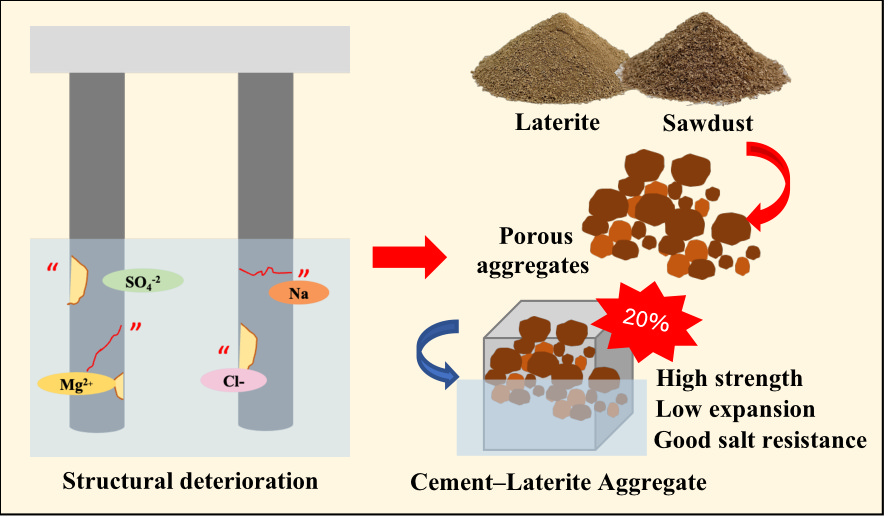
The study aimed to develop and evaluate the performance of cement mixed with porous aggregates for use in areas with high salt concentrations. The porous aggregates were produced from calcined laterite 70 wt% with sawdust 30 wt% and sieved into three sizes: > 2.31 mm, > 1 mm, and < 1 mm. The 20 wt% laterite aggregate was mixed with 80 wt% cement to compare with 100% cement. All samples were immersed in MgSO4 and NaCl solutions and cured at ambient temperature for 30 days to assess compressive strength, mass change, expansion, chemical analysis, and microstructure. Although 100% cement had the highest compressive strength, it significantly decreased after 30 days in both solutions. In contrast, cement with aggregates increased strength in MgSO4, with the three-size aggregate mixture achieving the highest strength (39.2 MPa) with minimal mass change and expansion. Under NaCl exposure, all mixes showed reduced strength. The three mixed sizes aggregate still exhibited the highest strength (31.9 MPa), low mass change, and expansion. This shows that the cement mixtures with 20 wt% aggregates have a distinct ability to withstand sulphate and chloride solutions, and the three-size aggregate formulation achieved strength exceeding the ASTM C1157 and ASTM C150 standards.
Downloads
เอกสารอ้างอิง
W.-S. Lin, C.-W. Liu, and M.-H. Li, “Influences of specific ions in groundwater on concrete degradation in subsurface engineered barrier system,” SpringerPlus, vol. 5, p. 2495, 2016. DOI: https://doi.org/10.1186/s40064-016-2495-8
F. Zhang, W. Feng, X. Wu, Z. Hu, X. Li, and L. Gao, “Study on concrete deterioration and chloride ion diffusion mechanism by different aqueous NaCl–MgSO4 concentrations,” Buildings, vol. 12, no. 11, p. 1843, 2022. DOI: https://doi.org/10.3390/buildings12111843
P. Sertsoongnern, J. Ayawanna, and S. Chaiyaput, “Performance evaluation of developed mixed cement containing asphalt waste dust and class-C fly ash in sulfate salt solution test,” Sustainable Chemistry and Pharmacy, vol. 42, p. 101824, 2024. DOI: https://doi.org/10.1016/j.scp.2024.101824
K. Muthusamy, S. W. Ahmad, M. H. Hashim, N. Mohamad, M. S. Kirgiz, M. A. A. Kamarudin, and G. Ravindran, “Sulphate resistance of lightweight aggregate concrete comprising sieved palm oil fuel ash as fine aggregate replacement,” Materials Today: Proceedings, vol. 66, pt. 4, pp. 2536–2540, 2022. DOI: https://doi.org/10.1016/j.matpr.2022.07.077
K. Yamato, A. Sasaki, T. Ito, and I. Yoshitake, “Resistance properties to chloride ingress of standard-cured concrete made with an admixture incorporating rich SiO2 and Al2O3,” International Journal of Concrete Structures and Materials, vol. 14, p. 391, 2020. DOI: https://doi.org/10.1186/s40069-020-0391-7
P. M. Sooraj, C. M. Shanoof, A. E. Vijayan, P. Minushegh, and T. Jithma, “Study of partial replacement of fine aggregate with laterite,” International Research Journal of Engineering and Technology (IRJET), vol. 12, no. 3, pp. 945–948, 2025.
D. Tonnayopas, N. Janmart, and N. Charoensuk, “Utilization of lateritic soil as coarse aggregate in concrete for artificial aquifer,” RMUTL Engineering Journal, vol. 5, no. 2, pp. 43–50, 2020.
O. Benjeddou, “Experimental investigation of the impact of wood sawdust incorporation on the physical and thermal properties of fired clay bricks,” Scientific Reports, vol. 15, p. 365, 2025. DOI: https://doi.org/10.1038/s41598-025-00365-z
S. Chaiyaput, P. Sertsoongnern, T. N. Nguyen, L. Z. Mase, and J. Ayawanna, “Feasibility assessment of porous granules from lateritic soil and sawdust as partial cement replacement under seawater immersion,” Results in Engineering, vol. 30, p. 110839, 2026. DOI: https://doi.org/10.1016/j.rineng.2026.110839
Thai Industrial Standards Institute (TISI), Standard No. TIS 15-1:2004 — Specification for Portland Cement, Bangkok, Thailand, 2004.
ASTM C1012, Standard test method for length change of hydraulic-cement mortars exposed to a sulfate solution, ASTM International, West Conshohocken, PA, USA.
Y. Xiancui, J. Linhua, G. Mingzhi, C. Yunjie, S. Zijian, and B. Rui, “Evaluation of sulfate resistance of slag contained concrete under steam curing,” Construction and Building Materials, vol. 195, pp. 231–237, 2019. DOI: https://doi.org/10.1016/j.conbuildmat.2018.11.073
K. Yang, J. Sun, H. Liu, W. Yang, and L. Dong, “Study on the thermogravimetric kinetics of dehydrated sewage sludge regulated by cationic polyacrylamide and sawdust,” Polymers, vol. 15, no. 10, p. 2396, 2023. DOI: https://doi.org/10.3390/polym15102396
G. S. Kumar, P. K. Saini, R. Deoliya, A. K. Mishra, and S. K. Negi, “Characterization of laterite soil and its use in construction applications: A review,” Resources, Conservation & Recycling Advances, vol. 16, p. 200120, 2022. DOI: https://doi.org/10.1016/j.rcradv.2022.200120
ASTM C1157, Standard performance specification for hydraulic cement, ASTM International, West Conshohocken, PA, USA.
ASTM C618, Standard specification for coal fly ash and raw or calcined natural pozzolan for use in concrete, ASTM International, West Conshohocken, PA, USA.
A. Marto, N. Latifi, and A. Eisazadeh, “Effect of non-traditional additives on engineering and microstructural characteristics of laterite soil,” Arabian Journal for Science and Engineering, vol. 39, pp. 6949–6957, 2014. DOI: https://doi.org/10.1007/s13369-014-1286-1
O. Romruen, T. Karbowiak, W. Tongdeesoontorn, K. A. Shiekh, and S. Rawdkuen, “Extraction and characterization of cellulose from agricultural by-products of Chiang Rai Province, Thailand,” Polymers, vol. 14, no. 9, p. 1830, 2022. DOI: https://doi.org/10.3390/polym14091830
K. Hemavibool, S. Hemavibool, and S. Ouypornkochagorn, “A study of the pozzolanic property of a variety of bituminous fly ashes,” Journal of Research Unit on Science, Technology and Environment for Learning, vol. 9, no. 2, pp. 169–176, 2018.
X. Wang, C. Wan, X. Zhang, and H. Chen, “Drying shrinkage of hardened cement paste and its relationship to the micro-structure,” in Proceedings of the International Conference on Durability of Concrete Structures, 2018.
A. Ahmed, “Chemical reactions in pozzolanic concrete,” Modern Approaches on Material Science, vol. 1, p. 120, 2019. DOI: https://doi.org/10.32474/MAMS.2019.01.000120
J. Browning, D. Darwin, D. Reynolds, and B. Pendergrass, “Lightweight aggregate as internal curing agent to limit concrete shrinkage,” ACI Materials Journal, vol. 108, pp. 638–644, 2011. DOI: https://doi.org/10.14359/51683467
R. S. Gollop, and H. F. W. Taylor, “Cement and concrete research,” Cement and Concrete Research, vol. 26, pp. 1013–1028, 1996. DOI: https://doi.org/10.1016/0008-8846(96)00089-0
K. Zheng, X. Xie, G. Gou, X. Chen, Y. Huang, and J. Gao, “Comparative study on characteristics and microstructure of magnesium silicate hydrate utilizing quartz and silica fume as siliceous raw materials,” Case Studies in Construction Materials, vol. 19, p. e02542, 2023. DOI: https://doi.org/10.1016/j.cscm.2023.e02313
C. Sonat, and C. Unluer, “Development of magnesium-silicate-hydrate (M-S-H) cement with rice husk ash,” Journal of Cleaner Production, vol. 211, pp. 787–803, 2019. DOI: https://doi.org/10.1016/j.jclepro.2018.11.246
T. Zhang, J. Zou, B. Wang, Z. Wu, Y. Jia, and C. R. Cheeseman, “Characterization of magnesium silicate hydrate (MSH) gel formed by reacting MgO and silica fume,” Materials, vol. 11, no. 10, p. 1885, 2018. DOI: https://doi.org/10.3390/ma11060909
T. Zhang, L. Vandeperre, and C. R. Cheeseman, “Formation of magnesium silicate hydrate (M-S-H) cement pastes using sodium hexametaphosphate,” Cement and Concrete Research, vol. 65, pp. 8–14, 2014. DOI: https://doi.org/10.1016/j.cemconres.2014.07.001
A. Torrado, and M. Valiente, “The effect of resin particle size on the rate of ion release: Interactions in mixed bed systems,” Analytical and Bioanalytical Chemistry, vol. 378, pp. 205–213, 2004. DOI: https://doi.org/10.1007/s00216-003-2212-7
T. U. Mohammed, and H. Hamada, “Relationship between free chloride and total chloride contents in concrete,” Cement and Concrete Research, vol. 33, no. 9, pp. 1487–1490, 2003. DOI: https://doi.org/10.1016/S0008-8846(03)00065-6
F. Althoey, Y. Farnam, S. Alyami, and A. Fenais, “Deterioration in concrete exposed to sodium chloride and heat-cool cycling,” MATEC Web of Conferences, vol. 361, p. 06002, 2022. DOI: https://doi.org/10.1051/matecconf/202236106002
C. Qiao, P. Suraneni, and W. Weiss, “Damage in cement pastes exposed to NaCl solutions,” Construction and Building Materials, vol. 171, pp. 741–749, 2018. DOI: https://doi.org/10.1016/j.conbuildmat.2018.03.123
L. Trusilewicz, and R. Talero, “Morphological differentiation and crystal growth form of Friedel’s salt originated from pozzolan and Portland cement,” Industrial & Engineering Chemistry Research, vol. 51, pp. 14315–14324, 2012.
C. Exstrom, and G. D. Piccini, “Chloride binding and desorption properties of concrete containing corn stover ash,” Journal of Sustainable Cement-Based Materials, vol. 11, no. 1, pp. 1–21, 2021. DOI: https://doi.org/10.1080/21650373.2021.1880982
P. Wattanachai, N. Otsuki, T. Saito, and T. Nishida, “A study on chloride ion diffusivity of porous aggregate concretes and improvement method,” Doboku Gakkai Ronbunshuu E, vol. 65, no. 1, pp. 30–44, 2009. DOI: https://doi.org/10.2208/jsceje.65.30
J. Osio-Norgaard, and W. V. Srubar III, “Zeolite adsorption of chloride from a synthetic alkali-activated cement pore solution,” Materials (Basel), vol. 12, no. 12, p. 2019, 2019. DOI: https://doi.org/10.3390/ma12122019
R. Talero, L. Trusilewicz, A. Delgado, C. Pedrajas, R. Lannegrand, V. Rahhal, R. Mejia, S. Delvasto, and F. Ramírez, “Comparative and semi-quantitative XRD analysis of Friedel’s salt originating from pozzolan and Portland cement,” Construction and Building Materials, vol. 25, pp. 2370–2380, 2011. DOI: https://doi.org/10.1016/j.conbuildmat.2010.11.037
A. O. Domínguez, R. D. Toledo Filho, J. A. C. P. Gomes, R. dos S. Silva, E. A. de Souza, and A. B. da Silva, “Study of reinforced concrete with the addition of pozzolanic against the penetration of chlorides through electrochemical impedance spectroscopy,” Construction Materials, vol. 4, no. 1, pp. 194–215, 2024. DOI: https://doi.org/10.3390/constrmater4010011
S. Yoon, J. Moon, X. Duan, E. Giannelis, and P. Monteiro, “Chloride adsorption by calcined layered double hydroxides in hardened Portland cement paste,” Materials Chemistry and Physics, vol. 145, pp. 376–386, 2014. DOI: https://doi.org/10.1016/j.matchemphys.2014.02.026
S. Tang, Y. Wang, Z. Geng, X. Xu, W. Yu, H. A, and J. Chen, “Structure, fractality, mechanics and durability of calcium silicate hydrates,” Fractal and Fractional, vol. 5, no. 2, p. 47, 2021. DOI: https://doi.org/10.3390/fractalfract5020047
C. Zhang, J. Li, M. Yu, Y. Lu, and S. Liu, “Mechanism and performance control methods of sulfate attack on concrete: A review,” Materials (Basel, Switzerland), vol. 17, no. 19, p. 4836, 2024. DOI: https://doi.org/10.3390/ma17194836
J. Ma, Z. Li, Y. Jiang, and X. Yang, “Synthesis, characterization and formation mechanism of Friedel’s salt (FS: 3CaO·Al2O3· CaCl2·10H2O) by the reaction of calcium chloride with sodium aluminate,” Journal of Wuhan University of Technology–Materials Science Edition, vol. 30, no. 6, pp. 1210–1216, 2015. DOI: https://doi.org/10.1007/s11595-015-1104-y
M. Ali, M. A. Shams, N. Bheel, A. Almaliki, A. Mahmoud, Y. Dodo, and O. Benjeddou, “A review on chloride induced corrosion in reinforced concrete structures: lab and in situ investigation,” RSC Advances, vol. 14, pp. 37252–37271, 2024. DOI: https://doi.org/10.1039/D4RA05506C
F. Yousuf, and W. Xiaosheng, “Water to cement ratio effect on cement paste microstructural development by electrical resistivity measurements and computer illustration,” American Journal of Civil Engineering and Architecture, vol. 9, no. 3, pp. 73–87, 2021. DOI: https://doi.org/10.12691/ajcea-9-3-1
A. Cuesta, J. D. Zea-Garcia, D. Londono-Zuluaga, A. G. De la Torre, I. Santacruz, O. Vallcorba, M. Dapiaggi, S. G. Sanfélix, and M. A. G. Aranda, “Multiscale understanding of tricalcium silicate hydration reactions,” Scientific Reports, vol. 8, no. 1, p. 8544, 2018. DOI: https://doi.org/10.1038/s41598-018-26943-y
M.-h. Zhang, and H. Li, “Pore structure and chloride permeability of concrete containing nano-particles for pavement,” Construction and Building Materials, vol. 25, pp. 608–616, 2011. DOI: https://doi.org/10.1016/j.conbuildmat.2010.07.032
Y. Han, J. Xia, H. Chang, and J. Xu, “The influence mechanism of ettringite crystals and microstructure characteristics on the strength of calcium-based stabilized soil,” Materials (Basel), vol. 14, no. 6, p. 1359, 2021. DOI: https://doi.org/10.3390/ma14061359
ดาวน์โหลด
เผยแพร่แล้ว
วิธีการอ้างอิง
ฉบับ
บท
Categories
การอนุญาต
ลิขสิทธิ์ (c) 2026 วารสารโลหะ, วัสดุ และแร่

This work is licensed under a Creative Commons Attribution-NonCommercial-NoDerivatives 4.0 International License.
Authors who publish in this journal agree to the following terms:
- Authors retain copyright and grant the journal right of first publication with the work simultaneously licensed under a Creative Commons Attribution License that allows others to share the work with an acknowledgment of the work's authorship and initial publication in this journal.
- Authors are able to enter into separate, additional contractual arrangements for the non-exclusive distribution of the journal's published version of the work (e.g., post it to an institutional repository or publish it in a book), with an acknowledgment of its initial publication in this journal.