Parring bamboo (Gigantochloa atter ) composites as alternatives for safety cabin panels
DOI:
https://doi.org/10.55713/jmmm.v36i4.2563คำสำคัญ:
Composite, Gigantochloa Atter, Safety cabin, Mechanical properties, Thermal propertiesบทคัดย่อ
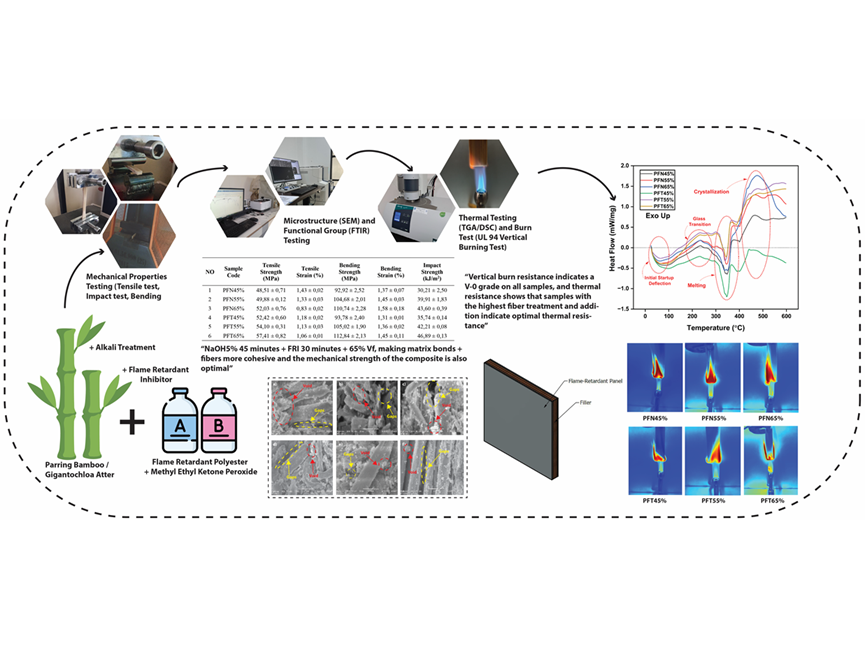
This study aims to develop and evaluate a reinforced composite of Parring Bamboo (Gigantochloa atter) fiber with a Flame Retardant Polyester matrix (PaBFeR–FeReP). The study focuses on the effects of fiber treatment—comprising a combination of 5% NaOH alkalization and a water-based flame retardant inhibitor (FRI)—as well as fiber volume fraction variations (45%, 55%, and 65%) on material performance. The novelty of this research lies in mapping the synergy between layered fiber interface modification (chemical and flame retardant treatments) and a phosphorus-modified polyester matrix, a configuration that has not been comprehensively explored in Parring bamboo. Composite panels were fabricated using the hand-layup method and characterized via mechanical testing (tensile, flexural, impact), UL-94 burning test, TGA-DSC, SEM, and FTIR. The results showed that fiber treatment (NaOH and FRI) combined with a 65% fiber volume fraction (PFT65) provided the highest overall mechanical performance. Furthermore, all composite variants successfully achieved the UL-94 V-0 fire resistance classification without flaming droplets. Thermal analysis (TGA) indicated that the treatment advanced the initial decomposition temperature (Tonset), which accelerated the formation of a protective char layer (charring). Further DSC analysis confirmed the occurrence of charring or cross-linking processes at temperatures above 400℃, which supported thermal stability. The PaBFeR–FeReP composite shows promising initial potential as a more environmentally friendly alternative material. However, its suitability for application as safety cabin panels still requires further validation against specific engineering requirements and structural regulatory standards.
Downloads
เอกสารอ้างอิง
M. Massaguni, Z. Djafar, R. Zulkifli, and L. Hakim "Enhancing mechanical strength of bamboo parring (Gigantochloa atter) fiber with alkaline treatment for flame ‑ retardant composite," Discover Materials, vol. 5, p. 136, 2025. DOI: https://doi.org/10.1007/s43939-025-00295-7
M. Massaguni, Z. Djafar, R. Zulkifli, and L. H. Arma, "Adhesion strength of parring bamboo (Gigantochloa atter) fiber with flame retardant polyester resin : Wettability," Material Design & Processing Communications, vol. 2015, no. 1, 2025. DOI: https://doi.org/10.1155/mdp2/7886553
E. Liu, M. Chen, Y. Chang, H. Zhang, and Z. Wu, "Sustainable super-light and high-strength wood-based composite foam with hydrophobic, flame-retardant and thermal-insulating properties," Industrial Crops and Products, vol. 233, p. 121500, 2025. DOI: https://doi.org/10.1016/j.indcrop.2025.121500
H. Lavrenyuk, V. P. Parhomenko, and B. Mykhalichko, "The effect of preparation technology and the complexing on the service properties of self-extinguishing copper(II) coordinated epoxy-amine composites for pouring polymer floors. International Journal of Technology, vol. 10, pp. 290–299, 2019. DOI: https://doi.org/10.14716/ijtech.v10i2.66
B. Mykhalichko, and H. Lavrenyuk, "Flame protection technologies for wood: Developing and testing for fire of timbers with a flame-retardant coating based on the epoxy-amine composite modified by copper(II) hexafluorosilicate," Periodica Polytechnica Chemical Engineering,vol. 66, pp. 304 – 312, 2022. DOI: https://doi.org/10.3311/PPch.19050
A. Karakoc, M. Bulota, M. Hummel, S. Sriubaitė, M. Hughes, H. Sixta, and J. Paltakari, "Effect of single-fiber properties and fiber volume fraction on the mechanical properties of Ioncell fiber composites," Journal of Reinforced Plastics and Composites, vol. 40, pp. 741–748, 2021. DOI: https://doi.org/10.1177/07316844211005393
A. H. D. Abdullah, N. Karlina, W. Rahmatiya, S. Mudaim, Patimah, and A. R. Fajrin, "Physical and mechanical properties of five Indonesian bamboos," IOP Conference Series: Earth and Environmental Science, vol. 60, p. 012014, 2017. DOI: https://doi.org/10.1088/1755-1315/60/1/012014
I. D. Mohammadi, A. M. Poursattar, F. Sadegh, M. E. Soltani, M. Safaeirad, and M. Frediani, "Synthesis and characterization of flame retardant unsaturated polyester-allyloxysilane resin for wood coatings," Scientific Reports, vol. 14, pp. 1–15. 2024. DOI: https://doi.org/10.1038/s41598-024-62765-x
Standard practice for preparation of metallographic specimens, ASTM E3-01, ASTM International, 2017.
Standard Test Methods for Flexural Properties of Unreinforced and Reinforced Plastics and Electrical Insulating Materials, ASTM D790-17, ASTM International, 2017.
Test Method for Determination of Charpy Impact Strength (Withdrawn 1998), ASTM D5942-96, ASTM International, 2017.
Z. Khan, B. F. Yousif, and M. Islam, "Fracture behaviour of bamboo fiber reinforced epoxy composites," Composites Part B: Engineering, vol. 16, pp. 186 – 199, 2017. DOI: https://doi.org/10.1016/j.compositesb.2017.02.015
M. Oliveira, V. Neves, and M. D. Banea, "Mechanical and thermal characterization of bamboo and interlaminar hybrid bamboo/ synthetic fibre-reinforced epoxy composites," Materials, vol. 17, no. 8, p. 1777, 2024. DOI: https://doi.org/10.3390/ma17081777
D. Wang, T. Bai, W. Cheng, C. Xu, G. Wang, H. Cheng, and G. Han, "Surface modification of bamboo fibers to enhance the interfacial adhesion of epoxy resin-based composites prepared by resin transfer molding," Polymers, vol. 11, no. 12, p. 2107, 2019. DOI: https://doi.org/10.3390/polym11122107
K. Zhang, F. Wang, W. Liang, Z. Wang, A. Duan, and B. Yang, "Thermal and mechanical properties of bamboo fiber reinforced epoxy composites," Polymers, vol. 10, no, 6, p. 608, 2018. DOI: https://doi.org/10.3390/polym10060608
B. A. Mebratie, B. S. Ayele, and A. A. Meku, "Investigating the tensile and flexural strength of sunflower oil treated Ethiopian Highland bamboo fibre reinforced polyester composites," Advances in Bamboo Science, vol. 3, p. 100021, 2023. DOI: https://doi.org/10.1016/j.bamboo.2023.100021
M. Jawaid, S. Krishnasamy, C. Muthukumar, H. Fouad, M. Hashem, A. S. Ismail, R. Khiari, and B. Singh, "Investigating the effect of Varied Short bamboo fiber content on the thermal, impact, and flexural properties of green epoxy composites," Journal of Natural Fibers, vol. 21, no. 1, p. 2296915, 2024. DOI: https://doi.org/10.1080/15440478.2023.2296915
J. Shi, Y. Wu, M. Zhang, J. Zhang, W. Zhang, H. Chen, Y. Peng, S. Q. Shi, and C. Xia, "Bamboo fiber‐reinforced epoxy composites fabricated by vacuum‐assisted resin transfer molding (VARTM): Effect of molding sequence and fiber content," Polymer Composites, vol. 45, no. 1, pp. 256–266, 2024. DOI: https://doi.org/10.1002/pc.27774
R. Kumar, A. Ganguly, and R. Purohit, "Optimization of mechanical properties of bamboo fiber reinforced epoxy hybrid nano composites by response surface methodology," International Journal on Interactive Design and Manufacturing, vol. 18, pp. 6479–92, 2024. DOI: https://doi.org/10.1007/s12008-023-01215-w
A. C. Manalo, E. Wani, N. A. Zukarnain, W. Karunasena,K. T. Lau, "Effects of alkali treatment and elevated temperature on the mechanical properties of bamboo fibre-polyester composites," Composites Part B: Engineering, vol. 80, pp. 73–83, 2015. DOI: https://doi.org/10.1016/j.compositesb.2015.05.033
W. Zhang, C. Wang, S. Gu, H. Yu, H. Cheng, and G. Wang, "Physical-mechanical properties of bamboo fiber composites using filament winding," Polymers, vol. 13, p. 2913, 2021. DOI: https://doi.org/10.3390/polym13172913
M. Elkolali, L. P. Nogueira, P. O. Rønning, and A. Alcocer, "Void content determination of carbon fiber reinforced polymers: A comparison between destructive and non-destructive methods," Polymers, vol. 14, p. 1212, 2022. DOI: https://doi.org/10.3390/polym14061212
J. Jang, M. Maydison, Y. Kim, Z. Han, and D. Oh, "Effect of void content on the mechanical properties of GFRP for ship design," Journal of Marine Science and Engineering, vol. 11, p. 1251, 2023. DOI: https://doi.org/10.3390/jmse11061251
P. Pączkowski, A. Puszka, and B. Gawdzik, "Investigation of degradation of composites based on unsaturated polyester resin and vinyl ester resin, Materials, vol. 15, p. 1286, 2022. DOI: https://doi.org/10.3390/ma15041286
J. Y. Chane-Ching, A. Lebugle, I. Rousselot, A. Pourpoint, and F. Pellé, "Colloidal synthesis and characterization of mono-crystalline apatite nanophosphors," Journal of Materials Chemistry, vol. 17, no. 28, pp. 2904‒2913, 2007. DOI: https://doi.org/10.1039/b701194f
O. Ozukanar, G. Sagdic, E. Çakmakçı, F. K. Özmen, M. E. Üreyen, U. S. Gunay, H. Dyrnazm, and V Kumbaraci, "Triazole‐, piperazine, and DOPO ‐containing eugenol‐based reactive flame retardant for unsaturated polyester resin," Journal of Applied Polymer Science, vol. 141, no. 43, p. e56127, 2024. DOI: https://doi.org/10.1002/app.56127
B. Schartel, "Phosphorus-based flame retardancy mechanisms—old hat or a starting point for future development?," Materials, vol. 3, no. 10, pp. 4710–4745, 2010. DOI: https://doi.org/10.3390/ma3104710
S. M. Seraji, P. Song, R. J. Varley, S. Bourbigot, D. Voice, and H. Wang, "Fire-retardant unsaturated polyester thermosets: The state-of-the-art, challenges and opportunities," Chemical Engineering Journal, vol. 430, p. 132785, 2022. DOI: https://doi.org/10.1016/j.cej.2021.132785
ดาวน์โหลด
เผยแพร่แล้ว
วิธีการอ้างอิง
ฉบับ
บท
การอนุญาต
ลิขสิทธิ์ (c) 2026 วารสารโลหะ, วัสดุ และแร่

This work is licensed under a Creative Commons Attribution-NonCommercial-NoDerivatives 4.0 International License.
Authors who publish in this journal agree to the following terms:
- Authors retain copyright and grant the journal right of first publication with the work simultaneously licensed under a Creative Commons Attribution License that allows others to share the work with an acknowledgment of the work's authorship and initial publication in this journal.
- Authors are able to enter into separate, additional contractual arrangements for the non-exclusive distribution of the journal's published version of the work (e.g., post it to an institutional repository or publish it in a book), with an acknowledgment of its initial publication in this journal.