Facile stearic acid modifications of alumina nanoparticles for superhydrophobic coating
DOI:
https://doi.org/10.55713/jmmm.v36i4.2632คำสำคัญ:
Superhydrophobic coating, Surface modification, Stearic acid, alumina, Polydimethylsiloxaneบทคัดย่อ
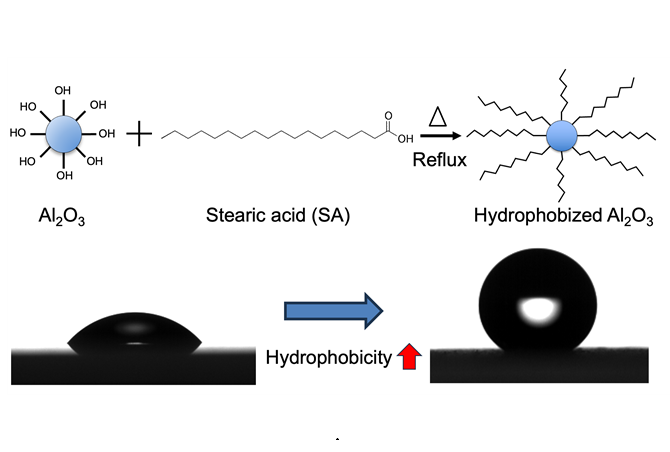
In this study, alumina nanoparticles were modified with stearic acid (SA) dissolved in ethanol solution via facile techniques, which were soaking and refluxing. The effects of these modification techniques on the thermal behaviors and the functional groups of the SA-modified alumina were investigated. Stearic acid was successfully modified onto alumina nanoparticles using both techniques. In comparison, the refluxing technique yielded a higher degree of SA modification, corresponding to a grafting density of 2.59 molecules·nm‒2, which is approximately twice that of the soaking technique. Then, the SA-modified alumina via refluxing technique was mixed with polydimethylsiloxane (PDMS) and spray coated on glass slides. The effects of coating layers and the SA-modified alumina content on the wettability and optical property were studies. The 4-layered coating containing 10 wt% of SA-modified alumina exhibited superhydrophobic property with a water contact angle of 150.0° and the contact angle hysteresis of 6.2°. It also showed excellent self-cleaning performance. However, transmittance of 4-layered coating reduced dramatically. The results showed that increasing the number of coating layers enhanced surface wettability but adversely affected optical transmittance due to increased light scattering. Therefore, a balance between wettability and optical transparency must be considered. These findings indicated that SA-modification effectively enhanced the hydrophobicity of alumina particles, and the incorporation of these SA-modified particles introduced sufficient roughness to further improve hydrophobicity. The progress in the surface modification and the utilization of a spray coating method highlight the potential for scalable and facile fabrication of superhydrophobic coating.
Downloads
เอกสารอ้างอิง
X. Zhang, F. Shi, J. Niu, Y. Jiang, and Z. Wang, "Superhydro-phobic surfaces: From structural control to functional application," Journal of Materials Chemistry, vol. 18, no. 6, pp. 621‒633, 2008. DOI: https://doi.org/10.1039/B711226B
W. Chen, Y. A. Fadeev, C. M. Hsieh, D. Oner, J. Youngblood, and J. T. McCarthy, "Ultrahydrophobic and ultralyophobic surfaces: Some comments and examples," Langmuir, vol. 15, pp. 3395‒3399, 1999. DOI: https://doi.org/10.1021/la990074s
Y.-Y. Quan, and L.-Z. Zhang, "Experimental investigation of the anti-dust effect of transparent hydrophobic coatings applied for solar cell covering glass," Solar Energy Materials and Solar Cells, vol. 160, pp. 382‒389, 2017. DOI: https://doi.org/10.1016/j.solmat.2016.10.043
X. Wu, and Z. Chen, "A mechanically robust transparent coating for anti-icing and self-cleaning applications," Journal of Materials Chemistry A, vol. 6, no. 33, pp. 16043‒16052, 2018. DOI: https://doi.org/10.1039/C8TA05692G
S. Narakaew, S. Au-pree, W. Baison, S. Thungprasert, I. Wattalo, P. Jaipor, T. Promanan, S. Sukdee, P. Santakij, C. Chanogkun, K. Ruttananteeranwichien, A. Chaisena, P. Apichai, and P. Napakaew, "The finished polyester fabric with hot NH4OH pretreatment and mixed ZnO-Zn(OH)2 nanoparticles for hydro-phobic property," Journal of Metals, Materials and Minerals, vol. 32, pp. 109‒117, 2022. DOI: https://doi.org/10.55713/jmmm.v32i1.1226
H. H. I. Eltigani, and Y. Boonyongmaneerat, "Progress of water desalination applications based on wettability and surface characteristics of graphene and graphene oxide: A review," Journal of Metals, Materials and Minerals, vol. 32, pp. 15‒26, 2022. DOI: https://doi.org/10.55713/jmmm.v32i3.1520
S. S. Latthe, R. S. Sutar, V. S. Kodag, A. K. Bhosale, A. M. Kumar, K. K, Sadasivuni, R. Xing, and S. Liu, "Self – cleaning super-hydrophobic coatings: Potential industrial applications," Progress in Organic Coatings, vol. 128, pp. 52‒58, 2019. DOI: https://doi.org/10.1016/j.porgcoat.2018.12.008
P. Wang, M. Chen, H. Han, X. Fan, Q. Liu, and J. Wang, "Transparent and abrasion-resistant superhydrophobic coating with robust self-cleaning function in either air or oil," Journal of Materials Chemistry A, vol. 4, no. 20, pp. 7869‒7874, 2016. DOI: https://doi.org/10.1039/C6TA01082B
A. Matin, U. Baig, S. Akhtar, N. Merah, M. A. Gondal, A. H. Bake, and A. Ibrahim, "UV-resistant and transparent hydrophobic surfaces with different wetting states by a facile dip-coating method," Progress in Organic Coatings, vol. 136, p. 105192, 2019. DOI: https://doi.org/10.1016/j.porgcoat.2019.06.038
A. Nakajima, K. Hashimoto, and T. Watanabe, "Recent studies on super-hydrophobic films," Monatshefte fur Chemie, vol. 132, pp. 31‒41, 2001. DOI: https://doi.org/10.1007/s007060170142
R. N. Wenzel, "Resistance of solid surfaces to wetting by water," Industrial and engineering chemistry, vol. 28, pp. 988‒994, 1936. DOI: https://doi.org/10.1021/ie50320a024
A. B. D. Cassie, and S. Baxter, "Wettability of porous surfaces," Transactions of the Faraday society, vol. 40, pp. 546‒551, 1944. DOI: https://doi.org/10.1039/tf9444000546
P. N. Manoudis, and I. Karapanagiotis, "Modification of the wettability of polymer surfaces using nanoparticles," Progress in Organic Coatings, vol. 77, no. 2, pp. 331‒338, 2014. DOI: https://doi.org/10.1016/j.porgcoat.2013.10.007
D. Ebert, and B. Bhushan, "Transparent, superhydrophobic, and wear-resistant coatings on glass and polymer substrates using SiO2, ZnO, and ITO nanoparticles," Langmuir, vol. 28, no. 31, pp. 11391‒11399, 2012. DOI: https://doi.org/10.1021/la301479c
L. Xu, R. G. Karunakaran, J. Guo, and S. Yang, "Transparent, superhydrophobic surfaces from one-step spin coating of hydro-phobic nanoparticles," ACS Applied Materials & Interfaces, vol. 4, no. 2, pp. 1118‒1125, 2012. DOI: https://doi.org/10.1021/am201750h
X. Sun, J. Xie, J. Zhang, M. Sang, Y. Li, P. Lyu, D. Chen, and H. Zhou, "Hydrophobic Al2O3/SiO2/PDMS composite coatings for anti-corrosion application of 304 stainless-steel," Journal of Inorganic and Organometallic Polymers and Materials, vol. 32, no. 11, pp. 4237‒4249, 2022. DOI: https://doi.org/10.1007/s10904-022-02423-9
R. Fateh, R. Dillert, and D. Bahnemann, "Preparation and characterization of transparent hydrophilic photocatalytic TiO2/ SiO2 thin films on polycarbonate," Langmuir, vol. 29, no. 11, pp. 3730‒3739, 2013. DOI: https://doi.org/10.1021/la400191x
Y. Shen, K. Li, H. Chen, Z. Wu, and Z. Wang, "Superhydrophobic F-SiO2@PDMS composite coatings prepared by a two-step spraying method for the interface erosion mechanism and anti-corrosive applications," Chemical Engineering Journal, vol. 413, p. 127455, 2021. DOI: https://doi.org/10.1016/j.cej.2020.127455
F. Su, and K. Yao, "Facile fabrication of superhydrophobic surface with excellent mechanical abrasion and corrosion resistance on copper substrate by a novel method," ACS Applied Materials & Interfaces, vol. 6, no. 11, pp. 8762‒8770, 2014. DOI: https://doi.org/10.1021/am501539b
M. Uhl, G. Schoeters, E. Govarts, W. Bil, T. Fletcher, L. S. Haug, R. Hoogenboom, C. Gundacker, X. Trier, M. F. Fernandez, A. C. Calvo, M. E. López, D. Coertjens, T. Santonen, L. P. Murínová, D. Richterová, K. De Brouwere, I. Hauzenberger, M. Kolossa-Gehring, and Þ. I. Halldórsson "PFASs: What can we learn from the european human biomonitoring initiative HBM4EU," International Journal of Hygiene and Environmental Health, vol. 250, p. 114168, 2023. DOI: https://doi.org/10.1016/j.ijheh.2023.114168
B. Zhang, W. Xu, Q. Zhu, and B. Hou, "Scalable, fluorine free and hot water repelling superhydrophobic and superoleophobic coating based on functionalized Al2O3 nanoparticles," Journal of Materials Science & Technology, vol. 66, pp. 74‒81, 2021. DOI: https://doi.org/10.1016/j.jmst.2020.06.035
L. Zhang, C.-H. Xue, M. Cao, M.-M. Zhang, M. Li, and J.-Z. Ma, "Highly transparent fluorine-free superhydrophobic silica nanotube coatings," Chemical Engineering Journal, vol. 320, pp. 244‒252, 2017. DOI: https://doi.org/10.1016/j.cej.2017.03.048
A. P. Desbois, and V. J. Smith, "Antibacterial free fatty acids: activities, mechanisms of action and biotechnological potential," Applied Microbiology and Biotechnology, vol. 85, no. 6, pp. 1629‒1642, 2010. DOI: https://doi.org/10.1007/s00253-009-2355-3
A. Jiménez, M. J. Fabra, P. Talens, and A. Chiralt, "Effect of lipid self-association on the microstructure and physical properties of hydroxypropyl-methylcellulose edible films containing fatty acids," Carbohydrate Polymers, vol. 82, pp. 585‒593, 2010. DOI: https://doi.org/10.1016/j.carbpol.2010.05.014
H. Li, L. Xin, K. Zhang, X. Yin, and S. Yu, "Fluorine-free fabrication of robust self-cleaning and anti-corrosion superhydro-phobic coating with photocatalytic function for enhanced anti-biofouling property," Surface and Coatings Technology, vol. 438, p. 128406, 2022. DOI: https://doi.org/10.1016/j.surfcoat.2022.128406
Y. Feng, S. Chen, and Y. Frank Cheng, "Stearic acid modified zinc nano-coatings with superhydrophobicity and enhanced antifouling performance," Surface and Coatings Technology, vol. 340, pp. 55‒65, 2018. DOI: https://doi.org/10.1016/j.surfcoat.2018.02.053
Y. Li, and W. Weng, "Surface modification of hydroxyapatite by stearic acid: Characterization and in vitro behaviors," Journal of Materials Science: Materials in Medicine, vol. 19, no. 1, pp. 19‒25, 2008. DOI: https://doi.org/10.1007/s10856-007-3123-5
H. Teisala, P. Baumli, S. A. L. Weber, D. Vollmer, and H. J. Butt, "Grafting silicone at room temperature-a transparent, scratch-resistant nonstick molecular coating," Langmuir, vol. 36, no. 16, pp. 4416‒4431, 2020. DOI: https://doi.org/10.1021/acs.langmuir.9b03223
S. Martin, and B. Bhushan, "Transparent, wear-resistant, super-hydrophobic and superoleophobic poly(dimethylsiloxane) (PDMS) surfaces," Journal of Colloid and Interface Science, vol. 488, pp. 118‒126, 2017. DOI: https://doi.org/10.1016/j.jcis.2016.10.094
E. J. Park, Y. K. Cho, D. H. Kim, M. G. Jeong, Y. H. Kim, and Y. D. Kim, "Hydrophobic polydimethylsiloxane (PDMS) coating of mesoporous silica and its use as a preconcentrating agent of gas analytes," Langmuir, vol. 30, no. 34, pp. 10256‒10262, 2014. DOI: https://doi.org/10.1021/la502915r
L. Hu, Z. Pu, Y. Tian, X. Zheng, J. Cheng, and J. Zhong, "Preparation and properties of fluorinated silicon two‐component polyurethane hydrophobic coatings," Polymer International, vol. 69, no. 5, pp. 448‒456, 2020. DOI: https://doi.org/10.1002/pi.5973
S. Zheng, D. A. Bellido-Aguilar, Y. Huang, X. Zeng, Q. Zhang, and Z. Chen, "Mechanically robust hydrophobic bio-based epoxy coatings for anti-corrosion application," Surface and Coatings Technology, vol. 363, pp. 43‒50, 2019. DOI: https://doi.org/10.1016/j.surfcoat.2019.02.020
S. Sutha, S. Suresh, B. Raj, and K. R. Ravi, "Transparent alumina based superhydrophobic self–cleaning coatings for solar cell cover glass applications," Solar Energy Materials and Solar Cells, vol. 165, pp. 128‒137, 2017. DOI: https://doi.org/10.1016/j.solmat.2017.02.027
S. Mishra, N. G. Shimpi, and A. D. Mali, "Influence of stearic acid treated nano-CaCO3 on the properties of silicone nano-composites," Journal of Polymer Research, vol. 18, no. 6, pp. 1715‒1724, 2011. DOI: https://doi.org/10.1007/s10965-011-9577-7
Z. Liu, L. Yao, X. Pan, Q. Liu, and H. Huang, "A green and facile approach to the efficient surface modification of alumina nanoparticles with fatty acids," Applied Surface Science, vol. 447, pp. 664‒672, 2018. DOI: https://doi.org/10.1016/j.apsusc.2018.04.035
M. E. Karaman, D. A. Antelmi, and R. M. Pashley, "The production of stable hydrophobic surfaces by the adsorption of hydrocarbon and fluorocarbon carboxylic acids onto alumina substrates," Colloids and Surfaces A: Physico-chemical and Engineering Aspects, vol. 182, pp. 285‒298, 2001. DOI: https://doi.org/10.1016/S0927-7757(00)00821-9
J. Chandradass, and M. Balasubramanian, "Sol–gel processing of alumina fibres," Journal of Materials Processing Technology, vol. 173, no. 3, pp. 275‒280, 2006. DOI: https://doi.org/10.1016/j.jmatprotec.2005.11.030
L. Zhang, L. Chen, H. Wan, J. Chen, and H. Zhou, "Synthesis and tribological properties of stearic acid-modified anatase (TiO2) nanoparticles," Tribology Letters, vol. 41, no. 2, pp. 409‒416, 2010. DOI: https://doi.org/10.1007/s11249-010-9724-z
L. Feng, H. Zhang, P. Mao, Y. Wang, and Y. Ge, "Superhydro-phobic alumina surface based on stearic acid modification," Applied Surface Science, vol. 257, pp. 3959‒3963, 2011. DOI: https://doi.org/10.1016/j.apsusc.2010.11.143
M. Zhang, M. Zhao, R. Chen, J. Liu, Q. Liu, J. Yu, R. Li, P. Liu, and J. Wang, "Fabrication of the pod-like KCC-1/TiO2 superhydrophobic surface on AZ31 Mg alloy with stability and photocatalytic property," Applied Surface Science, vol. 499, p. 143933, 2020. DOI: https://doi.org/10.1016/j.apsusc.2019.143933
F. Kimura, J. Umemura, and T. Takenaka, "FTIR-ATR studies on Langmuir-Blodgett films of stearic acid with 1-9 monolayers," Langmuir, vol. 2, pp. 96‒101, 1986. DOI: https://doi.org/10.1021/la00067a017
Y. Gan, M. Zhao, S. Zhao, Z. Su, J. Xie, L. Yang, and T.-J. Wang, "Increased stearic acid grafting density on silica nano-particles via alumina-activation," Applied Surface Science, vol. 678, p. 161077, 2024. DOI: https://doi.org/10.1016/j.apsusc.2024.161077
X.-X. Zhang, B.-B. Xia, H.-P. Ye, Y.-L. Zhang, B. Xiao, L.-H. Yan, H.-B. Lv, and B. Jiang, "One-step sol–gel preparation of PDMS–silica ORMOSILs as environment-resistant and crack-free thick antireflective coatings," Journal of Materials Chemistry, vol. 22, no. 26, pp. 13132‒13140, 2012. DOI: https://doi.org/10.1039/c2jm31005h
G. Mie, "Beiträge zur optik trüber medien, speziell kolloidaler metallösungen," Annalen der Physik, vol. 330, no. 3, pp. 377-445, 1908. DOI: https://doi.org/10.1002/andp.19083300302
P. Spinelli, M. A. Verschuuren, and A. Polman, "Broadband omnidirectional antireflection coating based on subwavelength surface Mie resonators," Nature Communications, vol. 3, p. 692, 2012. DOI: https://doi.org/10.1038/ncomms1691
ดาวน์โหลด
เผยแพร่แล้ว
วิธีการอ้างอิง
ฉบับ
บท
Categories
การอนุญาต
ลิขสิทธิ์ (c) 2026 วารสารโลหะ, วัสดุ และแร่

This work is licensed under a Creative Commons Attribution-NonCommercial-NoDerivatives 4.0 International License.
Authors who publish in this journal agree to the following terms:
- Authors retain copyright and grant the journal right of first publication with the work simultaneously licensed under a Creative Commons Attribution License that allows others to share the work with an acknowledgment of the work's authorship and initial publication in this journal.
- Authors are able to enter into separate, additional contractual arrangements for the non-exclusive distribution of the journal's published version of the work (e.g., post it to an institutional repository or publish it in a book), with an acknowledgment of its initial publication in this journal.