Sericin-mediated green production of silver nanoparticles with potent antibacterial activity against prawn pathogen Vibrio parahaemolyticus
DOI:
https://doi.org/10.55713/jmmm.v36i4.2604Keywords:
Silver nanoparticle, Sericin, Vibrio parahaemolyticus, MIC, MBCAbstract
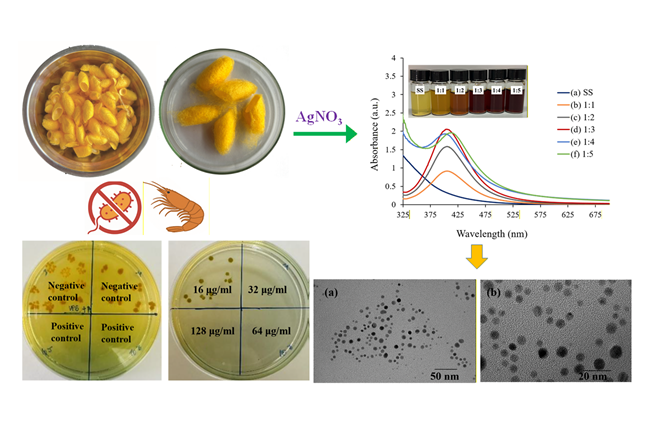
The increasing occurrence of antibiotic-resistant Vibrio species has become a major concern in aquaculture, particularly for the control of Vibrio parahaemolyticus, the causative agent of Acute Hepatopancreatic Necrosis Disease (AHPND), which leads to severe mortality and substantial economic losses in shrimp farming across many Asian countries. Therefore, the development of sustainable and non-antibiotic antibacterial strategies is urgently needed. In this study, silver nanoparticles (AgNPs) were synthesized using silk sericin (SS), an underutilized by-product of the sericulture industry, which served as both a natural reducing and stabilizing agent. Spherical AgNPs with a mean diameter of 12.9 ± 3.4 nm were successfully produced at an AgNO3-to-SS weight ratio of 1:3 under alkaline conditions. Comprehensive physicochemical characterization confirmed their nanoscale size, high crystallinity, and strong colloidal stability for at least four weeks. Antibacterial assays showed a minimum inhibitory concentration (MIC) of 16 μg·mL‒1 and a minimum bactericidal concentration (MBC) of 32 μg·mL‒1 against V. parahaemolyticus, indicating strong antimicrobial activity of the biogenic AgNPs. These results suggest that SS-mediated AgNPs represent a promising non-antibiotic strategy for controlling V. parahaemolyticus infections in aquaculture. In addition, the valorization of SS into functional nanomaterials highlights its potential for broader biomedical and biotechnological applications while supporting the sustainable utilization of sericulture waste. The nanoparticles were produced through a simple, eco-friendly, low-energy one-pot synthesis that is potentially suitable for industrial-scale production.
Downloads
References
Y. Kittichotsatsawat, W. Wattanutchariya, A. Jongjareonrak, and P. Seesuriyachan, “Enhancing manufacturing operations within the supply chain for sustainable frozen shrimp production,” Sustainability, vol. 17, p. 2412, 2025. DOI: https://doi.org/10.3390/su17062412
H. M. Santos, C.-Y. Tsai, K. R. A. Maquiling, L. L. Tayo, A. R. Mariatulqabtiah, C.-W. Lee, and K. P. Chuang, “Diagnosis and potential treatments for acute hepatopancreatic necrosis disease (AHPND): a review,” Aquaculture International, vol. 28, no. 1, pp. 169‒185, 2020. DOI: https://doi.org/10.1007/s10499-019-00451-w
X. Zheng, J. Guo, H. Rao, D. Guo, Y. Huang, Y. Xu, S. Liang, X. Xia, and C. Shi, “Antibacterial and antibiofilm activity of coenzyme Q0 against Vibrio parahaemolyticus,” Food Control, vol. 109, p. 106955, 2020. DOI: https://doi.org/10.1016/j.foodcont.2019.106955
V. Kumar, S. Roy, B. K. Behera, P. Bossier, and B. K. Das, “Acute hepatopancreatic necrosis disease (AHPND): virulence, pathogenesis and mitigation strategies in shrimp aquaculture,” Toxins, vol. 13, p. 524, 2021. DOI: https://doi.org/10.3390/toxins13080524
M. Ashrafudoulla, M. F. R. Mizan, A. J. Ha, S. H. Park, and S. D. Ha, “Antibacterial and antibiofilm mechanism of eugenol against antibiotic resistance Vibrio parahaemolyticus,” Food Microbiology, vol. 91, p. 103500, 2020. DOI: https://doi.org/10.1016/j.fm.2020.103500
H. A. Ahmed, R. M. El Bayomi, M. A. Hussein, M. H. E. Khedr, E. M. Abo Remela, and A. M. M. El-Ashram, “Molecular characterization, antibiotic resistance pattern and biofilm formation of Vibrio parahaemolyticus and V. cholerae isolated from crustaceans and humans,” International Journal of Food Microbiology, vol. 274, pp. 31‒37, 2018. DOI: https://doi.org/10.1016/j.ijfoodmicro.2018.03.013
S. Elmahdi, L. V. DaSilva, and S. Parveen, “Antibiotic resistance of Vibrio parahaemolyticus and Vibrio vulnificus in various countries: a review,” Food Microbiology, vol. 57, pp. 128‒134, 2016. DOI: https://doi.org/10.1016/j.fm.2016.02.008
C. W. Tan, Y. Rukayadi, H. Hasan, T. Y. Thung, E. lee, W. D. Rollon, H. Hara, A. Y. Kayali, M. Nishibuchi, and S. Radu, “Prevalence and antibiotic resistance patterns of Vibrio parahaemolyticus isolated from different types of seafood in Selangor, Malaysia,” Saudi Journal of Biological Sciences, vol. 27, no. 6, pp. 1602‒1608, 2020. DOI: https://doi.org/10.1016/j.sjbs.2020.01.002
F. C. Cabello, “Heavy use of prophylactic antibiotics in aquaculture: a growing problem for human and animal health and for the environment,” Environmental Microbiology, vol. 8, pp. 1137‒1144, 2006. DOI: https://doi.org/10.1111/j.1462-2920.2006.01054.x
C. Prabhu, A. U. Satyaprasad, and V. K. Deekshit, “Understanding bacterial resistance to heavy metals and nanoparticles: mechanisms, implications, and challenges,” Journal of Basic Microbiology, vol. 65, p. e2400596, 2025. DOI: https://doi.org/10.1002/jobm.202400596
M. Kandiah, and L. N. De Silva, “Microwave-assisted ecofriendly silver nanoparticle synthesis by varieties of Chrysanthemum morifolium Ramat: Assessing their antioxidant, photocatalytic and antibacterial activities,” Journal of Metals, Materials and Minerals, vol. 31, pp. 51‒61, 2021.
M. A. Huq, “Biogenic silver nanoparticles synthesized by Lysinibacillus xylanilyticus MAHUQ-40 to control antibiotic-resistant human pathogens Vibrio parahaemolyticus and Salmonella Typhimurium,” Frontiers in Bioengineering and Biotechnology, vol. 8, p. 2020, 2020. DOI: https://doi.org/10.3389/fbioe.2020.597502
S. K. I, R. Soundharajan, and H. Srinivasan, “Camellia sinensis mediated nanoparticles to control growth and biofilm in Vibrio sp.,” Aquaculture International, vol. 33, p. 204, 2025. DOI: https://doi.org/10.1007/s10499-025-01887-z
C. Vanlalveni, S. Lallianrawna, A. Biswas, M. Selvaraj, B. Changmai, and S. L. Rokhum, “Green synthesis of silver nano-particles using plant extracts and their antimicrobial activities: A review of recent literature,” RSC Advances, vol. 11, pp. 2804‒2837, 2021. DOI: https://doi.org/10.1039/D0RA09941D
L. Camacho-Jiménez, A. R. Álvarez-Sánchez, and C. H. Mejía-Ruíz, “Silver nanoparticles (AgNPs) as antimicrobials in marine shrimp farming: A review,” Aquaculture Reports, vol. 18, p. 100512, 2020. DOI: https://doi.org/10.1016/j.aqrep.2020.100512
N. H. Hoang, V. N. Nguyen, T. T. Nguyen, and T. M. D. Nguyen, “Impact of microwave synthesis time on the shape of silver nanostructures and their antibacterial activity,” Journal of Metals, Materials and Minerals, vol. 33, pp. 101‒106, 2023. DOI: https://doi.org/10.55713/jmmm.v33i1.1631
G. Magdy, E. Aboelkassim, S. M. Abd Elhaleem, and F. Belal, “A comprehensive review on silver nanoparticles: Synthesis approaches, characterization techniques, and recent pharmaceutical, environmental, and antimicrobial applications,” Microchemical Journal, vol. 196, p. 109615, 2024. DOI: https://doi.org/10.1016/j.microc.2023.109615
K. Khosravi-Katuli, E. Prato, G. Lofrano, M. Guida, G. Vale, and G. Libralato, “Effects of nanoparticles in species of aquaculture interest,” Environmental Science and Pollution Research, vol. 24, pp. 17326‒17346, 2017. DOI: https://doi.org/10.1007/s11356-017-9360-3
T. Sutjaritvorakul, and S. Chutipaijit, “Biogenic synthesis and antibacterial activity of silver nanoparticles (AgNPs) produced by Phomopsis sp. strain GFPA2,” Biomass Journal of Metals, Materials and Minerals, vol. 28, pp. 41‒46, 2019.
R. I. Kunz, R. M. C. Brancalhão, L. F. C. Ribeiro, and M. R. M. Natali, “Silkworm sericin: properties and biomedical applications,” BioMed Research International, vol. 2016, p. 8175701, 2016. DOI: https://doi.org/10.1155/2016/8175701
S. Seo, G. Das, H. Shin, and J. K. Patra, “Silk sericin protein materials: Characteristics and applications in food-sector industries,” International Journal of Molecular Sciences, vol. 24, p. 4951, 2023. DOI: https://doi.org/10.3390/ijms24054951
S. Shaw, R. Mondal, P. Dam, A. Mandal, R. Acharya, S. Manna, D. Gangopadhyay, and A. K. Mandal, “Synthesis, characterization and application of silk sericin-based silver nanocomposites for antibacterial and food coating solutions,” RSC Advances, vol. 14, no. 45, pp. 33068‒33079, 2024. DOI: https://doi.org/10.1039/D4RA07056A
S. S. Mathew, H. J. Maria, B. J. Allardyce, R. Rajkhowa, and S. Thomas, “Waste to wealth: exploring the versatile prospects of discarded silk sericin,” ACS Sustainable Chemistry & Engineering, vol. 12, pp. 1165-1184, 2024. DOI: https://doi.org/10.1021/acssuschemeng.3c04264
J. Liu, L. Shi, Y. Deng, M. Zou, B. Cai, Y. Song, Z. Wang, and L. Wang, “Silk sericin-based materials for biomedical applications,” Biomaterials, vol. 287, p. 121638, 2022. DOI: https://doi.org/10.1016/j.biomaterials.2022.121638
J. Wang, H. Liu, X. Shi, S. Qin, J. Liu, Q. Lv, J. Liu, Q. Li, Z. Wang, and L. Wang, “Development and application of an advanced biomedical material-silk sericin,” Advanced Materials, vol. 36, no. 23, p. 2311593, 2024. DOI: https://doi.org/10.1002/adma.202311593
S. Ravindra, Y. M. Mohan, N. N. Reddy, and K. M. Raju, “Fabrication of antibacterial cotton fibres loaded with silver nanoparticles via “green approach,” Colloids and Surfaces A: Physicochemical and Engineering Aspects, vol. 367, pp. 31‒40, 2010. DOI: https://doi.org/10.1016/j.colsurfa.2010.06.013
P. Aramwit, N. Bang, J. Ratanavarapor,n and S. Ekgasit, “Green synthesis of silk sericin-capped silver nanoparticles and their potent anti-bacterial activity,” Nanoscale Research Letters, vol. 9, p. 79, 2014. DOI: https://doi.org/10.1186/1556-276X-9-79
P. Chitichotpanya, and C. Chitichotpanya, “In vitro assessment of sericin-silver functionalized silk fabrics for enhanced UV protection and antibacterial properties using experimental design,” Coatings, vol. 7, p. 145, 2017. DOI: https://doi.org/10.3390/coatings7090145
H. He, G. Tao, Y. Wang, R. Cai, P. Guo, L. Chen, H. Zuo, P. Zhao, and Q. Xia, “In situ green synthesis and characterization of sericin-silver nanoparticle composite with effective anti-bacterial activity and good biocompatibility,” Materials Science and Engineering: C, vol. 80, pp. 509‒516, 2017. DOI: https://doi.org/10.1016/j.msec.2017.06.015
B. D. Hall, D. Zanchet, and D. Ugarte, “Estimating nanoparticle size from diffraction measurements,” Journal of Applied Crystallography, vol. 33, pp. 1335‒1341, 2000. DOI: https://doi.org/10.1107/S0021889800010888
CLSI, Performance Standards for Antimicrobial Susceptibility Testing: 24th Informational Supplement, CLSI document M100-S24. Wayne, PA, USA: Clinical and Laboratory Standards Institute, 2014.
Y. Dasaradhudu, and M.A. Srinivasan, “Synthesis and characterization of silver nanoparticles using co-precipitation method,” Materials Today: Proceedings, vol. 33, pp. 720‒723, 2020. DOI: https://doi.org/10.1016/j.matpr.2020.06.029
E. Mahmoudi, W. L. Ang, G. Panomsuwan, O. Jongprateep, A. Wahab, L. Y. Ng, Ng, and M. M. Ba-Abbad, “Influence of graphite feedstock on the characteristics of silver-decorated graphene oxide and antimicrobial property,” Journal of Metals, Materials and Minerals, vol. 31, pp. 143‒150, 2021.
H. M. Tahir, F. Saleem, S. Ali, Q. U. Ain, A. Fazal, M. Summer, R. Mushtaq, M. T. Zahid, I. Liaqat, and G. Murtaza, “Synthesis of sericin-conjugated silver nanoparticles and their potential antimicrobial activity,” Journal of Basic Microbiology, vol. 60, no. 5, pp. 458‒467, 2020. DOI: https://doi.org/10.1002/jobm.201900567
S. Rasheed, A. Amin, A. Sarwar, H. Saleem, and A. Hassan, “Evaluation of antimicrobial effect of silver nanoparticle based whey emulsions and edible films for the extension of shelf life of fruits and vegetables,” Current Microbiology, vol. 80, p. 158, 2023. DOI: https://doi.org/10.1007/s00284-023-03275-3
S. Srisod, K. Motina, T. Inprasit, and P. Pisitsak, “A green and facile approach to durable antimicrobial coating of cotton with silver nanoparticles, whey protein, and natural tannin,” Progress in Organic Coatings, vol. 120, pp. 123‒131, 2018. DOI: https://doi.org/10.1016/j.porgcoat.2018.03.007
M. A. El-Bendary, S. S. Afifi, M. E. Moharam, S. M. A. El-Ola, A. Salama, E. A. Omara, M. N. Shaheen, A. A. Hamed, and N. A. Gawdat, “Biosynthesis of silver nanoparticles using isolated Bacillus subtilis: characterization, antimicrobial activity, cytotoxicity, and their performance as antimicrobial agent for textile materials,” Preparative Biochemistry & Biotechnology, vol. 51, no. 1, pp. 54‒68, 2021. DOI: https://doi.org/10.1080/10826068.2020.1789992
M. N. Bahabadi, F. H. Delavar, M. Mirbakhsh, K. Niknam, and S. A. Johari, “Assessment of antibacterial activity of two different sizes of colloidal silver nanoparticle (cAgNPs) against Vibrio harveyi isolated from shrimp Litopenaeus vannamei,” Aquaculture International, vol. 25, pp. 463‒472, 2017. DOI: https://doi.org/10.1007/s10499-016-0043-8
Y. Zhou, and R. Tang, “Facile and eco-friendly fabrication of AgNPs coated silk for antibacterial and antioxidant textiles using honeysuckle extract,” Journal of Photochemistry and Photobiology B: Biology, vol. 178, pp. 463‒471, 2018. DOI: https://doi.org/10.1016/j.jphotobiol.2017.12.003
C. Chitichotpanya, P. Khwanmuang, W. Yamprayoonswat, S. Porntheeraphat, A. Jongkaewwattana, and P. Chitichotpanya, “Potent environmental-friendly virucidal medical textiles against coronavirus to combat infections during the COVID-19 pandemic,” Journal of Industrial Textiles, vol. 51, pp. 6996S‒7013S, 2022. DOI: https://doi.org/10.1177/15280837221094649
M. Kim, S.-C. Jee, S. K. Shinde, B. M. Mistry, R. G. Saratale, G. D. Saratale, G. S. Ghodake, D.-Y. Kim, J.-S. Sung, and A. A. Kadam, “Green-synthesis of anisotropic peptone-silver nano-particles and its potential application as anti-bacterial agent,” Polymers, vol. 11, no. 2, p. 271, 2019. DOI: https://doi.org/10.3390/polym11020271
M. Jariyaboon, P. Masrinoul, J. Komaikul, K. Muenkaew, S. Juntarapornchai, K. Ketsuwan, E. Rodpai, S. Ruangdachsuwan, S. Palabodeewat, and C. Chitichotpanya, “Optimization of Ag-TiO2 nanocomposite at a low toxicity dose as a self-virucidal disinfectant against COVID-19,” Emergent Materials, vol. 6, pp. 1259‒1272, 2023. DOI: https://doi.org/10.1007/s42247-023-00520-0
P. RathnaKumari, P. Kolanchinathan, D. Siva, B. Abirami, V. Masilamani, G. John, S. Achiraman, and A. Balasundaram, “Antibacterial efficacy of seagrass Cymodocea serrulata-engineered silver nanoparticles against prawn pathogen Vibrio parahaemolyticus and its combative effect on the marine shrimp Penaeus monodon,” Aquaculture, vol. 493, pp. 158‒164, 2018. DOI: https://doi.org/10.1016/j.aquaculture.2018.04.061
E. Haque, and R. Kumarasamy, “Bioengineered silver nanoparticle from Spirulina platensis in attenuating biofilm mediated virulence in Vibrio parahemolyticus: An in vitro and in vivo Approach,” International Journal of Pharmaceutical Investigation, vol. 10, pp. 486‒491, 2020. DOI: https://doi.org/10.5530/ijpi.2020.4.85
M. F. Saad, M. M. Elsayed, M. Khder, A. S. Abdelaziz, and A. S. El-Demerdash, “Biocontrol of multidrug resistant pathogens isolated from fish farms using silver nanoparticles combined with hydrogen peroxide insight to its modulatory effect,” Scientific Reports, vol. 14, p. 7971, 2024. DOI: https://doi.org/10.1038/s41598-024-58349-4
K. Bhatt, A. Kongor, M. Atharb, and V. Jain, “New views on the ingenious applications of Ag nanoparticles as a sensor for antibiotic detection and as a potent antimicrobial agent,” Journal of Metals, Materials and Minerals, vol. 31, pp. 1‒9, 2021. DOI: https://doi.org/10.55713/jmmm.v31i3.1121
S. Agnihotri, S. Mukherji, and S. Mukherji, “Size-controlled silver nanoparticles synthesized over the range 5–100 nm using the same protocol and their antibacterial efficacy,” RSC Advances, vol. 4, pp. 3974‒3983, 2014. DOI: https://doi.org/10.1039/C3RA44507K
A. Sharma, N. Kaur, A. Nanda, M. Kaur, R. Sharma, and H. S. Sohal, “Recent advances in synthesis and bio-applications of natural stabilizers for metal nanoparticles,” Journal of Metals, Materials and Minerals, vol. 34, p. 2145, 2024. DOI: https://doi.org/10.55713/jmmm.v34i4.2145
Downloads
Published
How to Cite
Issue
Section
Categories
License
Copyright (c) 2026 Journal of Metals, Materials and Minerals

This work is licensed under a Creative Commons Attribution-NonCommercial-NoDerivatives 4.0 International License.
Authors who publish in this journal agree to the following terms:
- Authors retain copyright and grant the journal right of first publication with the work simultaneously licensed under a Creative Commons Attribution License that allows others to share the work with an acknowledgment of the work's authorship and initial publication in this journal.
- Authors are able to enter into separate, additional contractual arrangements for the non-exclusive distribution of the journal's published version of the work (e.g., post it to an institutional repository or publish it in a book), with an acknowledgment of its initial publication in this journal.