Effect of Cu content on microstructure, morphology, and antibacterial properties of Ti-Cu alloy thin films
DOI:
https://doi.org/10.55713/jmmm.v36i1.2340Keywords:
Ti-Cu alloy, Thin film, Co-sputtering, Microstructure, Antibacterial propertiesAbstract
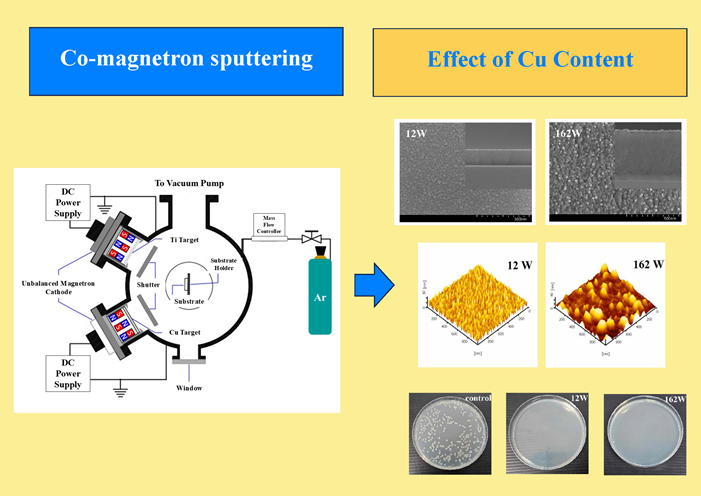
Ti-Cu alloy thin films exhibit considerable potential for the development of advanced antibacterial surfaces, particularly for biomedical applications. In this research, Ti-Cu binary alloy thin films with a wide range of Cu content from 25.8 at% to 77.8 at% were deposited using magnetron co-sputtering with pure Ti and Cu as the targets. The composition of Cu in the films can be controlled by the applied power of Cu targets. This study investigated the effect of Cu content on the microstructural, morphological, and antibacterial properties using X-ray diffraction (XRD), Field emission scanning electron microscopy (FESEM), Atomic force microscopy (AFM), X-ray photoelectron spectroscopy (XPS) and plate-count method, respectively. Structural analysis using XRD revealed that Ti (Cu) solid solution is formed for the Ti-Cu coatings with the Cu contents of 25.8 at% and the films tended to form an amorphous structure embedded with Cu nanocrystals when the Cu content was 77.8 at%. Surface morphology showed that the films with higher Cu content exhibited increased surface roughness and the presence of Cu nano-granular features. Antibacterial evaluations against Escherichi coli showed that the films containing Cu in the range of 25.8 at% to 77.8 at%. This effect is attributed to both inherent antibacterial properties by Cu and the microstructural modifications that enhance bacterial inhibition.
Downloads
References
X. Liu, S. Chen, J. K. Tsoi, and J. P. Matinlinna, “Binary titanium alloys as dental implant materials—a review,” Regenerative Biomaterials, vol. 4, no. 5, pp. 315–323, 2017. DOI: https://doi.org/10.1093/rb/rbx027
P. A. Dearnley, K. L. Dahm, and H. Çimenoglu, “The corrosion–wear behavior of thermally oxidised CP-Ti and Ti–6Al–4V,” Wear, vol. 256, no. 5, pp. 469–479, 2004. DOI: https://doi.org/10.1016/S0043-1648(03)00557-X
M. Geetha, A. K. Singh, R. Asokamani, and A. K. Gogia, “Ti based biomaterials, the ultimate choice for orthopaedic implants—A review,” Progress in Materials Science, vol. 54, no. 3, pp. 397–425, 2009. DOI: https://doi.org/10.1016/j.pmatsci.2008.06.004
H. Kahn, M. A. Huff, and A. H. Heuer, “The TiNi shape-memory alloy and its applications for MEMS,” Journal of Micromechanics and Microengineering, vol. 8, no. 3, p. 213‒221, 1998. DOI: https://doi.org/10.1088/0960-1317/8/3/007
Y. Tong, A. Shuitcev, and Y. Zheng, “Recent development of TiNi-based shape memory alloys with high cycle stability and high transformation temperature,” Advanced Engineering Materials, vol. 22, no. 4, p. 1900496, 2020. DOI: https://doi.org/10.1002/adem.201900496
R. Karelin, V. Komarov, V. Cherkasov, I. Khmelevskaya, V. Andreev, V. Yusupov, and S. Prokoshkin, “Structure and properties of TiNi shape memory alloy after quasi-continuous equal-channel angular pressing in various aged states,” Metals, vol. 13, no. 11, p. 1829, 2023. DOI: https://doi.org/10.3390/met13111829
M. Marczewski, K. Wieczerzak, X. Maeder, L. Lapeyre, C. Hain, M. Jurczyk, and T. Nelis, “Microstructure and mechanical properties of Ti-Nb alloys: comparing conventional powder metallurgy, mechanical alloying, and high power impulse magnetron sputtering processes for supporting materials screening,” Journal of Materials Science, vol. 59, no. 20, pp. 9107–9125, 2024. DOI: https://doi.org/10.1007/s10853-024-09715-0
E. M. Karakurt, Y. Huang, Y. Cetin, A. Incesu, H. Demirtas, M. Kaya, Y. Yildizhan, M. Tosun, and G. Akbas, “Assessing microstructural, biomechanical, and biocompatible properties of TiNb alloys for potential use as load-bearing implants,” Journal of Functional Biomaterials, vol. 15, no. 9, p. 253, 2024. DOI: https://doi.org/10.3390/jfb15090253
H. M. Grandin, S. Berner, and M. Dard, “A review of titanium zirconium (TiZr) alloys for use in endosseous dental implant,” Materials, vol. 5, no. 8, pp. 1348–1360, 2012. DOI: https://doi.org/10.3390/ma5081348
P. Ji, S. Liu, C. Shi, K. Xu, Z. Wang, B. Chen, B. Li, Y. Yang, and R. Liu, “Synergistic effect of Zr addition and grain refinement on corrosion resistance and pitting corrosion behavior of single α-phase Ti-Zr-based alloys,” Journal of Alloys and Compounds, vol. 896, p. 163013, 2022. DOI: https://doi.org/10.1016/j.jallcom.2021.163013
S. Rashid, M. Sebastiani, M. Z. Mughal, R. Daniel, and E. Bemporad, “Influence of the silver content on mechanical properties of Ti-Cu-Ag thin films,” Nanomaterials, vol. 11, no. 2, p. 435, 2021. DOI: https://doi.org/10.3390/nano11020435
C. Apblett, D. Muira, M. Sullivan, and P. J. Ficalora, “Reaction of Cu‐Ti bilayer films in vacuum and hydrogen,” Journal of Applied Physics, vol. 71, no. 10, pp. 4925–4932, 1992. DOI: https://doi.org/10.1063/1.350641
D. Wojcieszak, D. Kaczmarek, A. Antosiak, M. Mazur, Z. Rybak, A. Rusak, M. Osekowska, A. Poniedzialek, A. Gamian, and B. Szponar, “Influence of Cu–Ti thin film surface properties on antimicrobial activity and viability of living cells” Materials Science and Engineering: C, vol. 56, pp. 48–56, 2015. DOI: https://doi.org/10.1016/j.msec.2015.06.013
C. Yi, Z. Ke, L. Zhang, J. Tan, Y. Jiang, and Z. He, “Antibacterial Ti-Cu alloy with enhanced mechanical properties as implant applications,” Materials Research Express, vol. 7, no. 10, p. 105404, 2020. DOI: https://doi.org/10.1088/2053-1591/abc371
V. Stranak, H. Wulff, H. Rebl, C. Zietz, K. Arndt, R. Bogdanowicz, B. Nebe, R. Bader, A. Podbielski, Z. Hubicka, and R. Hippler, “Deposition of thin titanium–copper films with antimicrobial effect by advanced magnetron sputtering methods,” Materials Science and Engineering: C, vol. 31, no. 7, pp. 1512-1519, 2011. DOI: https://doi.org/10.1016/j.msec.2011.06.009
P. Mahmoudi, M. R. Akbarpour, H. B. Lakeh, F. Jing, M. R. Hadidi, and B. Akhavan, “Antibacterial Ti–Cu implants: A critical review on mechanisms of action,” Materials Today Bio, vol. 17, p. 100447, 2022. DOI: https://doi.org/10.1016/j.mtbio.2022.100447
W. Zhang, S. Zhang, H. Liu, L. Ren, Q. Wang, and Y. Zhang, “Effects of surface roughening on antibacterial and osteogenic properties of Ti-Cu alloys with different Cu contents,” Journal of Materials Science & Technology, vol 88, pp. 158-167. 2021. DOI: https://doi.org/10.1016/j.jmst.2021.01.067
E. Zhang, X. Wang, M. Chen, and B. Hou, “Effect of the existing form of Cu element on the mechanical properties, bio-corrosion and antibacterial properties of Ti-Cu alloys for biomedical application,” Materials Science and Engineering: C, vol. 69, pp. 1210-1221, 2016. DOI: https://doi.org/10.1016/j.msec.2016.08.033
S. Mahmoudi-Qashqay, M. R. Zamani-Meymian, and S. J. Sadati, “Improving antibacterial ability of Ti-Cu thin films with co-sputtering method,” Scientific Reports, vol. 13, no. 1, p. 16593, 2023. DOI: https://doi.org/10.1038/s41598-023-43875-4
N. Witit-anun, and A. Buranawong, “High-temperature oxidation resistance of CrAlN thin films prepared by DC reactive magnetron sputtering,” Journal of Metals, Materials and Minerals, vol. 33, no. 3, p. 1600, 2023. DOI: https://doi.org/10.55713/jmmm.v33i3.1600
K. Leelaruedee, K. Taweesup, and P. Visuttipitukul, “Formation of nano-crystalline chromium-zirconium nitride (Cr-Zr-N) film coating by DC unbalanced magnetron sputtering,” Journal of Metals, Materials and Minerals, vol. 31, no. 4, pp. 69–75, 2021.
R. L. Zong, S. P. Wen, F. Zeng, Y. Gao, and F. Pan, “Nano-indentation studies of Cu–W alloy films prepared by magnetron sputtering,” Journal of Alloys and Compounds, vol. 464, no. 1-2, pp. 544–549, 2008. DOI: https://doi.org/10.1016/j.jallcom.2007.10.033
M. Ghidelli, A. Orekhov, A. Li Bassi, G. Terraneo, P. Djemia, G. Abadias, M. Nord, A. Béché, N. Gauquelin, J. Verbeeck, J. P. Raskin, D. Schryvers, T. Pardoen, and H. Idrissi, “Novel class of nanostructured metallic glass films with superior and tunable mechanical properties,” Acta Materialia, vol. 213, p. 116955, 2021. DOI: https://doi.org/10.1016/j.actamat.2021.116955
A. Ishida, M. Sato, and Z. Y. Gao, “Effects of Ti content on microstructure and shape memory behavior of TixNi(84.5− x) Cu15. 5 (x= 44.6–55.4) thin films,” Acta materialia, vol. 69, pp. 292-300, 2014. DOI: https://doi.org/10.1016/j.actamat.2014.02.006
L. Qin, D. Ma, Y. Li, P. Jing, B. Huang, F. Jing, D. Xie, Y. Leng, B. Akhavan, and N. Huang, “Ti–Cu coatings deposited by a combination of HiPIMS and DC magnetron sputtering: The role of vacuum annealing on Cu diffusion, microstructure, and corrosion resistance,” Coatings, vol. 10, no. 11, p. 1064, 2020. DOI: https://doi.org/10.3390/coatings10111064
M. C. Biesinger, “Advanced analysis of copper X‐ray photoelectron spectra,” Surface and Interface Analysis, vol.49, no.13, pp. 1325-1334, 2017. DOI: https://doi.org/10.1002/sia.6239
A. Roy, A. K. Mukhopadhyay, S. C. Das, G. Bhattacharjee, A. Majumdar, and R. Hippler, “Surface stoichiometry and optical properties of Cux-TiyCz thin films deposited by magnetron sputtering,” Coatings, vol. 9, no. 9, p. 551, 2019. DOI: https://doi.org/10.3390/coatings9090551
Y. Cudennec, and A. Lecerf, “The transformation of Cu(OH)2 into CuO, revisited,” Solid State Sciences, vol. 5, no. 11–12, pp. 1471–1474, 2003. DOI: https://doi.org/10.1016/j.solidstatesciences.2003.09.009
I. Salah, E. Allan, S. P. Nair, and I. P. Parkin, “Antibacterial performance of a copper nanoparticle thin film,” Nano Select, vol. 5, no. 9, p. 2300134, 2024. DOI: https://doi.org/10.1002/nano.202300134
J. Hasan, R. J. Crawford, and E. P. Ivanova, “Antibacterial surfaces: The quest for a new generation of biomaterials,” Trends in Biotechnology, vol. 31, no. 5, pp. 295–304, 2013. DOI: https://doi.org/10.1016/j.tibtech.2013.01.017
Downloads
Published
How to Cite
License
Copyright (c) 2025 Journal of Metals, Materials and Minerals

This work is licensed under a Creative Commons Attribution-NonCommercial-NoDerivatives 4.0 International License.
Authors who publish in this journal agree to the following terms:
- Authors retain copyright and grant the journal right of first publication with the work simultaneously licensed under a Creative Commons Attribution License that allows others to share the work with an acknowledgment of the work's authorship and initial publication in this journal.
- Authors are able to enter into separate, additional contractual arrangements for the non-exclusive distribution of the journal's published version of the work (e.g., post it to an institutional repository or publish it in a book), with an acknowledgment of its initial publication in this journal.