Effect of anodization voltage and heat treatment on the surface crystallinity and hydrophilicity of the Ti-6Al-4V
DOI:
https://doi.org/10.55713/jmmm.v36i4.2550คำสำคัญ:
Hydrophilicity, Heat Treatment, Crystallinity, TiO2บทคัดย่อ
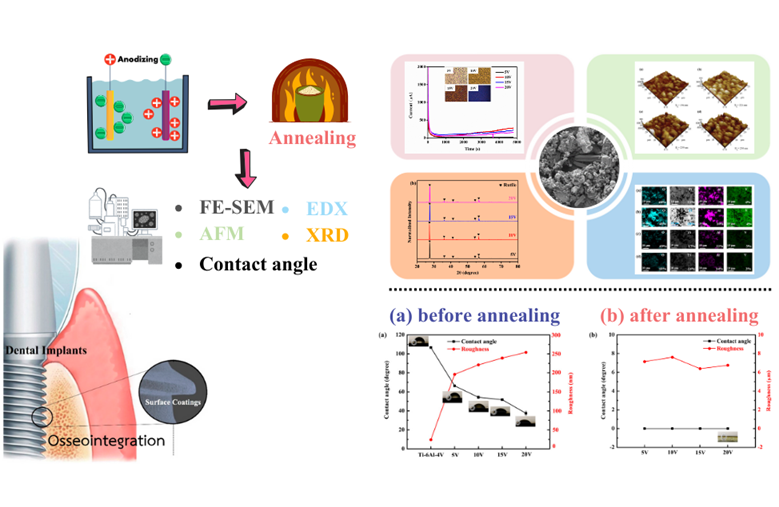
The formation of superhydrophilic surfaces on Ti-6Al-4V was achieved through anodization at different voltages, followed by heat treatment at 1000℃ for 2 h. This treatment not only enhanced surface crystallinity but also induced morphological changes. A comprehensive analysis of surface properties, including morphology, phase composition, elemental structure, surface roughness, and hydrophilicity, was conducted using OM, FE-SEM, EDX, XRD, AFM, 3D laser scanning confocal microscope, and contact angle measurements, respectively. The TiO2 anodized films exhibited enhanced crystallinity, increased surface roughness, and a higher oxygen-to-titanium ratio. As a result, the TiO2 anodized films showed consistent morphology and distribution of elements, with high temperature annealing leading to a transformation from amorphous to crystalline structures, accompanied by elevated surface roughness, and augmented hydrophilicity.
Downloads
เอกสารอ้างอิง
Z. Wang, W. Huang, and X. Meng, “Electrochemical behaviour of Ti–25Nb–3Mo–3Zr–2Sn biomedical alloy in different simulated physiological environments,” Materials Science and Technology, vol. 31, pp. 1335‒1341, 2015. DOI: https://doi.org/10.1179/1743284714Y.0000000696
S. Boonrungsiman, P. Prompinit, P. Khemthong, T. Wutikhun, A. Treethong, P. Kasamechonchung, N. Chanlek, R. Mani-ratanachote, M. Horprathum, A. Pankiew, S. Pornthreeraphat, N. Khemasiri, and A. Klamchuen, “Effects of thermal treatment on hydrophilicity and corrosion resistance of Ti surface,” Surface and Interface Analysis, vol. 51, no. 3, pp. 308‒315, 2019. DOI: https://doi.org/10.1002/sia.6580
P. Whangdee, W. Saenrang, and D. Pongkao Kashima, “Effect of fluoride and hydroxyl group on bioactivity of the anodized films prepared by two-step anodization at low current density,” Surface and Interface Analysis, vol. 54, no. 7, pp. 724‒733, 2022. DOI: https://doi.org/10.1002/sia.7085
P. Whangdee, S. Nilmoung, N. Pangpaiboon, and D. Pongkao Kashima, “The effect of low current density on the hydrophilicity and surface properties of the anodized films performed by two-step anodization,” SNRU Journal of Science and Technology, vol. 11, pp. 45‒54, 2019.
P. Whangdee, S. Nilmoung, N. Pangpaiboon, and D. Pongkao Kashima, “Effect of ethanol on hydrophilicity of the anodized films performed by two-step anodization at low current density,” Journal of Metals, Materials and Minerals, vol. 29, no. 3, pp. 60‒65, 2019.
Y. M. Wang, B. L. Jiang, L. X. Guo, and T. C. Lei, “Controlled synthesis of microarc oxidation coating on Ti6Al4V alloy and its antifriction properties,” Materials Science and Technology, vol. 20, no. 12, pp. 1590‒1594, 2004. DOI: https://doi.org/10.1179/026708304225019669
X.-m. Wang, and F.-q. Zhang, “Influence of anions in phosphate and tetraborate electrolytes on growth kinetics of microarc oxidation coatings on Ti6Al4V alloy,” Transactions of Nonferrous Metals Society of China, vol. 32, pp. 2243‒2252, 2022. DOI: https://doi.org/10.1016/S1003-6326(22)65944-2
P. K. Srivas, K. Kapat, B. Das, P. Pal, P. G. Ray, and S. Dhara, “Hierarchical surface morphology on Ti6Al4V via patterning and hydrothermal treatment towards improving cellular response,” Applied Surface Science, vol. 478, pp. 806‒817, 2019. DOI: https://doi.org/10.1016/j.apsusc.2019.02.039
C. Wang, H. Huang, Z. Zhang, L. Zhang, J. Yan, and L. Ren, “Formation, evolution and characterization of nanoporous structures on the Ti6Al4V surface induced by nanosecond pulse laser irradiation,” Materials & Design, vol. 223, p. 111243, 2022. DOI: https://doi.org/10.1016/j.matdes.2022.111243
Y. Xu, Y. Lu, J. Liang, and R. D. Sison, “Microstructure and corrosion behaviour of additively manufactured Ti–6Al–4V with various post-heat treatments,” Materials Science and Technology, vol. 35, pp. 89‒97, 2019. DOI: https://doi.org/10.1080/02670836.2018.1542052
X. Zhang, Y. Wan, Z. Liu, H. Wang, M. Yu, A. Liu, and D. Zhang, “Preparation and bioactive response of super-hydro-philic surface on selective laser melting titanium,” Procedia CIRP, vol. 89, pp. 222‒227, 2020. DOI: https://doi.org/10.1016/j.procir.2020.05.145
M. Fazel, H. R. Salimijazi, M. Shamanian, M. Minneboo,K. Modaresifar, I. A. J. van Hengel, L. E. Fratila-Apachitei, I. Apachitei, and A. A. Zadpoor, “Osteogenic and antibacterial surfaces on additively manufactured porous Ti-6Al-4V implants: Combining silver nanoparticles with hydrothermally synthesized HA nanocrystals,” Materials Science and Engineering: C, vol. 120, p. 111745, 2021. DOI: https://doi.org/10.1016/j.msec.2020.111745
K. H. Cheung, M. B. Pabbruwe, W.-F. Chen, P. Koshy, and C. C. Sorrell, “Effects of substrate preparation on TiO2 morphology and topography during anodization of biomedical Ti6Al4V,” Materials Chemistry and Physics, vol. 252, p. 123224, 2020. DOI: https://doi.org/10.1016/j.matchemphys.2020.123224
A. Vadiraj, M. Kamaraj, U. K. Mudali, and A. K. Nath, “Effect of surface modified layers on fretting fatigue damage of bio-medical titanium alloys,” Materials Science and Technology, vol. 22, no. 9, pp. 1119‒1125, 2006. DOI: https://doi.org/10.1179/174328406X109212
Y. H. Wong, M. G. Affendy, S. K. Lau, P. C. The, H. J. Lee, C. Y. Tan, and S. Ramesh, “Effects of anodisation parameters on thin film properties: A review,” Materials Science and Technology, vol. 33, pp. 699‒711, 2017. DOI: https://doi.org/10.1080/02670836.2016.1193654
P. Whangdee, W. Saenrang, and D. Pongkao Kashima, “Effect of surface fluorination on the hydrophilicity of the anodised films for dental implant applications,” Materials Research Innovations, vol. 24, no. 6, pp. 321–325, 2020. DOI: https://doi.org/10.1080/14328917.2019.1677077
P. Whangdee, S. Sriprasertsuk, V. Sirmaneepong, and D. Pongkao Kashima, “Surface characteristics and hydrophilicity of the as-anodized films formed at high current density on Ti-6Al-4V in different electrolytes,” Key Engineering Materials, vol. 608, pp. 274‒279, 2014. DOI: https://doi.org/10.4028/www.scientific.net/KEM.608.274
P. Whangdee, S. Chukasorn, V. Srimaneepong, T, Watanabe, and D. Pongkao Kashima, “Effects of surface roughness and chemical species on hydrophilicity of anodized film on Ti-6Al-4V formed at a low current density,” Advanced Materials Research, vol. 664, pp. 774‒779, 2013. DOI: https://doi.org/10.4028/www.scientific.net/AMR.664.774
V. V. Akimov, E. A. Tyukhai, V. L. Tauson, A. Y. Safronov, A. V. Kashevskii, B. G. Pushkarev, S. B. Nikiforov, and E. V. Voloshin, “Characteristics of morphology, structure and composition of titanium surface under its modification by electrochemical polarization in phosphate-alkaline solutions,” Surface and Interface Analysis, vol. 47, no. 12, pp. 1081‒1097, 2015. DOI: https://doi.org/10.1002/sia.5848
P. Ausiello, E. Bolli, S. Kaciulis, A. Gloria, A. Lanzotti, M. Martorelli, A. Mezzi, R. Montanari, M. Richetta, and A. Varone, “Morphology and microchemistry study of three commercial dental implants,” Surface and Interface Analysis, vol. 55, no. 5, pp. 411‒416, 2023. DOI: https://doi.org/10.1002/sia.7166
S. Durdu, G. Cihan, E. Yalcin, and A. Altinkok, “Characterization and mechanical properties of TiO2 nanotubes formed on titanium by anodic oxidation,” Ceramics International, vol. 47, no. 8, pp. 10972‒10979, 2021. DOI: https://doi.org/10.1016/j.ceramint.2020.12.218
X. Li, C. Li, T. Gong, J. Su, W. Zhang, Y. Song, and X. Zhu, “Comparative study on the anodizing process of Ti and Zr and oxide morphology,” Ceramics International, vol. 47, no. 16, pp. 23332‒23337, 2021. DOI: https://doi.org/10.1016/j.ceramint.2021.05.046
Y. Ni, J. Zhang, T. Gong, M. Sun, Z. Zhao, X. Li, H. Yu, and X. Zhu, “Quantitative analysis of the volume expansion of nanotubes during constant voltage anodization,” Surfaces and Interfaces, vol. 26, p. 101419, 2021. DOI: https://doi.org/10.1016/j.surfin.2021.101419
C. C. Manole, and C. Pirvu, “Surface and electrochemical analysis for the understanding of TiO2 nanopores/nanotubes changes in post-elaboration treatment,” Surface and Interface Analysis, vol. 43, pp. 1022‒1029, 2011. DOI: https://doi.org/10.1002/sia.3685
X. Hou, P. D. Lung, and Y. Li, “Controlling anodization time to monitor film thickness, phase composition and crystal orientation during anodic growth of TiO2 nanotubes,” Electro-chemistry Communications, vol. 134, p. 107168, 2022. DOI: https://doi.org/10.1016/j.elecom.2021.107168
Q. Zhou, M. Tian, Z. Ying, Y. Dan, F. Tang, J. Zhang, J. Zhu, and X. Zhu, “Dense films formed during Ti anodization in NH4F electrolyte: Evidence against the field-assisted dissolution reactions of fluoride ions,” Electrochemistry Communications, vol. 111, p. 106663, 2020. DOI: https://doi.org/10.1016/j.elecom.2020.106663
Y. Li, Y. Tan, K. Liang, L. Zhang, and S. Zhang, “Study of the dimensions and photoelectric properties of TiO2 NTs prepared by the double Ti-Electrode oxidation method,” Journal of Alloys and Compounds, vol. 859, p. 157878, 2021. DOI: https://doi.org/10.1016/j.jallcom.2020.157878
L. Skowronski, and M. Chorobinski, “The effect of thickness and optical constants of the dielectric layer on the color behaviour of the glass/Ti/TiO2 decorative coatings,” Thin Solid Films, vol. 691, p. 137595, 2019. DOI: https://doi.org/10.1016/j.tsf.2019.137595
S. Kim, M. Jung, M. Kim, and J. Choi, “Bi-functional anodic TiO2 oxide: Nanotubes for wettability control and barrier oxide for uniform coloring,” Applied Surface Science, vol. 407, pp. 353‒360, 2017. DOI: https://doi.org/10.1016/j.apsusc.2017.02.166
A. G. Sanchez, W. Schreiner, G. Duffo, and S. Cere, “Surface modification of titanium by anodic oxidation in phosphoric acid at low potentials. Part 1. Structure, electronic properties and thickness of the anodic films,” Surface and Interface Analysis, vol. 45, no. 6, pp. 1037‒1046, 2013. DOI: https://doi.org/10.1002/sia.5210
O. Yilmaz, M. F. Ebeoglugil, R. Dalmis, and T. Dikici, “Effect of anodizing time on the structural color and photocatalytic properties of the TiO2 films formed by electrochemical method,” Materials Science in Semiconductor Processing, vol. 167, p. 107768, 2023. DOI: https://doi.org/10.1016/j.mssp.2023.107768
A. Maciej, A. Wadas, M. Sowa, R. Socha, M. Kubiczek, and W. Simka, “Colourful thin passive films on a Zn-Co alloy formed by anodic oxidation,” Electrochimica Acta, vol. 373, p. 137922, 2021. DOI: https://doi.org/10.1016/j.electacta.2021.137922
L. Mohan, C. Dennis, N. Padmapriya, C. Anandan, and N. Rajendran, “Effect of electrolyte temperature and anodization time on formation of TiO2 nanotubes for biomedical applications,” Materials Today Communications, vol. 23, p. 101103, 2020. DOI: https://doi.org/10.1016/j.mtcomm.2020.101103
L. Zhang, M. Shao, Z. Zhang, X. Yi, J. Yan, Z. Zhou, D. Fang, Y. He, and Y. Li, “Corrosion behavior of nitrided layer of Ti6Al4V titanium alloy by hollow cathodic plasma source nitriding,” Materials, vol. 16, no. 8, p. 2961, 2023. DOI: https://doi.org/10.3390/ma16082961
M. D. Wadge, M. J. Carrington, H. Constantin, K. Orange, J. Greaves, Md. T. Islam, K. M. Z. Hossain, T. P. Copper, Z. R. Kudrynskyi, R. M. Felfel, I. Ahmed, and D. M. Grant, “Characterization of potential nanoporous sodium titanate film formation on Ti6Al4V and TiO2 microspherical substrates via wet-chemical alkaline conversion,” Materials Characterization, vol. 185, p. 111760, 2022. DOI: https://doi.org/10.1016/j.matchar.2022.111760
M. Wang, Y. Wu, S. Lu, T. Chen, Y. Zhao, H. Chen, and Z. Tang, “Fabrication and characterization of selective laser melting printed Ti–6Al–4V alloys subjected to heat treatment for customized implants design,” Progress in Natural Science: Materials International, vol. 26, no. 6, pp. 671‒677, 2016. DOI: https://doi.org/10.1016/j.pnsc.2016.12.006
E. Ahounbar, S. M. M. Khoei, M. Urgen, and M. Shokouhimehr, “Characteristics of the hierarchical porous TiO2 layer synthesized on Ti via plasma electrolytic oxidation: Role of the applied voltage,” Ceramics International, vol. 47, no. 6, pp. 8279‒8289, 2021. DOI: https://doi.org/10.1016/j.ceramint.2020.11.189
D. Yang, Titanium Dioxide - Material for a Sustainable Environment, London: IntechOpen., 2018, pages 518. DOI: https://doi.org/10.5772/intechopen.70290
M. Jahdi, S. B. Mishra, E. N. Nxumalo, S. D. Mhlanga, and A. K. Mishra, “Synergistic effects of sodium fluoride (NaF) on the crystallinity and band gap of Fe-doped TiO2 developed via microwave-assisted hydrothermal treatment,” Optical Materials, vol. 104, p. 109844, 2020. DOI: https://doi.org/10.1016/j.optmat.2020.109844
M. Fazel, H. R. Salimijazi, M. Shamanian, I. Apachitei, and A. A. Zadpoor, “Influence of hydrothermal treatment on the surface characteristics and electrochemical behavior of Ti-6Al-4V bio-functionalized through plasma electrolytic oxidation,” Surface and Coatings Technology, vol. 374, pp. 222‒231, 2019. DOI: https://doi.org/10.1016/j.surfcoat.2019.05.088
M. Daniyal, S. Akhtar, and A. Azam, “Effect of nano-TiO2 on the properties of cementitious composites under different exposure environments,” Journal of Materials Research and Technology, vol. 8, no. 6, pp. 6158‒6172, 2019. DOI: https://doi.org/10.1016/j.jmrt.2019.10.010
S. S. Lephuthing, A. M. Okoro, O. O. Ige, and P. A. Olunambi, “Microstructural and electrochemical studies of spark plasma sintered multiwall carbon nanotubes reinforced TiO2–MnO2 based composite,” Journal of Materials Research and Technology, vol. 12, pp. 894‒903, 2021. DOI: https://doi.org/10.1016/j.jmrt.2021.03.003
A. Medvids, S. Varnagiris, E. Letko, D. Milcius, L. Grase, S. Gaidukovs, A. Mychko, A. Pludons, P. Onufrijevs, and H. Minura, “Phase transformation from rutile to anatase with oxygen ion dose in the TiO2 layer formed on a Ti substrate,” Materials Science in Semiconductor Processing, vol. 106, p. 104776, 2020. DOI: https://doi.org/10.1016/j.mssp.2019.104776
T. Kobayashi, and S. Konishi, “Acceleration of wettability switching on TiO2 thin films under ultraviolet irradiation and direct current bias voltage,” Surface and Coatings Technology, vol. 363, pp. 80‒86, 2019. DOI: https://doi.org/10.1016/j.surfcoat.2019.02.043
F. Meng, L. Xiao, and Z. Sun, “Thermo-induced hydrophilicity of nano-TiO2 thin films prepared by RF magnetron sputtering,” Journal of Alloys and Compounds, vol. 485, no. 1‒2. pp. 848‒852, 2009. DOI: https://doi.org/10.1016/j.jallcom.2009.06.107
Y. Jiang, H. Liu, K. Shi, C. Tang, and J. Song, “Effect of annealing temperature on wettability of TiO2/PDA thin films,” Surface and Coatings Technology, vol. 411, p. 126994, 2021. DOI: https://doi.org/10.1016/j.surfcoat.2021.126994
O. Secundino-Sánchez, J. Diaz-Reyes, J. Aguila-Lopez, and J. F. Sanchez-Ramirez, “Crystalline phase transformation of electrospinning TiO2 nanofibres carried out by high temperature annealing,” Journal of Molecular Structure, vol. 1194, pp. 163‒170, 2019. DOI: https://doi.org/10.1016/j.molstruc.2019.05.092
D. Nesheva, T. Babeva, M. Vasileva, B. Valdez-Salas, V. Dzhurkov, M. U. Grujić-Brojčin, M. J. Šćepanović, O. Perez, N. Nedev, M Curiel, T. Srećković, “Phase characterization and ethanol adsorption in TiO2 nanotubes anodically grown on Ti6Al4V alloy substrates,” Journal of Alloys and Compounds, vol. 798, pp. 394‒402, 2019. DOI: https://doi.org/10.1016/j.jallcom.2019.05.247
F. Güzelçimen, F. Güzelçimen, B. Tanören, Ç. Çetinkaya, M. D. Kaya, H. İ. Efkere, Y. Özen, D. Bingöl, M. Sirkeci, B. Kınacı, M. B. Ünlü, S. Özçelik, “The effect of thickness on surface structure of rf sputtered TiO2 thin films by XPS, SEM/EDS, AFM and SAM,” Vacuum, vol. 182, p. 109766, 2020. DOI: https://doi.org/10.1016/j.vacuum.2020.109766
Y. Jiang, K. Shi, H. Tang, and Y. Wang, “Enhanced wettability and wear resistance on TiO2/PDA thin films prepared by sol-gel dip coating,” Surface and Coatings Technology, vol. 375, pp. 334‒340, 2019. DOI: https://doi.org/10.1016/j.surfcoat.2019.07.051
R. Sun, Z. Chen, J. Peng, and T. Zheng, “The effect mechanisms of pH, complexant and calcination temperature on the hydro-philicity of TiO2 films prepared by the sol-gel method,” Applied Surface Science, vol. 462, pp. 480‒488, 2018. DOI: https://doi.org/10.1016/j.apsusc.2018.08.163
D. Wei, Y. Zhou, and C. Yang, “Yang, Structure, cell response and biomimetic apatite induction of gradient TiO2-based/nano-scale hydrophilic amorphous titanium oxide containing Ca composite coatings before and after crystallization,” Colloids and Surfaces B: Biointerfaces, vol. 74, no. 1, pp. 230‒237, 2009. DOI: https://doi.org/10.1016/j.colsurfb.2009.07.025
M. Sarraf, E. Zalnezhad, A. R. Bushroa, A. M. S. Hamouda, A. R. Rafieerad, and B. Nasiri-Tabrizi, “Effect of microstructural evolution on wettability and tribological behavior of TiO2 nano-tubular arrays coated on Ti–6Al–4V,” Ceramics International, vol. 41, no. 6, pp. 7952‒7962, 2015. DOI: https://doi.org/10.1016/j.ceramint.2015.02.136
Y. Luo, Y. Jiang, J. Zhu, J. Tu, and S. Jiao, “Surface treatment functionalization of sodium hydroxide onto 3D printed porous Ti6Al4V for improved biological activities and osteogenic potencies,” Journal of Materials Research and Technology, vol. 9, no. 6, pp. 13661‒13670, 2020. DOI: https://doi.org/10.1016/j.jmrt.2020.09.076
ดาวน์โหลด
เผยแพร่แล้ว
วิธีการอ้างอิง
ฉบับ
บท
Categories
การอนุญาต
ลิขสิทธิ์ (c) 2026 วารสารโลหะ, วัสดุ และแร่

This work is licensed under a Creative Commons Attribution-NonCommercial-NoDerivatives 4.0 International License.
Authors who publish in this journal agree to the following terms:
- Authors retain copyright and grant the journal right of first publication with the work simultaneously licensed under a Creative Commons Attribution License that allows others to share the work with an acknowledgment of the work's authorship and initial publication in this journal.
- Authors are able to enter into separate, additional contractual arrangements for the non-exclusive distribution of the journal's published version of the work (e.g., post it to an institutional repository or publish it in a book), with an acknowledgment of its initial publication in this journal.