Tailoring mechanical response of AA8006 aluminum alloy through severe cold rolling: A process–structure–property study
DOI:
https://doi.org/10.55713/jmmm.v37i1.2614คำสำคัญ:
Al–Fe–Si-based alloys, Cold rolling, Work hardening, Crystallographic texture, Electron backscatter diffractionบทคัดย่อ
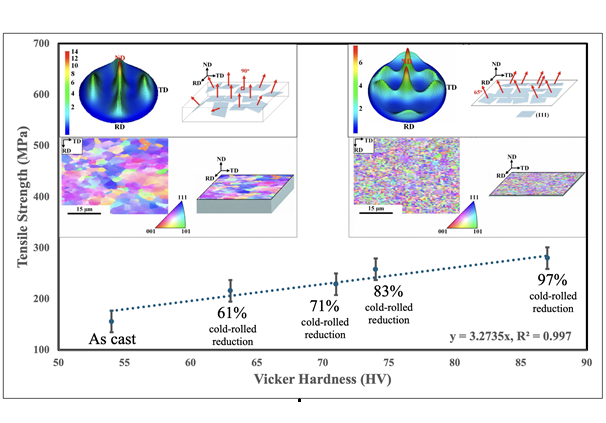
This study investigates the process–structure–property relationships of AA8006 aluminum alloy processed by twin-roll casting followed by cold rolling with thickness reductions ranging from 0% to 97%. Microstructural characterization reveals progressive grain elongation and fragmentation of Al–Fe–Mn–Si intermetallic particles with increasing deformation. These microstructural changes are accompanied by a continuous increase in tensile strength from 156 MPa to 280 MPa and a significant increase in hardness, primarily attributed to work hardening and particle–dislocation interactions. Crystallographic characterization using X-ray diffraction (XRD) and electron backscatter diffraction (EBSD) demonstrates substantial texture evolution and grain subdivision during cold rolling, indicating the development of deformation-induced microstructures. The combined microstructural, mechanical, and crystallographic analyses provide a comprehensive understanding of the strengthening mechanisms and deformation behavior of severely cold-rolled AA8006 alloy, offering useful insights for optimizing thermomechanical processing routes in non-heat-treatable aluminum alloys.
Downloads
เอกสารอ้างอิง
F. Czerwinski, “Aluminum alloys for electrical engineering: A review,” Journal of Materials Science, vol. 59, no. 32. pp.14847–14892, 2024. DOI: https://doi.org/10.1007/s10853-024-09890-0
J. Hirsch, and T. Al-Samman, “Superior light metals by texture engineering: Optimized aluminum and magnesium alloys for automotive applications,” Acta Materialia, vol. 61, no. 3, pp. 818–843, 2013, DOI: https://doi.org/10.1016/j.actamat.2012.10.044
T. Jin, H. Xiao, L. Ding, X. Zhao, X. Lei, B. Wan, Y. Weng, Z. Jia, and Q. Liu, “Microstructure and texture evolution in aluminum alloys,” Materials Characterization, vol. 200, p. 112857, 2023. DOI: https://doi.org/10.1016/j.matchar.2023.112857
X. Gong, H. Li, S. B. Kang, J. H. Cho, and S. Li, “Texture and microstructure evolution during rolling of aluminum alloys,” Materials & Design, vol. 31, pp. 1581–1587, 2010. DOI: https://doi.org/10.1016/j.matdes.2009.09.021
Z. Li, J. Peng, J. Zhang, X. Chen, Q. Shan, S. Han, and F. Zhang, “Revealing the microstructure, texture evolution mechanism and mechanical properties of cryogenic rolled and microtherm aged AA6061,” Journal of Manufacturing Processes, vol. 120, pp. 205–221, 2024. DOI: https://doi.org/10.1016/j.jmapro.2024.04.039
R. Kumar, A. Gupta, T. R. Dandekar, and R. K. Khatirkar, “Evolution of microstructure and texture during homogenization in a strip cast AA8011 aluminum alloy,” Intermetallics, vol. 130, p. 107064, 2021. DOI: https://doi.org/10.1016/j.intermet.2020.107064
G. Gao, X. Li, B. Xiong, Z. Li, Y. Zhang, Y. Li, and L. Yan, “Effect of deformation on aluminum alloy microstructure,” Materials, vol. 15, p. 5638, 2022. DOI: https://doi.org/10.3390/ma15165638
Z. Wu, H. Bei, F. Otto, G. M. Pharr, and E. P. George, “Microstructural evolution and strengthening mechanisms,” Intermetallics, vol. 46, pp. 131–140, 2014. DOI: https://doi.org/10.1016/j.intermet.2013.10.024
N. B. Dahotre, “Surface modification and material processing,” Materials Manufacturing Processes, vol. 14, pp. 903–905, 1999. DOI: https://doi.org/10.1080/10426919908914882
R. K. Ray, J. J. Jonas, and R. E. Hook, “Cold rolling and annealing textures in low carbon and extra low carbon steels,” International Materials Reviews, vol. 39, pp. 129–172, 1994. DOI: https://doi.org/10.1179/imr.1994.39.4.129
O. Engler, S. Zaefferer, and V. Randle, “Introduction to texture analysis: Macrotexture, microtexture, and orientation mapping, 3rd ed. Boca Raton, FL, USA: CRC Press, 2024, DOI: https://doi.org/10.1201/9781003258339-2
A. B. Lopes, F. B. Barlat, J. Grácio, J. F. Duarte, and E. F. Rauch, “Effect of crystallographic texture on plastic anisotropy,” International Journal of Plasticity, vol. 19, pp. 1–22, 2003. DOI: https://doi.org/10.1016/S0749-6419(01)00016-X
Z. Bojar, P. R. Jóźwik, K. Karczewski, and W. Polkowski, “Microstructure and texture evolution in metallic materials,” Archives of Civil and Mechanical Engineering, vol. 14, pp. 550–559, 2014. DOI: https://doi.org/10.1016/j.acme.2014.04.011
S. Sadi, A. Hanna, T. Baudin, A. L. Helbert, F. Brisset, D. Bradai, and H. Azzeddine, “Evaluation of static recrystallization and grain growth kinetics of hot-rolled AZ31 alloy,” Journal of Metals, Materials and Minerals, vol. 32, no. 1, pp. 12–26, 2022. DOI: https://doi.org/10.55713/jmmm.v32i1.1241
W. Boonchouytan, J. Chatthong, and R. Burapa, “Analysis of the impact factors from the friction stir welding process for dissimilar butt joints between semi-solid cast aluminum 356 and AISI 1018 carbon steel,” Journal of Metals, Materials and Minerals, vol. 31, no. 2, pp. 1–9, 2021. DOI: https://doi.org/10.55713/jmmm.v31i2.1003
S. Hamza, Z. Boumerzoug, A. L. Helbert, F. Bresset, and T. Baudin, “Texture analysis of welded 304L pipeline steel,” Journal of Metals, Materials and Minerals, vol. 29, no. 3, 2019.
ASTM International. Standard Practice for Microetching Metals and Alloys. ASTM E407-07(2015)e1. West Conshohocken, PA: ASTM International, 2015.
N. Jantaping, C. A. Schuh, and Y. Boonyongmaneerat, “Influences of crystallographic texture and nanostructural features on corrosion properties of electrogalvanized and chromate conversion coatings,” Surface and Coatings Technology, vol. 329, pp. 120–130, 2017. DOI: https://doi.org/10.1016/j.surfcoat.2017.09.022
N. Jantaping, C. Banjongprasert, T. Chairuangsri, U. Patakham, and Y. Boonyongmaneerat, “Challenges and strategies of surface modification of electrogalvanized coatings for electron microscopy analysis,” Micron, vol. 86, pp. 48–53, 2016. DOI: https://doi.org/10.1016/j.micron.2016.04.006
P. Moldovan, G. Popescu, and F. Miculescu, “Microscopic study regarding the microstructure evolution of the 8006 alloy in the plastic deformation process,” Journal of Materials Processing Technology, vol. 153–154, pp. 408–415, 2004. DOI: https://doi.org/10.1016/j.jmatprotec.2004.04.345
O. Matvienko, O. Daneyko, T. Kovalevskaya, A. Khrustalyov, I. Zhukov, and A. Vorozhtsov, “Microstructure evolution in metallic systems,” Metals, vol. 11, p. 279, 2021. DOI: https://doi.org/10.3390/met11020279
N. Hansen and D. Juul Jensen, “Development of microstructure in FCC metals during cold work,” Philosophical Transactions of the Royal Society A, vol. 357, pp. 1447–1469, 1999. DOI: https://doi.org/10.1098/rsta.1999.0384
A. J. Ardell, “Precipitation hardening,” Metallurgical Transactions A, vol. 16, pp. 2131–2165, 1985. DOI: https://doi.org/10.1007/BF02670416
O. Engler, and J. Hirsch, “Texture control by thermomechanical processing of AA6xxx Al-Mg-Si sheet alloys for automotive applications,” Materials Science and Engineering A, vol. 336, pp. 249–262, 2002. DOI: https://doi.org/10.1016/S0921-5093(01)01968-2
H. Jazaeri, and F. J. Humphreys, “Recrystallization kinetics and texture evolution,” Acta Materialia, vol. 52, pp. 3251–3262, 2004. DOI: https://doi.org/10.1016/j.actamat.2004.03.031
Q. Liu, and N. Hansen, “Macroscopic and microscopic subdivision and local misorientation in cold-worked metals,” Proceedings of the Royal Society A, vol. 454, pp. 2555–2592, 1998. DOI: https://doi.org/10.1098/rspa.1998.0271
ดาวน์โหลด
เผยแพร่แล้ว
วิธีการอ้างอิง
ฉบับ
บท
Categories
การอนุญาต
ลิขสิทธิ์ (c) 2026 วารสารโลหะ, วัสดุ และแร่

This work is licensed under a Creative Commons Attribution-NonCommercial-NoDerivatives 4.0 International License.
Authors who publish in this journal agree to the following terms:
- Authors retain copyright and grant the journal right of first publication with the work simultaneously licensed under a Creative Commons Attribution License that allows others to share the work with an acknowledgment of the work's authorship and initial publication in this journal.
- Authors are able to enter into separate, additional contractual arrangements for the non-exclusive distribution of the journal's published version of the work (e.g., post it to an institutional repository or publish it in a book), with an acknowledgment of its initial publication in this journal.