Intelligent material recognition from thermal signatures using hybrid deep learning frameworks
DOI:
https://doi.org/10.55713/jmmm.v37i1.2693คำสำคัญ:
Long-wave infra-red, Material recognition, deep learning architecture, neural networksบทคัดย่อ
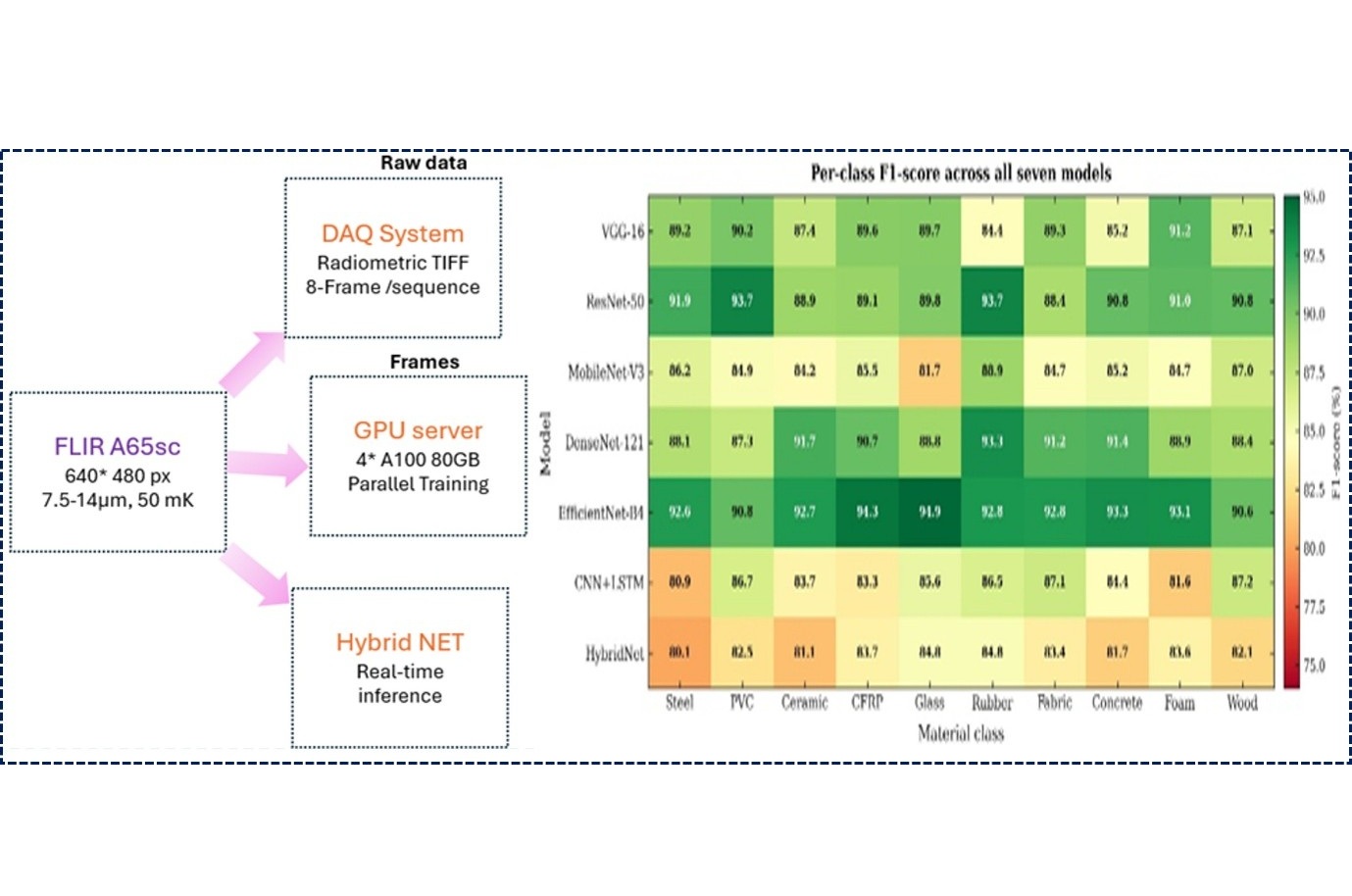
Accurate material identification using thermal infrared signatures has significant implications for industrial inspection, autonomous systems, and non-contact diagnostics. In this study, we propose a physics-informed deep learning framework for intelligent material recognition based on transient thermal behavior. A large-scale dataset, ThermalMat-85K, comprising 85,000 long-wave infrared (LWIR) images across ten material classes, was constructed under controlled multi-angle, multi-distance, and multi-environment conditions. Each sample was validated through Fourier transform infrared (FT-IR) spectroscopy and X-ray diffraction (XRD) to ensure chemical and structural integrity prior to thermal acquisition. Seven deep learning architectures were systematically evaluated, including VGG-16, ResNet-50, MobileNet-V3, DenseNet-121, EfficientNet-B4, a CNN+LSTM temporal hybrid, and a proposed Hybrid Net integrating convolutional, transformer, and recurrent modules with cross-modal attention gating. EfficientNet-B4 achieved the highest Top-1 accuracy (93.1%) and macro F1-score (92.8%), demonstrating superior class-wise stability. Residual and dense connectivity architectures also exhibited strong performance, while lightweight and temporal hybrids revealed trade-offs between efficiency and discriminative power. Class-wise confusion analysis indicates that misclassification trends correlate strongly with thermophysical proximity, particularly thermal conductivity and emissivity overlap. These findings confirm that transient thermal decay dynamics encode physically meaningful features suitable for material discrimination. The results establish a robust benchmark for physics-informed thermal material recognition and provide guidance for selecting architectures based on deployment constraints and robustness requirements.
Downloads
เอกสารอ้างอิง
N. F. M. Taha, "Robotics as a catalyst for sustainable food manufacturing: A malaysian empirical study," Applied Research, vol. 5, p. e70077, 2026. DOI: https://doi.org/10.1002/appl.70077
C. Shaba, D. P. Elpa, and P. L. Urban, "Automated and robotic sample delivery systems for mass spectrometry and ion-mobility spectrometry," Digital Discovery, vol. 5, no. 3, pp. 983‒1010, 2026. DOI: https://doi.org/10.1039/D5DD00492F
X. C. A. Chacon, G. Cappuccino, and R. A. Lu, "Smart sorting systems of spent lithium batteries: Challenges and pathways to industrial adoption," Journal of Energy Storage, vol. 153, p. 120971, 2026. DOI: https://doi.org/10.1016/j.est.2026.120971
Q. Zeng, H. Liu, Y. Zhang, Y. Zheng, X. Ding, M. Zhu, G. Shi, Y. Wang, H. Haick, and M. Zhang, "Materials and system design for self-decision bioelectronic systems,” Advanced Materials, vol. 38, no. 9, p. e21164, 2026. DOI: https://doi.org/10.1002/adma.202521164
D. Li, H. Shi, B. Cai, X. Bai, L. Chen, G. Han, and C. Mi, "A review of technical advances and applications of intelligent inspection robots in structural health monitoring," SmartBot vol. 1, no. 3, p. e70000, 2025. DOI: https://doi.org/10.1002/smb2.70000
S. Hajra, S. Panda, K. R. Kaja, M. A. Belal, V. Vivekananthan, and H. J. Kim, "Self-powered fire safety indicator based on fabric-based triboelectric nanogenerator," Energy Technology, vol. 13, no. 10, p. 2402488, 2025. DOI: https://doi.org/10.1002/ente.202402488
K. R. Kaja, S. Hajra, S. Panda, M. Belal, S. Nam, P. Pakawanit, B. K. Panigrahi, H. Khanbareh, C. Bowen, J. Yu, and H. J. Kim, "Waste polyethylene-coated fabrics for dual-mode interfaces triboelectrification for self-powered sensors," Results in Engineering, vol. 28, p. 107111, 2025. DOI: https://doi.org/10.1016/j.rineng.2025.107111
J.-T. Lin, Y.-P. Chung, Y.-Y. Lee, T.-L. Wu, T. T. T. Huynh, P. T. Nguyen, M.-J. Lu, B.-W. Huang, B. Sriram, S.-F. Wang, G.-P. Chang-Chien, S. Kogularasu, and W.-C. Lin, "Emerging analytical frontiers in microplastic detection: From spectroscopy to smart sensor technologies," Talanta Open, vol. 12, p. 100514, 2025. DOI: https://doi.org/10.1016/j.talo.2025.100514
A. Hernik, J. Smets, Z. Wang, Y. Semenova, J.-C. Tan, R. Ameloot, and I. Naydenova, "Optical detection of volatile organic compounds: A review of methods and functionalized sensing materials," Advanced Optical Materials, vol. 13, no. 27, p. e00369, 2025. DOI: https://doi.org/10.1002/adom.202500369
M. Inês Silva, E. Malitckii, T. G. Santos, and P. Vilaça, "Review of conventional and advanced non-destructive testing techniques for detection and characterization of small-scale defects, Progress in Materials Science, vol. 138, p. 101155, 2023. DOI: https://doi.org/10.1016/j.pmatsci.2023.101155
M. Shaaban, Y. Al-Hamidi, S. El-Borgi, and A. Krishnamoorthy, "Machine learning-driven in situ defect monitoring and real-time process control in directed energy deposition: Techniques, challenges, and future prospects," Materials Today Communications, vol. 51, p. 114767, 2026. DOI: https://doi.org/10.1016/j.mtcomm.2026.114767
P. Salazar-Villacis, and B. Benyahia, "The ADePT framework for assessing autonomous laboratory robotics," Communications Chemistry, vol. 9, Art. no. 99, 2026. DOI: https://doi.org/10.1038/s42004-026-01932-9
G. Tom, S. P. Schmid, S. G. Baird, Y. Cao, K. Darvish, H. Hao, S. Lo, S. Pablo-García, E. M. Rajaonson, M. Skreta, N. Yoshikawa, S. Corapi, G. D. Akkoc, F. Strieth-Kalthoff, M. Seifrid, and A. Aspuru-Guzik, "Self-driving laboratories for chemistry and materials science," Chemical Reviews, vol. 124, no. 16, 9633–9732, 2024. DOI: https://doi.org/10.1021/acs.chemrev.4c00055
S. Hajra, K. R. Kaja, S. Panda, M. A. Belal, B. K. Panigrahi, P. Pakawanit, and H. J. Kim, "Waste based triboelectric nano-generator for energy harvesting and self-powered sensors," Journal of Cleaner Production, vol. 509, Art. no.145591, 2025. DOI: https://doi.org/10.1016/j.jclepro.2025.145591
S. Mekruksavanich, and A. Jitpattanakul, "Hybrid convolution neural network with channel attention mechanism for sensor-based human activity recognition," Scientific Reports, vol. 13, no. 1, p. 12067, 2023. DOI: https://doi.org/10.1038/s41598-023-39080-y
P. Das, A. Barma, F. R. Rijvi, A. Islam, and M. R. Rashid, "Unified analytical framework for non-Fourier heat conduction in graded cylindrical media: Applications to perovskite solar cells and borehole heat exchangers," Case Studies in Thermal Engineering, vol. 79, p. 107818, 2026. DOI: https://doi.org/10.1016/j.csite.2026.107818
P. Saini, J. D. Osorio, M. P. Shah, U. N. Patel, A. Nelapudi, and L. A. Porto-Hernandez, "Nature-inspired lotus-shaped fins combined with hybrid nanoparticles and metal foam for high-performance latent heat thermal energy storage," International Journal of Heat and Mass Transfer, vol. 255, p. 127897, 2026. DOI: https://doi.org/10.1016/j.ijheatmasstransfer.2025.127897
B. Ozdemir, and I. Pacal, "An innovative deep learning frame-work for skin cancer detection employing ConvNeXtV2 and focal self-attention mechanisms," Results in Engineering, vol. 25 p. 103692, 2025. DOI: https://doi.org/10.1016/j.rineng.2024.103692
X. Cui, Q. Ruan, X. Zhuo, X. Xia, J. Hu, R. Fu, Y. Li, J. Wang, and H. Xu, "Photothermal nanomaterials: A powerful light-to-heat converter," Chemical Reviews, vol. 123, no. 11, p. 6891–6952, 2023. DOI: https://doi.org/10.1021/acs.chemrev.3c00159
A. Batool, and Y.-C. Byun, "A lightweight multi-path convolutional neural network architecture using optimal features selection for multiclass classification of brain tumor using magnetic resonance images," Results in Engineering, vol. 25, p. 104327, 2025. DOI: https://doi.org/10.1016/j.rineng.2025.104327
L. Gao, S. Zheng, and F. Min, "WAHNet: A wave-attention hybrid network for surface wave suppression in seismic data," Geophysical Prospecting, vol. 74, no. 3, p. e70151, 2026. DOI: https://doi.org/10.1111/1365-2478.70151
S. D. Alpsalaz, E. Aslan, Y. Özüpak, F. Alpsalaz, H. Uzel, and V. Bereznychenko, "Hybrid deep learning with attention fusion for enhanced colon cancer detection," Scientific Reports, vol. 15, Art. no. 45583, 2025. DOI: https://doi.org/10.1038/s41598-025-29447-8
S. Oh, E. Lee, and S. K. Hong, "Physic-informed deep operator networks for modeling 2D time-domain electromagnetic wave propagation in various media," IScience, vol. 29, no. 3, p. 115076, 2026. DOI: https://doi.org/10.1016/j.isci.2026.115076
G. Li, Q. Fang, L. Zha, X. Gao, and N. Zheng, "HAM: Hybrid attention module in deep convolutional neural networks for image classification," Pattern Recognition, vol. 129, p. 108785, 2022. DOI: https://doi.org/10.1016/j.patcog.2022.108785
M. Z. Naser, "Fundamental flaws of physics-informed neural networks and explainability methods in engineering systems," Computers & Industrial Engineering, vol. 212, p. 111704, 2026. DOI: https://doi.org/10.1016/j.cie.2025.111704
G. Subbiah, M. Channappagoudra, D. Bhanot, V. J. Upadhye, S. Choudhury, K. K. Shukla, and K. P. Kumar, "Bio-based innovation: Assessing the suitability of Solanum nigrum stem fibers for textile and biomedical applications," Results in Engineering, vol. 26, p. 105441, 2025. DOI: https://doi.org/10.1016/j.rineng.2025.105441
A. Otsuki, S. Jose, M. Mohan, and S. Thomas, "Chapter 6 - Scanning probe microscope" in Non-Destructive Material Characterization Methods, Elsevier, 2023, pp. 151–165. DOI: https://doi.org/10.1016/B978-0-323-91150-4.00019-7
J. George, K. Palanisamy, S. Kulandaivel, P. Saravanan, D. M. Peedika, K. Rajagopalan, and M. K. Kaliyannan, "Impact of cerium oxide nanoparticles on survivability and reproduction of earthworm eudrilus eugeniae and its compost quality," BioNanoScience, vol. 13, no. 2, pp. 1911–1921, 2023. DOI: https://doi.org/10.1007/s12668-023-01173-3
S. M. Hosseini-Nasab, S. H. R. Mousavi, and S. Fuchs, "Thermal-property profiles from well-logs in sedimentary rocks: A novel machine-learning-based prediction tool trained on physically modelled synthetic data," Geophysical Journal International, vol. 243, no. 1, p. ggaf260, 2025. DOI: https://doi.org/10.1093/gji/ggaf260
N. Karimi, F. Riffard, F. Rabaste, S. Perrier, R. Cueff, C. Issartel, and H. Buscail, "Characterization of the oxides formed at 1000°C on the AISI 304 stainless steel by X-ray diffraction and infrared spectroscopy," Applied Surface Science, vol. 254, no. 8, pp. 2292–2299, 2008. DOI: https://doi.org/10.1016/j.apsusc.2007.09.018
Y.-J. Cai, T.-Y. Liu, T. Shen, Y.-H. Wu, Z.-Z. Lin, G.-Y. Zhu, and C. Wang, "The crystallization properties of PVC were measured by room-temperature phosphorescence," Materials Today Communications, vol, 47, p. 113044, 2025. DOI: https://doi.org/10.1016/j.mtcomm.2025.113044
K. Djebaili, Z. Mekhalif, A. Boumaza, and A. Djelloul, "XPS, FTIR, EDX, and XRD analysis of Al2O3 scales grown on PM2000 alloy," Journal of Spectroscopy, vol. 2015, no. 1, p. 868109, 2015. DOI: https://doi.org/10.1155/2015/868109
T. Suter, V. Brázdová, K. McColl, T.S. Miller, H. Nagashima, E. Salvadori, A. Sella, C. A. Howard, C. W. M. Kay, F. Corà, and P. F. McMillan, "Synthesis, structure and electronic properties of graphitic carbon nitride films," The Journal of Physical Chemistry C, vol. 122, no. 44, pp. 25183–25194, 2018. DOI: https://doi.org/10.1021/acs.jpcc.8b07972
M. Bosca, L. Pop, G. Borodi, P. Pascuta, and E. Culea, "XRD and FTIR structural investigations of erbium-doped bismuth–lead–silver glasses and glass ceramics," Journal of Alloys and Compounds, vol. 479, no. 1‒2, pp. 579–582, 2009. DOI: https://doi.org/10.1016/j.jallcom.2009.01.001
Y. J. Lee, S. W. Kweon, T.-J. Lee, and H. J. Kim, "Quantification of cellulose II using infrared spectroscopy: Machine learning approaches," International Journal of Biological Macro-molecules, vol. 323, Art. no. 147193, 2025. DOI: https://doi.org/10.1016/j.ijbiomac.2025.147193
ดาวน์โหลด
เผยแพร่แล้ว
วิธีการอ้างอิง
ฉบับ
บท
Categories
การอนุญาต
ลิขสิทธิ์ (c) 2026 วารสารโลหะ, วัสดุ และแร่

This work is licensed under a Creative Commons Attribution-NonCommercial-NoDerivatives 4.0 International License.
Authors who publish in this journal agree to the following terms:
- Authors retain copyright and grant the journal right of first publication with the work simultaneously licensed under a Creative Commons Attribution License that allows others to share the work with an acknowledgment of the work's authorship and initial publication in this journal.
- Authors are able to enter into separate, additional contractual arrangements for the non-exclusive distribution of the journal's published version of the work (e.g., post it to an institutional repository or publish it in a book), with an acknowledgment of its initial publication in this journal.