Magnetocaloric effect of GdTbDyErPr rare-earth high-entropy alloy
DOI:
https://doi.org/10.55713/jmmm.v36i3.2636Keywords:
Rare-earth high-entropy alloy, HCP structure, Magnetic properties, Magnetocaloric effectAbstract
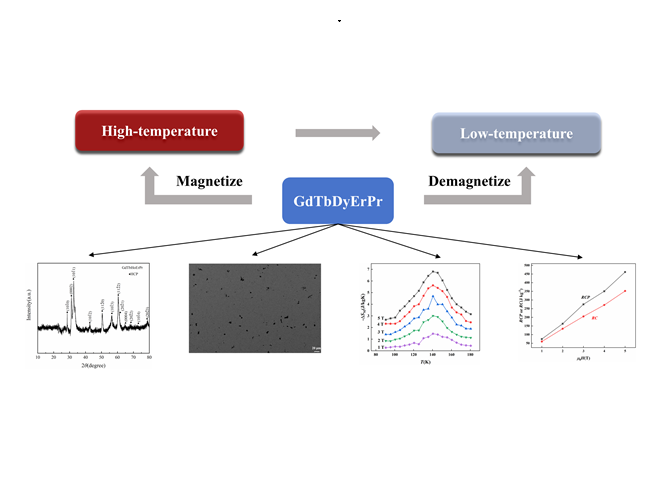
In this study, a GdTbDyErPr rare-earth high-entropy alloy (RE HEA) was successfully synthesized and its magnetic properties and magnetocaloric effect (MCE) were systematically investigated. The results indicate that the as-cast GdTbDyErPr RE HEA exhibits a single-phase hexagonal close-packed (HCP) structure with lattice parameters of a = 3.609 Å and c = 5.734 Å. Based on large parameter Ω, high mixing entropy (ΔSmix), and small parameters δ and εi, it can be inferred that the GdTbDyErPr alloy forms a disordered solid solution. The GdTbDyErPr RE HEA undergoes a first-order magnetic transition near about 143 K. The parameters |∆ |, RC, and RCP are determined to be 6.8 J∙kg‒1K‒1, 352 J∙kg‒1 and 462 J∙kg‒1 for GdTbDyErPr RE HEA under 0 T to 5 T. The facile synthesizability and remarkable MCE of the GdTbDyErPr RE HEA position it as a promising candidate for magnetic cooling technology
Downloads
References
A. Czernuszewicz, Y. Mudryk, J. Cui, L. Griffith, D. D. Johnson, and J. Slaughter, “From the discovery of the giant magnetocaloric effect to the development of high-power-density systems,” Advanced Materials Technologies, vol. 10, no. 5, p. e00545, 2025. DOI: https://doi.org/10.1002/admt.202500545
P. Z. Z. Nehan, O. Vitayaya, D. R. Munazat, M. T. E. Manawan, D. Darminto, and B. Kurniawa, “The magnetocaloric effect properties for potential applications of magnetic refrigerator technology: A review,” Physical Chemistry Chemical Physics, vol. 26, no. 19, p. 14476, 2024. DOI: https://doi.org/10.1039/D4CP01077A
A. M. Aliev, and A. G. Gamzatov, “Magnetocaloric effect in alternating magnetic fields: a review,” Physics of Metals and Metallography, vol. 125, no. 12, pp. 1901‒1926, 2024. DOI: https://doi.org/10.1134/S0031918X24602518
K. Ahn, “Ni-Mn based conventional full Heusler alloys, all-d-metal full Heusler alloys, and their promising functional properties to solid state cooling by magnetocaloric effect,”Journal of Alloys and Compounds, vol. 978, p. 173378, 2024. DOI: https://doi.org/10.1016/j.jallcom.2023.173378
F. Q, Zhang, X. F. Miao, N. van Dijk, E. Brück, and Y. Ren, “Advanced magnetocaloric materials for energy conversion: Recent progress, opportunities, and perspective,” Advanced Energy Materials, vol. 14, no. 28, p. 2400369, 2024. DOI: https://doi.org/10.1002/aenm.202400369
Y. Gong, X. F. Miao, F. J. Qian, F. Xu, and L. Caron, “A brief review of microstructure design in transition metal-based magnetocaloric materials,”Journal of Physics: Condensed Matter, vol. 36, no. 50, p. 503001, 2024. DOI: https://doi.org/10.1088/1361-648X/ad7cb3
S. Kumar, R. Muhammad, S. Kim, J. Yi, K. Son, and H. Oh, “Exploring magnetocaloric materials for sustainable refrigeration near hydrogen gas liquefaction temperature,” Advanced Functional Materials, vol. 34, no. 30, p. 240513, 2024. DOI: https://doi.org/10.1002/adfm.202402513
A. Vinod, D. A. Babu, and M. Wuppulluri, “A short review on the evolution of magnetocaloric La(Fe,Si)13 and its fabrication through melt spinning,”ACS Omega, vol. 9, no. 10, pp. 11110‒11128, 2024. DOI: https://doi.org/10.1021/acsomega.3c08622
L. Cirillo, S. Gargiulo, A. Greco, C. Masselli, V. Orabona, and L. Verneau, “A review of the state of the art of the cryogenic magnetocaloric systems for gas liquefaction,” International Journal of Refrigeration, vol. 179, pp. 184‒203, 2025. DOI: https://doi.org/10.1016/j.ijrefrig.2025.08.007
U. Lucia, and G. Grisolia, “Magnetocaloric refrigeration in the context of sustainability: A review of thermodynamic bases, the state of the art, and future prospects,” Energies, vol. 17, no. 14, p. 3584, 2024. DOI: https://doi.org/10.3390/en17143585
K. Klinar, J. Y. Law, V. Franco, X. Moya, and A. Kitanovski, “Perspectives and energy applications of magnetocaloric, pyro-magnetic, electrocaloric, and pyroelectric materials,” Advanced Energy Materials, vol. 14, no. 33, p. 2401739, 2024. DOI: https://doi.org/10.1002/aenm.202401739
Z. Zheng, F. Zhang, H. Shentu, X. Hu, Q. Wu, M. Pan, N. Yu, J. Fang, H. Ge, and H. Yang, “Magnetic properties and magneto-caloric effect of chromium-based high-entropy perovskite oxides,” Journal of Alloys and Compounds, vol. 1010, p. 177632, 2025. DOI: https://doi.org/10.1016/j.jallcom.2024.177632
V. K. Pecharsky, and K. A. Gschneidner, Jr., “Giant magnetocaloric effect in Gd5(Si2Ge2),” Physical Review Letters, vol. 78, no. 23, pp. 4494-4497, 1997. DOI: https://doi.org/10.1103/PhysRevLett.78.4494
J. M. Xu, J. M. Lin, L. Y. Zhu, X. J. Chen, and Y. K. Zhang, “Structural and low-temperature magnetic properties in Ba2GdBiO6 double-perovskite oxide,” Solid State Communications, vol. 411, p. 116359, 2026. DOI: https://doi.org/10.1016/j.ssc.2026.116359
J. M. Lin, X. J. Chen, L. Y. Zhu, K. Zhe, X. Y. Zhao, and Y. K. Zhang, “Cryogenic magnetic properties and magnetocaloric effect in Gd2YNbO7 oxide,” Cryogenics, vol. 156, p. 104313, 2026. DOI: https://doi.org/10.1016/j.cryogenics.2026.104313
X. P. Na, Y. Z. Du, Z. Q. Zhang, Y. Li, and L. W. Li, “Magnetic properties and magnetocaloric effect in DyAgSi compound,” Cryogenics, vol. 156, p. 104310, 2026. DOI: https://doi.org/10.1016/j.cryogenics.2026.104310
Y. Z. Na, W. X. Hao, X. Y. Zhao, Y. Xie, and Y. K. Zhang, “Magnetic properties and cryogenic magnetocaloric effects in RE2Zr2O7 (RE = Gd, Dy, Ho and Er) ceramics,” Ceramics International, vol. 51, no. 20, Part B, pp. 31140‒31149, 2025. DOI: https://doi.org/10.1016/j.ceramint.2025.04.302
N. A. de Oliveira, and P. J. von Ranke, “Theoretical aspects of the magnetocaloric effect,” Physics Reports, vol. 489, no. 4‒5, pp. 89‒159, 2010. DOI: https://doi.org/10.1016/j.physrep.2009.12.006
V. Franco, J. S. Blázquez, J. J. Ipus, J. Y. Law, L. M. Moreno-Ramírez, and A. Conde, “Magnetocaloric effect: From materials research to refrigeration devices,” Progress in Materials Science, vol. 93, pp. 112‒232, 2018. DOI: https://doi.org/10.1016/j.pmatsci.2017.10.005
A. M. Tishin, and Y. I. Spichkin, “Recent progress in magneto-caloric effect: Mechanisms and potential applications,” International Journal of Refrigeration, vol. 37, pp. 223‒229, 2014. DOI: https://doi.org/10.1016/j.ijrefrig.2013.09.012
Y. Wang, H. Pan, and S. Liu, “Research progress of high efficiency magnetic refrigeration technology and magnetic materials,” Journal of Superconductivity and Novel Magnetism, vol. 38, no. 1, p. 86, 2025. DOI: https://doi.org/10.1007/s10948-024-06847-x
L. Gao, J. H. Huang, Y. D. Zhang, Y. R. Guo, P. Y. Wang, and Z. Q. Ou, “Research and development of room-temperature magnetic refrigerant and magnetic refrigerator,” Journal of Refrigeration, vol. 43, no. 4, pp. 77‒87, 2022.
J. Liu, T. Gottschall, K. P. Skokov, J. D. Moore, and O. Gutfleisch, “Giant magnetocaloric effect driven by structural transitions,” Nature Materials, vol. 11, no. 7, pp. 620‒626, 2012. DOI: https://doi.org/10.1038/nmat3334
R. Bjørk, C. R. H. Bahl, A. Smith, and N. Pryds, “Review and comparison of magnet designs for magnetic refrigeration,” International Journal of Refrigeration, vol. 33, no. 3, pp. 437‒448, 2010. DOI: https://doi.org/10.1016/j.ijrefrig.2009.12.012
M. S. Kamran, H. O. Ahmad, and H. S. Wang, “Review on the developments of active magnetic regenerator refrigerators-evaluated by performance,” Renewable and Sustainable Energy Reviews, vol. 133, p. 110247, 2020. DOI: https://doi.org/10.1016/j.rser.2020.110247
P. Sharma, V. K. Dwivedi, and S. P. Dwivedi, “Development of high entropy alloys: a review,” Materials Today: Proceedings, vol. 43, pp. 502‒509, 2021. DOI: https://doi.org/10.1016/j.matpr.2020.12.023
Y.-F. Yang, F. Hu, T. Xia, R.-H. Li, J.-Y. Bai, J.-Q. Zhu, J.-Y. Xu, and G.-F. Zhang, “High entropy alloys: A review of preparation techniques, properties and industry application,” Journal of Alloys and Compounds, vol. 1010, p. 177691, 2025. DOI: https://doi.org/10.1016/j.jallcom.2024.177691
M. H. Tsai and J. W. Yeh, “High-entropy alloys: A critical review,” Materials Research Letters, vol. 2, no. 3, pp. 107‒123, 2014. DOI: https://doi.org/10.1080/21663831.2014.912690
W. D. Li, D. Xie, D. Y. Li, Y. Zhang, Y. F. Gao, and P. K. Liaw, “Mechanical behavior of high-entropy alloys,” Progress in Materials Science, vol. 118, p. 100777, 2021. DOI: https://doi.org/10.1016/j.pmatsci.2021.100777
Z. F. Zhang, L. Chu, J. Q. Zhao, B. Xu, and Q. L. Ye, “Phase separation promotes FCC-phase mechanical twinning in AlCoCrFeMo0.05Ni2 high entropy alloy,” Journal of Metals, Materials and Minerals, vol. 34, no. 3, p. 2107, 2024. DOI: https://doi.org/10.55713/jmmm.v34i3.2107
Y. Qiu, S. Thomas, M. A. Gibson, H. L. Fraser, and N. Birbilis, “Corrosion of high entropy alloys,” npj Materials Degradation, vol. 1, no. 1, p. 15, 2017. DOI: https://doi.org/10.1038/s41529-017-0009-y
N. A. Zarkevich and V. I. Zverev, “Viable materials with a giant magnetocaloric effect,” Crystals, vol. 10, no. 9, p. 815, 2020. DOI: https://doi.org/10.3390/cryst10090815
L. Shao, L. Xue, Q. Luo, K. Yin, Z. Yuan, M. Zhu, T. Liang, Q. Zeng, L. Sun, and B. Shen, “Heterogeneous GdTbDyCoAl high-entropy alloy with distinctive magnetocaloric effect induced by hydrogenation,” Journal of Materials Science & Technology, vol. 109, pp. 147‒156, 2022. DOI: https://doi.org/10.1016/j.jmst.2021.08.076
C. M. Pang, L. Chen, H. Xu, W. Guo, Z. W. Lv, J. T. Huo, M. J. Cai, B. L. Shen, X. L. Wang, and C. C. Yuan, “Effect of Dy, Ho, and Er substitution on the magnetocaloric properties of Gd-Co-Al-Y high entropy bulk metallic glasses,” Journal of Alloys and Compounds, vol. 827, p. 154101, 2020. DOI: https://doi.org/10.1016/j.jallcom.2020.154101
J. Li, L. Xue, W. M. Yang, C. C. Yuan, J. T. Huo, and B. L. Shen, “Distinct spin glass behavior and excellent magnetocaloric effect in Er20Dy20Co20Al20RE20 (RE = Gd, Tb and Tm) high-entropy bulk metallic glasses,” Intermetallics, vol. 96, pp. 90‒93, 2018. DOI: https://doi.org/10.1016/j.intermet.2018.03.002
X. Yang, and Y. Zhang, “Prediction of high-entropy stabilized solid-solution in multi-component alloys,” Materials Chemistry and Physics, vol. 132, no. 2‒3, pp. 233‒238, 2012. DOI: https://doi.org/10.1016/j.matchemphys.2011.11.021
B. Miracle, J. D. Miller, O. N. Senkov, C. Woodward, M. D. Uchic, and J. Tiley, “Exploration and development of high entropy alloys for structural applications,” Entropy, vol. 16, no. 1, pp. 494-525, 2014. DOI: https://doi.org/10.3390/e16010494
S. S. Fang, X. S. Xiao, L. Xia, W. H. Li, and Y. D. Dong, “Relationship between the widths of supercooled liquid regions and bond parameters of Mg-based bulk metallic glasses,” Journal of Non-Crystalline Solids, vol. 321, no. 1‒2, pp. 120‒125, 2003. DOI: https://doi.org/10.1016/S0022-3093(03)00155-8
S. Guo, C. Ng, J. Lu, and C. T. Liu, “Effect of valence electron concentration on stability of fcc or bcc phase in high entropy alloys,” Journal of Applied Physics, vol. 109, no. 10, p. 103505, 2011. DOI: https://doi.org/10.1063/1.3587228
S. Guo, and C. T. Liu, “Phase stability in high entropy alloys: Formation of solid-solution phase or amorphous phase,” Journal of Non-Crystalline Solids, vol. 321, no. 1‒2, pp. 120‒125, 2003.
H. J. Ma, L. Gao, X. Jin, J. J. Zhao, J. Zhao, and J. H. Huang, “Low-temperature magnetic refrigeration in Gd20Tb20Er20Al20M20 (M = Fe, Co) high-entropy metallic glasses,” Chinese Journal of Physics, vol. 92, pp. 353‒365, 2024. DOI: https://doi.org/10.1016/j.cjph.2024.09.021
W. Sheng, J. Q. Wang, G. Wang, J. T. Huo, X. M. Wang, and R.-W. Li, “Amorphous microwires of high entropy alloys with large magnetocaloric effect,” Intermetallics, vol. 96, pp. 79‒83, 2018. DOI: https://doi.org/10.1016/j.intermet.2018.02.015
S. F. Lu, L. Ma, J. Wang, Y. S. Du, L. Li, J. T. Zhao, and G. H. Rao, “Effect of configuration entropy on magnetocaloric effect of rare earth,” Journal of Alloys and Compounds, vol. 874, p. 159981, 2021. DOI: https://doi.org/10.1016/j.jallcom.2021.159918
J. T. Huo, L. Huo, J. Li, H. Men, X. Wang, A. Inoue, C. Chang, J.-Q. Wang, and R.-W. Li, “High-entropy bulk metallic glasses as promising magnetic refrigerants,” Journal of Applied Physics, vol.117, p. 073902, 2015. DOI: https://doi.org/10.1063/1.4908286
Downloads
Published
How to Cite
Issue
Section
Categories
License
Copyright (c) 2026 Journal of Metals, Materials and Minerals

This work is licensed under a Creative Commons Attribution-NonCommercial-NoDerivatives 4.0 International License.
Authors who publish in this journal agree to the following terms:
- Authors retain copyright and grant the journal right of first publication with the work simultaneously licensed under a Creative Commons Attribution License that allows others to share the work with an acknowledgment of the work's authorship and initial publication in this journal.
- Authors are able to enter into separate, additional contractual arrangements for the non-exclusive distribution of the journal's published version of the work (e.g., post it to an institutional repository or publish it in a book), with an acknowledgment of its initial publication in this journal.