Mechanical properties and crystallization of polybutylene terephthalate reinforced with glass flakes and aluminum powder
DOI:
https://doi.org/10.55713/jmmm.v36i1.2301คำสำคัญ:
PBT, glass flake, aluminum powder, electrical surface resistivity, compositeบทคัดย่อ
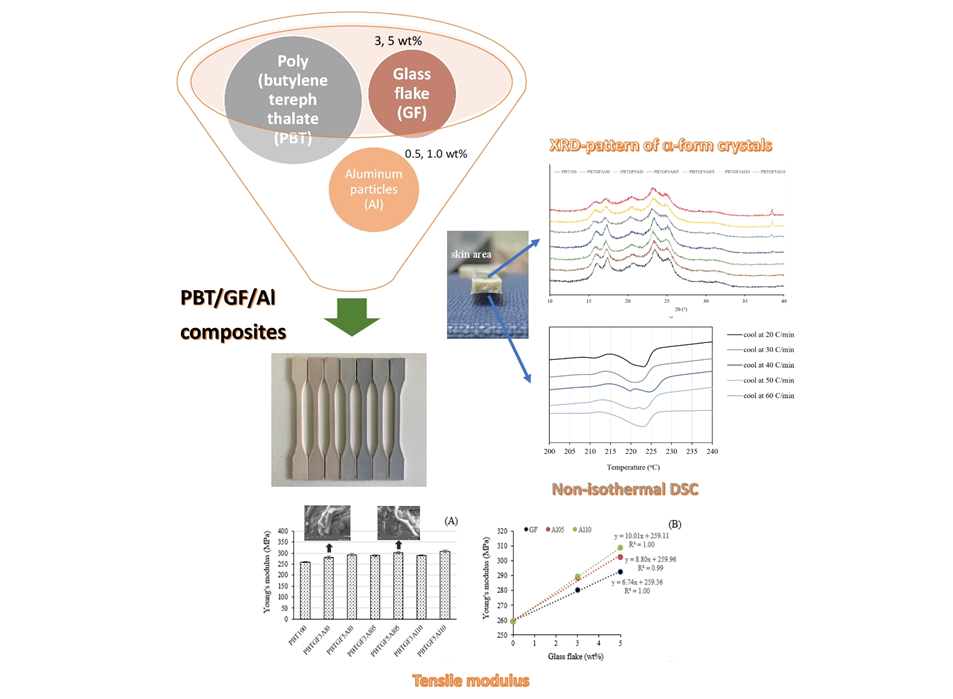
This research investigated mechanical properties and crystallization of poly(butylene terephthalate) composites by adding glass flakes (GF) and aluminum particles (Al). The concentration of the GF was 3 wt% or 5 wt%, and the Al was 0.5 wt% or 1.0 wt%. The stress-strain curves of the PBT-based composites showed yielding and necking. The PBT/GF/Al composites with GF/Al ratios of 3/0.5 wt/wt%, 3/1.0 wt/wt%, 5/0.5 wt/wt%, and 5/1.0 wt/wt% had Young’s moduli of 11.44%, 11.70%, 16.81%, and 19.31% higher than that of neat PBT, respectively. In the presence of Al at 1.0 wt%, the flexural modulus of the PBT/GF/Al composites increased to 3.6% higher than that of neat PBT, and all flexure specimens recovered elastically after being subjected to 5% strain. The neat PBT and all PBT/GF/Al composites exhibited the XRD pattern of a-form crystals, in which the changed crystal dimensions implied the heterogeneous nucleation with the presence of these fillers. The cooling rate of the injection molding was so fast that the filler-nucleated crystallization formed only a-form crystals. Adding the GF and Al increased the Tc of the PBT matrix, confirming these fillers acted as nucleating agents. Adding GF/Al fillers of 6 wt% reduced the electrical surface resistivity to 1010 ohm∙sq‒1, indicating it was an anti-static material.
Downloads
เอกสารอ้างอิง
M. Vosough Kia, M. Ehsani, S. E. Hosseini, and G. H. Asadi, "Fabrication and characterization of transparent nanocomposite films based on poly (lactic acid)/polyethylene glycol reinforced with nano glass flake," International Journal of Biological Macromolecules, vol. 254, p. 127473, 2024. DOI: https://doi.org/10.1016/j.ijbiomac.2023.127473
P. Russo, F. Cimino, D. Acierno, G. Lupò, and C. Petrarca, "Poly(butylene terephthalate) based composites containing alumina whiskers: Influence of filler functionalization on dielectric properties," International Journal of Polymer Science, vol. 2014, p. 9, 2014. DOI: https://doi.org/10.1155/2014/150589
N. G. Karsli, C. Ozkan, A. Aytac, and V. Deniz, "Characterization of poly(butylene terephthalate) composites prepared by using various types of sized carbon fibers," Materials and Design, vol. 87, pp. 318‒323, 2015. DOI: https://doi.org/10.1016/j.matdes.2015.08.047
Z. Yenier, S. Aker, Y. Seki, L. Altay, O. Bigun, and M. Sarikanat, "Improving thermal conductivity of polybutylene terephthalate composites with hybrid synthetic graphite and carbon fiber," Journal of Thermoplastic Composite Materials, vol. 36, no. 2, 2023. DOI: https://doi.org/10.1177/08927057211018491
M. Yokouchi, Y. Sakakibara, Y. Chatani, H. Tadokoro, T. Tanaka, and K. Yoda, "Structures of two crystalline forms of poly (butylene terephthalate) and reversible transition between them by mechanical deformation," Macromolecules, vol. 9, no. 2, pp. 266‒273, 1976. DOI: https://doi.org/10.1021/ma60050a018
S. Colonna, R. A. Perez-Camargo, H. Chen, G. Liu, D. Wang, A. J. Müller, G. Saracco, and A. Fina, "Supernucleation and orientation of poly(butylene terephthalate) crystals in nano-composites containing highly reduced graphene oxide," Macromolecules, vol. 50, pp. 9380−9393, 2017. DOI: https://doi.org/10.1021/acs.macromol.7b01865
GlassFlakes. https://www.glassflakes.com/specification/ (accessed 3 January, 2024).
C. J. Watkinson, and J. H. K. Elvidge, "Method and apparatus for forming glass flakes," England, 1987.
S. Jharimune, X. Gu, M. L. Lim, M. Dent, N. Rakers, C. Y. Lee, H. He, A. Mubarok, and C. B. Hui, "Effect of glass flake in anti-corrosive coatings for extreme conditions," presented at the AMPP Annual Conference + Expo, San Antonio, Texas, USA, 2022. [Online]. Available: https://onepetro.org/amppcorr/ proceedings-abstract/AMPP22/2AMPP22/D021S010R002/488835.
A. Alhamidi, A. Anis, S. M. Al-Zahrani, Z. Bashir, and M. M. Alrashed, "Conductive plastics from Al platelets in a PBT-PET polyester blend having co-continuous morphology," Polymers, vol. 14, no. 6, p. 1092, 2022. DOI: https://doi.org/10.3390/polym14061092
E. Alagöz, and E. Selver, "Glass flakes for enhancing mechanical properties of glass/epoxy composites," Proceedings of the Institution of Mechanical Engineers, Part L: Journal of Materials: Design and Applications, vol. 238, no. 8, pp. 1438‒1456, 2024. DOI: https://doi.org/10.1177/14644207231224784
M. E. Fatemeh S. Miri, Hossein A. Khonakdar, and Behjat Kavyani, "A comprehensive study on physical, mechanical, and thermal properties of poly(ethylene terephthalate) filled by micro- and nanoglass flakes," Journal of Vinyl and Additive Technology, vol. 26, no. 3, pp. 380‒389, 2020. DOI: https://doi.org/10.1002/vnl.21753
I. Kobykhno, A. Kiryanov, V. Klinkov, A. Chebotareva, S. Evlashin, D. Ju, Y. Wu, A. Semencha, H. Zhao, and O. Tolochko, "Effect of glass filler geometry on the mechanical and optical properties of highly transparent polymer composite," Polymers, vol. 14, no. 23, p. 5179, 2022. DOI: https://doi.org/10.3390/polym14235179
T. Michii, M. Seto, M. Yamabe, Y. Kubota, G. Aoki, and H. Ohtsuka, "Study on warpage behavior and filler orientation during injection molding," International Polymer Processing, vol. 23, no. 5, pp. 419‒429, 2008. DOI: https://doi.org/10.3139/217.0064
N. Vidakis, M. Petousis, N. Mountakis, V. Papadakis, C. Charou, V. Rousos, and P. Bastas, "Glass fillers in three different forms used as reinforcement agents of polylactic acid in material extrusion additive manufacturing," Applied Science, vol. 13, pp. 6471-6496, 2023. DOI: https://doi.org/10.3390/app13116471
A. Anis, A. Y. Elnour, M. A. Alam, S. M. Al-Zahrani, F. AlFayez, and Z. Bashir, "Aluminum-filled amorphous-PET, a composite showing simultaneous increase in modulus and impact resistance," Polymers, vol. 12, p. 2038, 2020. DOI: https://doi.org/10.3390/polym12092038
S. Yang, Q. Wang, and B. Wen, "Highly thermally conductive and superior electrical insulation polymer composites via in situ thermal expansion of expanded graphite and in situ oxidation of aluminum nanoflakes," ACS Applied Materials & Interfaces, vol. 13, no. 1, pp. 1511‒1523, 2021. DOI: https://doi.org/10.1021/acsami.0c18603
A. F. Osman, and M. Mariatti, "Properties of aluminum filled polypropylene composites," Polymers and Polymer Composites, vol. 14, no. 6, pp. 623‒633, 2006. DOI: https://doi.org/10.1177/096739110601400608
S. A. Vyavahare, B. M. Kharat, and A. P. More, "Polybutylene terephthalate (PBT) blends and composites: A review," Vietnam Journal of Chemistry, vol. 62, no. 5, pp. 1‒11, 2023. DOI: https://doi.org/10.1002/vjch.202300177
C. Loyer, P. Ferreira, J.-B. Marijon, V. Michel, G. Regnier, J. Vera, V. Duval, and E. Richaud, "Embrittlement of polybutylene terephthalate induced by injection molding," Polymer Degradation and Stability, vol. 196, p. 109843, 2022. DOI: https://doi.org/10.1016/j.polymdegradstab.2022.109843
P. Qian, Y. Zhang, H. Mao, H. Wang, and H. Shi, "Nucleation and mechanical enhancements in poly(butylene terephthalate) nanocomposites influenced by functionalized graphene oxide," SN Applied Sciences, vol. 1, p. 443, 2019. DOI: https://doi.org/10.1007/s42452-019-0466-8
O. Hamlaoui, O. Klinkova, R. Elleuch, and I. Tawfiq, "Effect of the glass fiber content of a polybutylene terephthalate reinforced composite structure on physical and mechanical characteristics," Polymers, vol. 14, p. 17, 2022. DOI: https://doi.org/10.3390/polym14010017
O. Mysiukiewicz, P. Kosmela, M. Barczewski, and A. Hejna, "Mechanical, thermal and rheological properties of polyethylene-based composites filled with micrometric aluminum powder," Materials, vol. 13, no. 5, p. 1242, 2020. DOI: https://doi.org/10.3390/ma13051242
M. Haga, T. Nakaoki, H. Ishihara, K. Yamashita, and K. Funaki, "Crystallinity and chain orientation of injection-molded poly (butylene terephthalate) depending on the depth profile at the surface," Trends in Chemical Engineering, vol. 17, pp. 1‒9, 2019.
D. Heidrich, and M. Gehde, "The 3-phase structure of polyesters (PBT, PET) after isothermal and non-isothermal crystallization," Polymers, vol. 14, p. 793, 2022. DOI: https://doi.org/10.3390/polym14040793
B. Liu, and W. Wu, "Nonisothermal crystallization kinetics of poly(butylene terephthalate)/epoxidized ethylene propylene diene rubber/glass fiber composites," Polymer Engineering & Science, vol. 59, no. 2, pp. 217‒434, 2019. DOI: https://doi.org/10.1002/pen.24909
H.-I. Mao, C.-W. Chen, and S.-P. Rwei, "Synthesis and non-isothermal crystallization kinetics of poly(butylene terephthalate-co-tetramethylene ether glycol) copolyesters," Polymers, vol. 12, no. 9, p. 1897, 2020. DOI: https://doi.org/10.3390/polym12091897
R. Nisticò, M. D’Arienzo, B. D. Credico, S. Mostoni, and R. Scotti, "The role of inorganic fillers in electrostatic discharge composites," Inorganics, vol. 10, p. 222, 2022. DOI: https://doi.org/10.3390/inorganics10120222
TE_Connectivity. "Requirements for electrostatic protective packaging material."https://www.te.com/commerce/Document Delivery/DDEController?Action=srchrtrv&DocNm=115-59 &DocType=Specification+Or+Standard&DocLang=English&PartCntxt= 2324869-2&DocFormat=pdf (accessed 07/17/2025, 2025).
ดาวน์โหลด
เผยแพร่แล้ว
วิธีการอ้างอิง
การอนุญาต
ลิขสิทธิ์ (c) 2025 วารสารโลหะ, วัสดุ และแร่

This work is licensed under a Creative Commons Attribution-NonCommercial-NoDerivatives 4.0 International License.
Authors who publish in this journal agree to the following terms:
- Authors retain copyright and grant the journal right of first publication with the work simultaneously licensed under a Creative Commons Attribution License that allows others to share the work with an acknowledgment of the work's authorship and initial publication in this journal.
- Authors are able to enter into separate, additional contractual arrangements for the non-exclusive distribution of the journal's published version of the work (e.g., post it to an institutional repository or publish it in a book), with an acknowledgment of its initial publication in this journal.