TOPOCROM – Rethinking the fundamentals of electrocrystallisation
DOI:
https://doi.org/10.55713/jmmm.v36i4.2487คำสำคัญ:
Chromium, Electroplating, Electrocrystallisationบทคัดย่อ
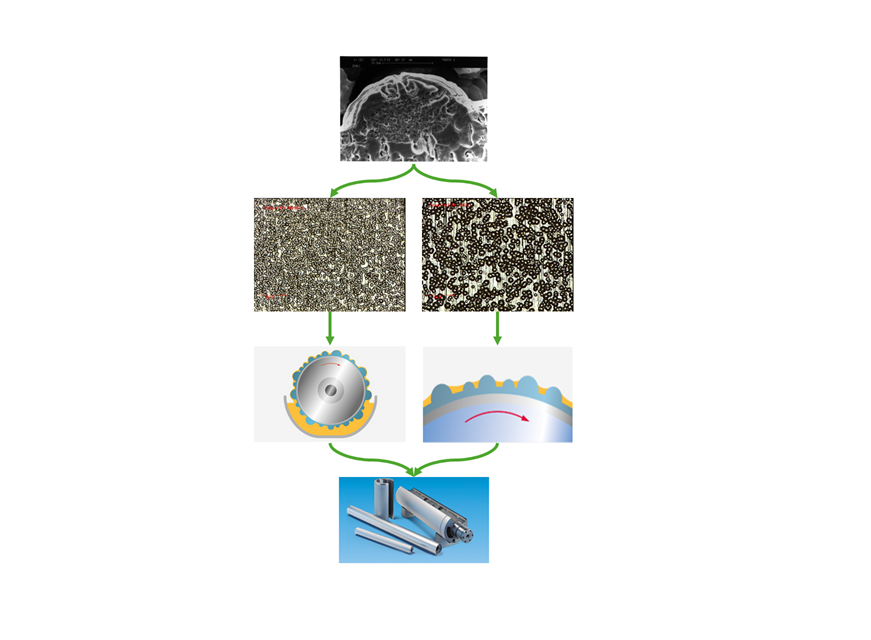
This article describes the scientific electrochemical and material-technical background of a technology with which hard chrome layers can be specifically provided with a topography, i.e. with a microstructure. The structure is characterised by the formation of spherical cap-shaped structural elements. This process, called TOPOCROM®, has been successfully available on the market for some time and is applied exclusively by a German job plater. As is often the case in the electroplating industry, which is characterised by medium-sized companies, the original development was based on the trial and error principle. With increasing industrial success, the need to better understand the basic mechanisms grew, which led to the investigations presented in this paper. First, theoretical considerations are made based on the fundamentals of electrocrystallisation. These lead to the assumption that a change in the crystallisation form occurs when the structures are generated by the so-called current ramp. This assumption was verified by experiments in which flat discs were plated and then measured using EBSD. This proved that the suspected change in electrocrystallisation actually takes place, more precisely from a strongly field-oriented {111} texturing to an unoriented crystal form. On this basis, a growth model for the special layers was then developed.
Downloads
เอกสารอ้างอิง
G. A. Lausmann, Die galvanische Verchromung, 2nd ed., Leuze, Bad Saul-gau, 2006.
A. F. Holleman, E. Wiberg, and N. Wiberg, Lehrbuch der Anorganischen Chemie, 102nd ed., De Gruyter, Berlin, New York, 2007. DOI: https://doi.org/10.1515/9783110177701
F. Salzer, F, Patent DE 225769, 1909.
E. Liebreich, Patent DE 398054, 1924.
S. Handy, C. F. Oduoza, and T. Pearson, “Theoretical aspects of electrodeposition of decora-tive chromium from trivalent electrolytes and corrosion rate study of different nickel/chro-mium coatings,” Transactions of the Institute of Metal Finishing, vol. 84, no. 6, pp. 300‒308, 2006. DOI: https://doi.org/10.1179/174591906X162946
T. Mang, K. Bobzin, and T. Bartels, Industrial tribology: Tribosystems, friction, wear and sur-face engineering, lubrication, Wiley-VCH-Verl., Weinheim, 2011. DOI: https://doi.org/10.1002/9783527632572
J. Staeves, Beurteilung der Topografie von Blechen im Hinblick auf die Reibung bei der Umformung, Dissertation, Darmstadt, Shaker Verlag, 1998
B. Ritterbach, Qualitätsregelkreis zur Erzeugung definierter Feinblechrauheiten mit verschiedenen Texturierverfahren, Dissertation, Düsseldorf, VDI Verlag, 1999
H. Fischer, Elektrolytische Abscheidung und Elektrokristallisation von Metallen, Springer, Berlin, 717 pages, 1954. DOI: https://doi.org/10.1007/978-3-642-86549-7
ดาวน์โหลด
เผยแพร่แล้ว
วิธีการอ้างอิง
ฉบับ
บท
Categories
การอนุญาต
ลิขสิทธิ์ (c) 2026 วารสารโลหะ, วัสดุ และแร่

This work is licensed under a Creative Commons Attribution-NonCommercial-NoDerivatives 4.0 International License.
Authors who publish in this journal agree to the following terms:
- Authors retain copyright and grant the journal right of first publication with the work simultaneously licensed under a Creative Commons Attribution License that allows others to share the work with an acknowledgment of the work's authorship and initial publication in this journal.
- Authors are able to enter into separate, additional contractual arrangements for the non-exclusive distribution of the journal's published version of the work (e.g., post it to an institutional repository or publish it in a book), with an acknowledgment of its initial publication in this journal.