An integrated experimental–numerical approach for characterizing deformation behavior of high-strength steels
DOI:
https://doi.org/10.55713/jmmm.v36i2.2518คำสำคัญ:
Nakajima tests, Forming limit curves (FLCs), Forming limit stress curves (FLSCs), High-strength steel, Hardening modelบทคัดย่อ
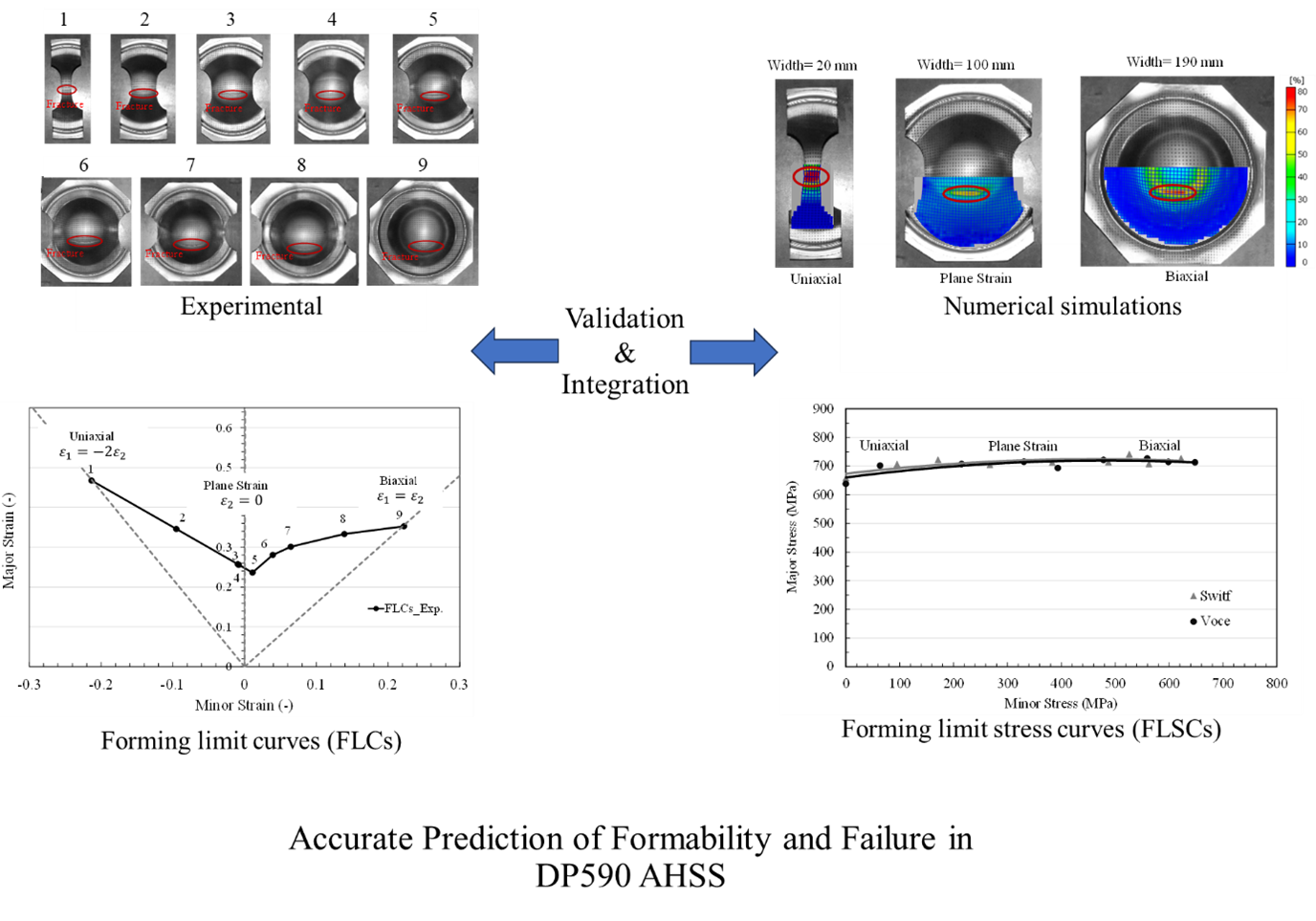
This study aims to establish an integrated experimental–numerical framework for characterizing the deformation behavior of DP590 high-strength steel sheet. The framework combines experimental uniaxial tensile and Nakajima tests with finite element (FE) simulations to provide a comprehensive assessment of forming limits and fracture behavior. Forming limit curves (FLCs) and forming limit stress curves (FLSCs) were determined with the integrated approach and then validated numerically using the Hill’48 yield criterion together with both Swift and Voce hardening laws. Model calibration incorporated experimental data on directional mechanical properties to ensure that material anisotropy was accurately represented. The FE simulations demonstrated strong agreement with the experimental data across uniaxial, plane-strain, and biaxial loading paths. The Swift hardening law consistently predicted higher forming limit stresses and more accurate drawing-depth estimates than the Voce law, particularly under biaxial and plane-strain conditions. The novelty of this work lies in the simultaneous validation of both strain- and stress-based forming limits, combined with the quantitative prediction of drawing depths, which has rarely been reported for DP590 grade. The proposed framework improves the predictive accuracy of forming simulations and provides practical guidelines for material characterization and process optimization in the automotive and related manufacturing industries.
Downloads
เอกสารอ้างอิง
T. K. Roy, B. Bhattacharya, C. Ghosh, and S. K. Ajmani, “Advanced high strength steel: processing and applications,” 1st ed, Springer Nature Singapore, 2018, 216 pages. DOI: https://doi.org/10.1007/978-981-10-7892-7
F. A. Pérez-González, J. H. Ramírez-Ramírez, L. E. Hernández, M. A. Quiñones, N. F. Garza-Montes-de-Oca, and R. Colás, “Characteristics of advanced high-strength steels obtained by the compact strip production route,” Materials Science and Technology, vol. 39, no. 3, pp. 327-337, 2023. DOI: https://doi.org/10.1080/02670836.2022.2111116
S. Panich, M. Liewald, and V. Uthaisangsuk, “Stress and strain based fracture forming limit curves for advanced high strength steel sheet,” International Journal of Material Forming, vol. 11, pp. 643-366, 2018. DOI: https://doi.org/10.1007/s12289-017-1378-z
A. Nakwattanaset, S. Suranuntchai, and S. Panich, “Strain-and stress-based forming limit curves of DP440 steel sheet with application to the cross-die forming test,” AIP Conference Proceedings, vol. 2279, p. 050004, 2020. DOI: https://doi.org/10.1063/5.0022977
T. Sirinakorn, S. Sodjit, and V. Uthaisangsuk, “Influences of microstructure characteristics on forming limit behavior of dual phase steels,” Steel Research International, vol. 86, no. 11, pp. 1594-1609, 2015. DOI: https://doi.org/10.1002/srin.201400584
L. Huang, and M. Shi, “Forming limit curves of advanced high strength steels: Experimental determination and empirical prediction,” SAE International Journal of Materials and Manufacturing, vol. 11, no. 4, pp. 409-418, 2018. DOI: https://doi.org/10.4271/2018-01-0804
R. M. De A. Bornancin, C. P. Nikhare, and P. V. P. Marcondes, “Numerical comparison of advanced high strength steels forming limit curve using banabic and nakazima tests,” International Journal on Interactive Design and Manufacturing, vol. 18, pp. 6469-6478, 2024. DOI: https://doi.org/10.1007/s12008-023-01218-7
S. Panich, F. Barlat, V. Uthaisangsuk, S. Suranuntchai, and S. Jirathearanat, “Experimental and theoretical formability analysis using strain and stress based forming limit diagram for advanced high strength steels,” Materials and Design, vol. 51, pp. 756-766, 2013. DOI: https://doi.org/10.1016/j.matdes.2013.04.080
S. Kingklang, W. Julsri, T. Chiyatan, and V. Uthaisangsuk, “A comparative study of forming and crash behavior of high strength steels,” Materials Performance and Characterization, vol. 8, no. 1, pp. 355-379, 2019. DOI: https://doi.org/10.1520/MPC20190089
J. He, D. Zeng, X. Zhu, Z. C. Xia, and S. Li, “Effect of nonlinear strain paths on forming limits under isotropic and anisotropic hardening,” International Journal of Solids and Structures, vol. 51, pp. 402-415, 2014. DOI: https://doi.org/10.1016/j.ijsolstr.2013.10.013
P. Rui, N. Peixinho, and S. L. Costa, “A review of sheet metal forming evaluation of advanced high-strength steels (AHSS),” Metals, vol. 14, no. 4, p. 394, 2024. DOI: https://doi.org/10.3390/met14040394
Z. Marciniak, and K. Kuczyński, “Limit strains in the processes of stretch-forming sheet metal,” International Journal of Mechanical Sciences, vol. 9, no. 9, pp. 609-612, 1967. DOI: https://doi.org/10.1016/0020-7403(67)90066-5
R. J. Hill, “Constitutive modelling of orthotropic plasticity in sheet metals,” Journal of the Mechanics and Physics of Solids, vol. 38, no. 3, pp. 405-417, 1990. DOI: https://doi.org/10.1016/0022-5096(90)90006-P
F. Barlat, and L. Jianshe, “Plastic behavior and stretchability of sheet metals. part I: A yield function for orthotropic sheets under plane stress conditions,” International Journal of Plasticity, vol. 5, pp. 51-66, 1989. DOI: https://doi.org/10.1016/0749-6419(89)90019-3
F. Barlat, J. C. Brem, J. W. Yoon, K. Chung, R. E. Dick, D. J. Lege, F. Pourboghrat, S. Choi, and E. W. Chu, “Plane stress yield function for aluminum alloy sheets-part 1: Theory,” International Journal of Plasticity, vol. 19, pp. 1297-1319, 2003. DOI: https://doi.org/10.1016/S0749-6419(02)00019-0
H. W. Swift, “Plastic instability under plane stress,” Journal of the mechanics and physics of solids, vol. 1, no. 1, pp. 1-18, 1952. DOI: https://doi.org/10.1016/0022-5096(52)90002-1
E. Voce, “The relationship between stress and strain for homo-geneous deformations,” Journal of the Institute of Metals, vol. 74, pp. 537-562, 1948.
B. Liu, K. Zhang, F. Xiao, and J. Yang, “Application of constitutive model for high-strength steels in automobile: A review,” Steel Research International, vol. 96, no. 11, pp. 30-64, 2025. DOI: https://doi.org/10.1002/srin.202400982
S. Panich, K. Chongbunwatana, and T. Jantarasricha, “Formability evaluation of sheet metal forming on advanced high-strength steel via an integrative experimental-theoretical approach based on localized necking and fracture limits,” Journal of Mechanical Science and Technology, vol. 5, pp. 5389-5404, 2021. DOI: https://doi.org/10.1007/s12206-021-1110-2
G. J. Béres, Z. Weltsch, R. Borbély, M. L. Kölüs, Z. Lukács, and M. Tisza, “An extended stress-based forming limit diagram focusing on the wrinkling phenomenon and the effect of the normal pressure on clamped surfaces,” Journal of Materials Processing Technology, vol. 322, p. 118196, 2023. DOI: https://doi.org/10.1016/j.jmatprotec.2023.118196
M. Zhang, Z-q. Cheng, Y-k Chen,Y. Wang, Z-p. Zou, Z-l. Mi, and Y. Li, “A novel dual-stage failure criterion based on forming limit curve for uncured glare,” Journal of Materials Processing Technology, vol. 332, p. 118567, 2024. DOI: https://doi.org/10.1016/j.jmatprotec.2024.118567
F. Shen, Y. Sparrer, J. Rao, M. Könemann, S. Münstermann, and J. Lian, “A forming limit framework accounting for various failure mechanisms: Localization, ductile and cleavage fracture,” International Journal of Plasticity, vol. 175, p. 103921, 2024. DOI: https://doi.org/10.1016/j.ijplas.2024.103921
T. Huang, M. Zhan, K.Wang, F. Chen, J. Guo, Y. Li, Z. Song, and L. Bai, “Forming limit stress diagram prediction of pure titanium sheet based on GTN model,” Materials, vol. 12, no. 11, p. 1783, 2019. DOI: https://doi.org/10.3390/ma12111783
H. Cui, L. Di, F. Qiutao, L. Zipeng, X. Jiachuan, and J. Ning, “Research on forming limit stress diagram of advanced high strength dual-phase steel sheets,” Materials, vol. 16, no. 13, p. 4543, 2023. DOI: https://doi.org/10.3390/ma16134543
T. B. Stoughton, “A general forming limit criterion for sheet metal forming,” International Journal of Mechanical Sciences, vol. 42, pp. 1-17, 2000. DOI: https://doi.org/10.1016/S0020-7403(98)00113-1
Z. Zhu, and I. L. Al-Qadi, “Crack detection of asphalt concrete using combined fracture mechanics and digital image correlation,” Journal of Transportation Engineering, Part B: Pavements, vol. 149, no. 3, p. 04023012, 2023. DOI: https://doi.org/10.1061/JPEODX.PVENG-1249
N. Amraish, A. Reisinger, and D. Pahr, “A novel specimen shape for measurement of linear strain fields by means of digital image correlation,” Scientific Reports, vol. 11, p. 17515, 2021. DOI: https://doi.org/10.1038/s41598-021-97085-x
R. Hill, “A theory of the yielding and plastic flow of anisotropic metals, proceedings of the royal society of london. series A,” Mathematical and Physical Sciences, vol. 193, pp. 281-297, 1948. DOI: https://doi.org/10.1098/rspa.1948.0045
T-T. Luyen, T-B. Mac, and D-T. Nguyen, “Simulation and experimental comparison study based on predicting forming limit curve of SUS304 sheet material,” Modern Physics Letters B, vol. 37, no. 16, p. 2340001, 2023. DOI: https://doi.org/10.1142/S0217984923400018
C. Bonatti, and D. Mohr, “Neural network model predicting forming limits for bi-linear strain paths,” International Journal of Plasticity, vol. 137, p. 102886, 2021. DOI: https://doi.org/10.1016/j.ijplas.2020.102886
S. Zhang, S. Zhang, H. Ye, L. Zhou, N. Yuan, and C. Zhou, “Hardening behavior and prediction of ductile fracture during AA7075-T651 sheet metal forming,” Journal of Materials Engineering and Performance, vol. 32, pp. 10455-10468, 2023. DOI: https://doi.org/10.1007/s11665-023-07843-3
ดาวน์โหลด
เผยแพร่แล้ว
วิธีการอ้างอิง
การอนุญาต
ลิขสิทธิ์ (c) 2026 วารสารโลหะ, วัสดุ และแร่

This work is licensed under a Creative Commons Attribution-NonCommercial-NoDerivatives 4.0 International License.
Authors who publish in this journal agree to the following terms:
- Authors retain copyright and grant the journal right of first publication with the work simultaneously licensed under a Creative Commons Attribution License that allows others to share the work with an acknowledgment of the work's authorship and initial publication in this journal.
- Authors are able to enter into separate, additional contractual arrangements for the non-exclusive distribution of the journal's published version of the work (e.g., post it to an institutional repository or publish it in a book), with an acknowledgment of its initial publication in this journal.